Under the theme “Viet Nam in a new era of development,” Hai reviewed the country’s history, cultural traditions and major milestones in its process of national construction, defense and development. He stressed that after four decades of Doi Moi (1986–2026), Viet Nam has made remarkable progress, transforming itself from a war-ravaged and impoverished country into a dynamic economy deeply integrated into regional and global markets.
    |
 |
|
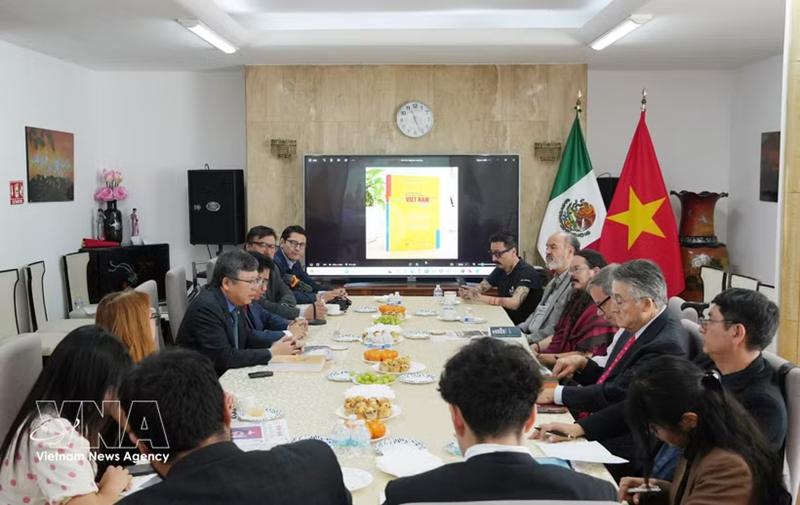
An overview of the meeting between Vietnamese Ambassador Nguyen Van Hai and representatives of Mexican press and media agencies. |
In 2025, Viet Nam’s GDP reached approximately USD 514.7 billion, ranking 32nd worldwide, while its total import-export turnover stood at USD 930 billion, placing it 15th globally. The country attracted more than USD 38 billion in foreign direct investment (FDI). Meanwhile, multidimensional poverty fell below 1%, the Human Development Index (HDI) reached 0.766 and health insurance coverage exceeded 90% of the population, reflecting closer links between economic growth and social progress and equity.
Regarding strategic goals, the diplomat shared that Viet Nam aims to become a developing country with modern industry and upper-middle income by 2030, and a developed, high-income nation by 2045. To achieve these targets, the country is shifting its growth model, with science and technology, innovation and digital transformation serving as key drivers. Priority areas include the digital, green and circular economies, semiconductor industries and artificial intelligence, alongside institutional reform, high-quality human resources development and synchronized infrastructure.
At the meeting, Hai also introduced the English-Spanish bilingual book “The Aspiration for a Strong and Prosperous Viet Nam in the New Era,” which brings together selected articles and speeches by General Secretary of the Communist Party of Viet Nam Central Committee and President To Lam, and provides international readers with insights into the Party’s vision and strategic orientations.
During the question-and-answer session, Mexican journalists raised questions about the factors behind Viet Nam’s development success and its ability to sustain rapid, inclusive and sustainable growth amid population ageing. They showed particular interest in social welfare policies, access to education and healthcare, including free tuition at public schools and free periodic health check-ups or screening from 2026.
Other topics included the new growth model’s links with FDI attraction, priority economic sectors, the role of mass organizations in policymaking and the leadership of the Communist Party of Viet Nam. Journalists also discussed Viet Nam’s experience in the struggle for national independence, its role amid current geopolitical tensions and its contribution to international solidarity and cooperation.
Regarding the bilateral ties, Mexican media representatives sought information on measures to expand Viet Nam-Mexico cooperation, particularly in trade, investment and people-to-people exchanges.
The meeting provided Mexican media with official information and a deeper understanding of Viet Nam’s development achievements, policies and experience, while highlighting the country’s pursuit of a development path of independence, self-reliance, equity and sustainability.
Source: VNA