The conference saw the presence of a delegation from Quang Ninh city led by Vice Chairman of the municipal People’s Committee Le Van Anh, and a delegation from Bac Ninh city led by Standing Vice Chairwoman of the municipal People’s Council Tran Thi Hang. Nguyen Dong Trung, Deputy Director of the External Relations and Cultural Diplomacy Department under the Ministry of Foreign Affairs, also attended.
    |
 |
|
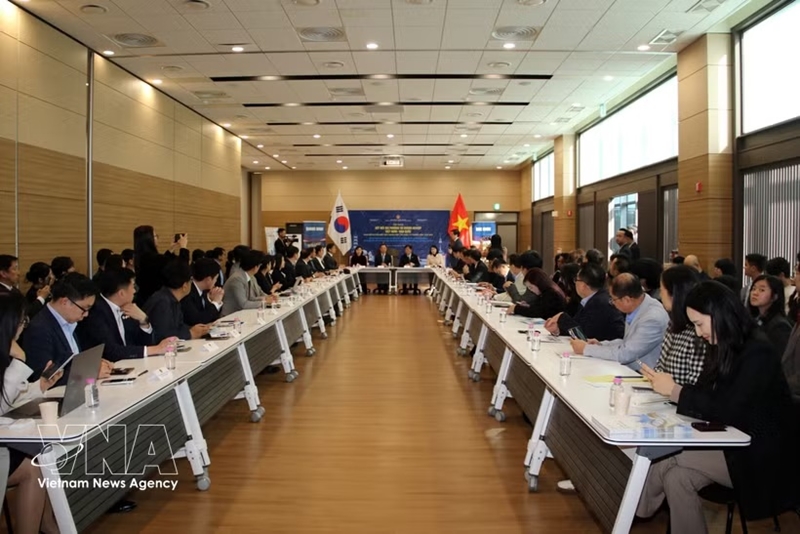
The conference held on November 4 to connect Vietnamese localities and businesses with RoK partners. |
The event gathered more than 200 Korean and Vietnamese participants, including representatives of major companies such as Samsung, LH, Hanwha, Lotte and Shinhan Bank, as well as economic associations and organizations like the Business Association of Vietnamese in Korea (BAVIK). It provided a platform for Korean companies to discuss investment needs, the business environment and project implementation directly with representatives of Vietnamese localities.
In his opening remarks, Vietnamese Ambassador to the RoK Vu Ho said bilateral relations are growing strongly and becoming more substantive under the Comprehensive Strategic Partnership framework. Economic, trade and investment cooperation remain key pillars, while collaboration is expanding into new areas such as semiconductors, artificial intelligence (AI), digital technology, clean energy and innovation.
He stressed that direct connections between Vietnamese localities and Korean businesses will help tap complementary strengths, expand investment opportunities and deliver practical results. The embassy will continue facilitating partnerships, promoting Viet Nam’s investment environment and supporting businesses in turning cooperation opportunities into projects.
Representatives of Quang Ninh and Bac Ninh introduced their development orientations, advantages and priority sectors for attracting Korean investment. Quang Ninh has strengths in the marine economy, tourism, logistics and energy, while Bac Ninh has developed an industrial base centered on electronics, high technology and foreign-invested enterprises.
Anh highlighted Quang Ninh’s strategic location, seaports, border gates and transport infrastructure, saying the city hopes to attract Korean investment in renewable and clean energy, green industries, logistics, smart seaports, infrastructure, smart city development and environmental technology. It also encourages investment in high-quality tourism and services, along with sectors with high value added.
Meanwhile, Hang said Bac Ninh wishes to attract more high-tech projects, especially in semiconductors, next-generation electronics, AI, supporting industries, research and development, smart manufacturing and automation. It also aims to strengthen links between foreign-invested and domestic firms, promote technology transfer, develop a skilled workforce and elevate local businesses' position in global supply chains.
Chairman of the Korea–Viet Nam Economic and Cultural Association (KOVECA) Kwon Sung Taek stressed the need to strongly shift from diplomatic exchanges and activities to promoting direct links between localities and businesses that center on actual demand and concrete projects.
While Quang Ninh could strengthen connections with Korean localities that excel in tourism, seaports, and the maritime economy such as Busan, Gangwon, and Jeju, Bac Ninh holds significant potential for cooperation with industrial hubs like Gyeonggi, South Chungcheong, and North Gyeongsang.
He proposed concrete cooperation projects in high-end tourism, port logistics and smart city development in Quang Ninh, and semiconductors, electronics, AI, robotics and smart factories in Bac Ninh. He also called for expanding collaboration in education, high-quality manpower training, student exchanges and cultural activities.
KOVECA affirmed its readiness to serve as a bridge through cooperation committees, business forums, investment promotion activities, and support for business networking, thereby helping to identify and select viable projects for implementation.
Source: VNA