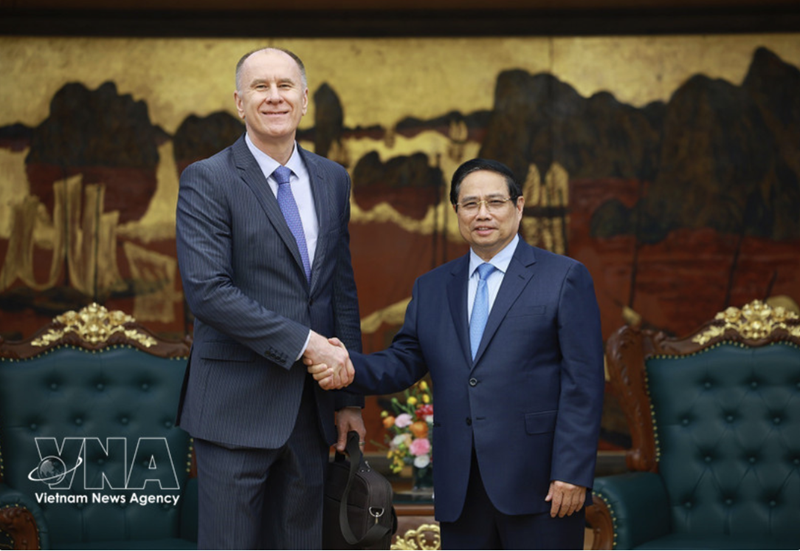
Welcoming Sommer in his new role and other members of the delegation, PM Pham Minh Chinh expressed confidence that the IMF official, who has long been engaged in assessing Vietnam’s macroeconomic performance, will continue to be a sincere and trusted partner of the country.
    |
 |
|
Prime Minister Pham Minh Chinh receives Martin Sommer, head of the IMF’s Article IV consultation mission team to Vietnam, in Hanoi on March 27. |
He appreciated the delegation’s constructive and professional engagement, along with their assessments and policy recommendations under the Article IV consultation and the mid-term review.
The PM briefed the IMF delegation on Vietnam’s socio-economic situation and development orientation, reiterating the country’s ambition to achieve double-digit growth in the coming years in line with the strategic goals. As reaffirmed by Party General Secretary To Lam, Vietnam aims to become a developing country with upper-middle income by 2030 and a high-income developed nation by 2045.
He stressed that future growth will not rely solely on demand stimulus measures but will be grounded in sustainability, driven by institutional reform, science and technology, innovation, digital and green transformation, and improvements in productivity and competitiveness. He added that Vietnam targets fast and sustainable growth and, importantly, that people benefit from achievements of this process.
Highlighting the IMF’s substantive and effective cooperation with Vietnam, PM Pham Minh Chinh said the fund’s policy assessments and advice has provided crucial references to support the country in making and implementing fiscal and monetary policies in a proactive and flexible manner, thereby helping maintain macroeconomic stability and promote growth.
For his part, Sommer noted impacts of the ongoing tensions in the Middle East on energy markets, fuel prices and global trade.
He offered recommendations for Vietnam to maintain macroeconomic stability, control inflation, ensure financial and energy security, and manage public, government and external debts. He also stressed the importance of effectively governing fiscal and monetary policies, diversifying development resources, addressing bottlenecks of the economy, and reforming administrative procedures to enhance economic resilience against external shocks.
Sommer praised Vietnam’s policymaking and socio-economic governance amid global uncertainty and applauded the fruitful cooperation between the country and the IMF. He described Vietnam as one of the most efficient users of IMF assistance, particularly in applying policy recommendations to achieve fast and sustainable development.
PM Pham Minh Chinh thanked the IMF delegation for its insights and further clarified issues of the IMF's concern, including geopolitical and geo-economic issues, along with measures for ensuring macroeconomic stability, fostering growth, controlling inflation, and guaranteeing major economic balances, including energy security. He also mentioned the country's governance of fiscal and monetary policies amid global volatility, mobilization of resources, and promotion of public – private partnerships in infrastructure development.
|
|
 |
|
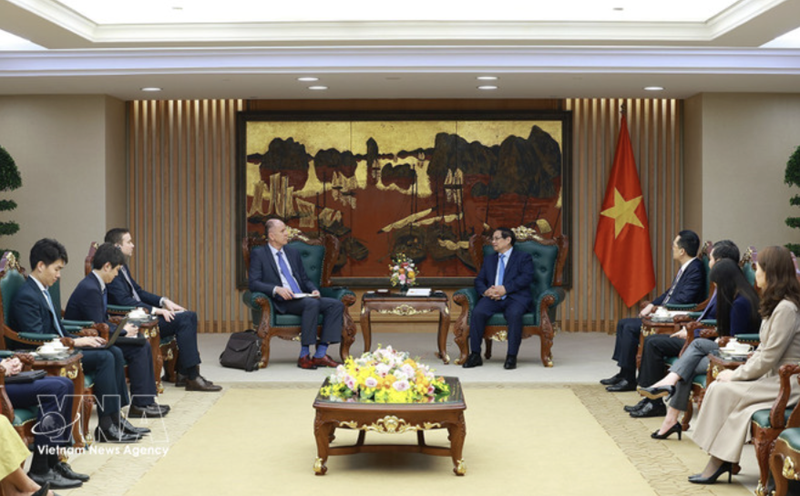
The meeting between Prime Minister Pham Minh Chinh and the IMF delegation in Hanoi on March 27 |
Emphasizing the spirit of “listening sincerely, sharing wholeheartedly and acting effectively,” the PM called on the IMF to further enhance the quality of policy dialogue and consultation with Vietnam, provide timely global and regional economic forecasts, and strengthen technical assistance.
He also suggested the fund support in building institutional capacity, modernizing monetary and macroprudential policy frameworks, enhancing the financial and banking system, developing capital markets, improving statistics and forecasting capacity, and making structural reform to raise productivity.
The Vietnamese Government's agencies, he affirmed, stand ready to maintain close coordination with the IMF, share information in accordance with regulations, and jointly develop policy assessments and recommendations aligned with the country’s reality and development goals, thus contributing to peace, cooperation and development in the region and beyond.
Source: VNA