The dialogue was held in Ha Noi and Ninh Binh province from September 27 to October 1, as Viet Nam and UNESCO are celebrating the 50th anniversary of their relations (1976-2026). The event brought together around 250 domestic and international delegates to discuss issues concerning heritage conservation and management in the region.
Baker said the event held particular significance in the year marking five decades of Viet Nam-UNESCO cooperation. He noted that it also reflected a broader shift in Viet Nam’s role within UNESCO, from primarily receiving assistance and participating in international cooperation to increasingly contributing its own experience, ideas and initiatives to regional and global discussions.
    |
 |
|
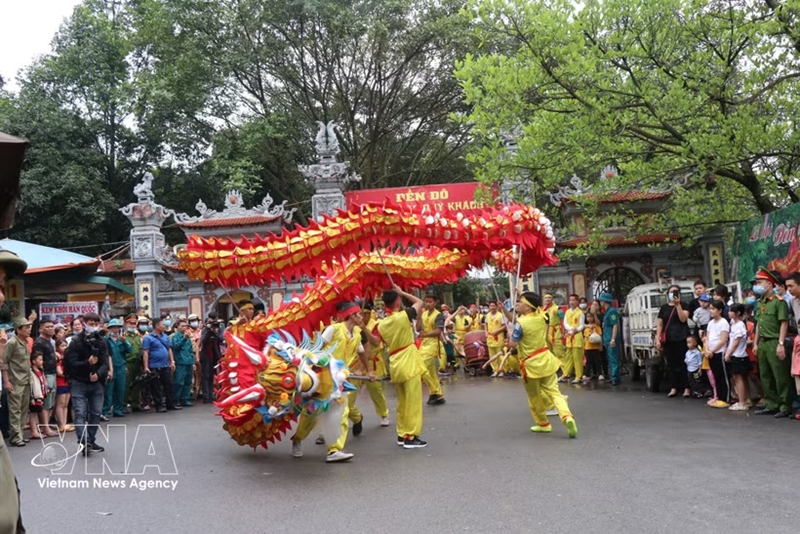
The annual Do Temple Festival commemorates King Ly Thai To (Ly Cong Uan). Bac Ninh province is preparing a scientific dossier for submission to UNESCO to honor historical and cultural figure Ly Cong Uan. (Photo: VNA) |
The dialogue was a clear example of this growing contribution, he said. By bringing together heritage experts and practitioners from across the Asia-Pacific region, Viet Nam helped foster an important discussion on how heritage could be understood, conserved and managed within the World Heritage system in different cultural contexts while responding to contemporary challenges.
The event was also particularly timely following the United Nations General Assembly’s declaration of the International Decade of Culture for Sustainable Development (2027-2036), an initiative proposed by Viet Nam. The decade reflects the international community’s growing recognition of the role of culture in sustainable development, including in strengthening identity, social cohesion and community resilience, he added.
The dialogue concluded with the adoption of the Ha Noi Outcome Document, which recorded key findings and recommendations emerging from the discussions.
On the Ha Noi Outcome Document, he said it built on a series of previous international instruments, from the 1994 Nara Document on Authenticity to the 2025 Nairobi Outcome Document on Heritage and Authenticity. It brought an Asia-Pacific perspective to the global discussion on authenticity, drawing on the region’s diverse cultural contexts and heritage practices.
“For Viet Nam, the Document addressed a number of important issues, including living heritage, reconstruction, community knowledge, and the relationship between tangible and intangible dimensions of heritage. In this sense, the Dialogue created a valuable two-way exchange: bringing international experience and lessons to Viet Nam, while also sharing relevant practices and experiences from Viet Nam with the wider international community,” assessed Baker.
The document came at a time when world heritage conservation was facing growing pressures from climate change, urbanization and socio-economic development. After decades of implementing the 1972 Convention concerning the Protection of the World Cultural and Natural Heritage, discussions on authenticity continue to evolve to reflect diverse cultural contexts.
The Ha Noi Document was particularly significant as it contained recommendations directly relevant to bodies responsible for implementing the 1972 Convention. These recommendations were expected to be considered at the 49th session of the World Heritage Committee in Türkiye in 2027, including in relation to possible updates to the Operational Guidelines for the Implementation of the World Heritage Convention.
Regarding the investment project to preserve, restore and rehabilitate Kinh Thien Palace, which was officially launched on September 29, Baker said UNESCO welcomes Viet Nam’s rigorous approach, from scientific research and documentation to consultation and dialogue leading to the reconstruction project.
Since 2023, the process has involved sustained efforts by Vietnamese researchers, archaeologists, architects and other experts, alongside continuous consultations with UNESCO and the International Council on Monuments and Sites (ICOMOS). Viet Nam has made significant investments, deepened its understanding of the heritage and strengthened the scientific basis for the reconstruction, he said.
The September 29 ground-breaking ceremony, attended by General Secretary of the Communist Party of Viet Nam Central Committee and President To Lam, marked an important milestone in this long-term process in which continued research, documentation, dialogue and community engagement will be essential to safeguarding the heritage and transmitting its values to future generations, he stated.
UNESCO highly values Viet Nam’s engagement with the processes under the 1972 Convention, Baker said, noting that the project has been developed through close dialogue with the World Heritage Centre, ICOMOS and the World Heritage Committee, together with continuous efforts to address the committee’s recommendations. This process led to the World Heritage Committee’s decision in July 2026 and reflected Viet Nam’s close cooperation with the World Heritage system.
UNESCO also welcomes Viet Nam’s attention to community participation and public interpretation of heritage. This is important to help people understand the outstanding universal value of the heritage site and its enduring cultural significance. In the spirit of the Ha Noi Outcome Document, community engagement should remain an important component of the project during its implementation, he said.
Regarding UNESCO’s further technical support and recommendations to ensure compliance with the strict authenticity requirements set out in the Nara Document and ICOMOS technical guidance, while protecting the original archaeological layers beneath the site, Baker said UNESCO’s top priority was to ensure that any intervention in the central sector of the Thang Long Imperial Citadel in Ha Noi maintained the site’s outstanding universal value, authenticity and integrity, including its archaeologically significant layers.
“In this regard, UNESCO will continue to facilitate dialogue between Viet Nam and the World Heritage advisory mechanisms, including ICOMOS, and provide technical advice as appropriate,” he affirmed.
Source: VNA