Talking about Viet Nam’s key contributions to hosting this international event, the Deputy Minister of Foreign Affairs underlined that the Asia-Pacific Dialogue on Heritage and Authenticity was a leading high-level regional policy forum, bringing together world leaders and heritage experts, including the Director of the UNESCO World Heritage Center, the Chairperson of the 49th session of the World Heritage Committee, and ambassadors representing members of the World Heritage Committee. The conference addressed one of the core and long-term issues of the World Heritage Convention and obtained significant results, marked by four key highlights.
    |
 |
|
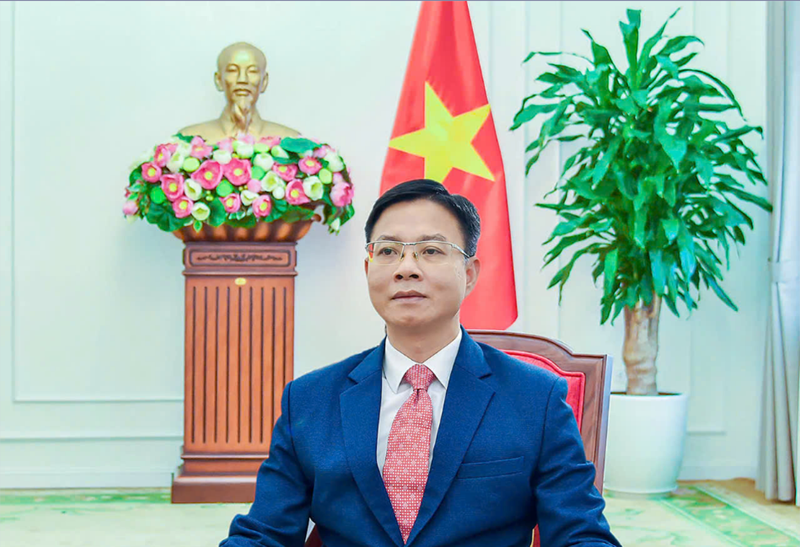
Deputy Minister of Foreign Affairs Ngo Le Van, Chairman of the Viet Nam National Commission for UNESCO |
First, the adoption of the Hanoi Document on Heritage and Authenticity marked an important shift in the thinking and methodology of heritage conservation in the region and globally. For the first time, the region’s perspective, supported by clear and well-grounded arguments, was incorporated into global discussions.
Second, the conference highlighted Viet Nam’s role in initiating and leading international dialogue. Viet Nam was not only the host country and co-chair of the conference but also directly contributed to setting its agenda and shaping global heritage policy.
Third, the conference demonstrated how policy can be linked to practical action. For the first time, a policy conference on authenticity was directly linked to a specific heritage conservation event: the groundbreaking ceremony for the project to conserve, restore, and rehabilitate Kinh Thien Palace on September 29, as well as field visits to Trang An and Tam Chuc. Delegates not only discussed theoretical concepts but also witnessed firsthand Viet Nam’s approach to heritage conservation at the Thang Long Imperial Citadel. The site serves as an exemplary model of cooperation in safeguarding authenticity, enhancing outstanding universal value, and effectively addressing the balance between conservation and development at a heritage site.
Fourth, the event underscored Viet Nam’s organizational capabilities. Hosting the event in Hanoi and Ninh Binh helped affirm Viet Nam’s capacity to organize major international events and establish itself as a reliable partner and a destination for cultural and heritage initiatives and multilateral dialogue in the region, thereby contributing to the enhancement of Viet Nam’s international standing and soft power.
The adoption of an international heritage document bearing the name of Hanoi one the occasion of the 50th anniversary of Viet Nam-UNESCO relations also reflected Viet Nam’s evolving position and role in cultural diplomacy and multilateral mechanisms, Ngo Le Van said.
He described the event as a new milestone in Viet Nam-UNESCO relations over the past five decades, marking a transition from receiving assistance and participating in cooperation to proactively making contributions. In 1981, when Viet Nam was still facing considerable postwar difficulties, the UNESCO Director-General called on the international community to join efforts to save the ancient capital of Hue. Forty-five years later, also in Hanoi, Viet Nam worked with UNESCO and international experts to develop a strategic document on heritage. This, he said, vividly demonstrated the country’s development and the depth of the Viet Nam-UNESCO partnership over half a century.
The dialogue also underscored Viet Nam’s capacity and credibility in initiating, connecting, and helping shape strategic issues and major policies at the regional and global levels. Alongside Viet Nam’s initiative for the International Decade of Culture for Sustainable Development 2027-2036, adopted by the U.N. General Assembly, the Hanoi Document affirmed Viet Nam’s growing contribution to policy orientation and professional expertise. It also reflected the country’s participation in developing international standards on culture and heritage and contributing to human civilization.
Ngo Le Van emphasized that the event demonstrated how cultural diplomacy could create opportunities and mobilize resources for national development. The dialogue helped translate into practice the directions set out at the 14th National Congress of the Communist Party of Viet Nam, Resolution No.80-NQ/TW on Vietnamese cultural development, Resolution No.06-NQ/TW on implementing the foreign policy set out at the 14th National Party Congress, and Resolution No.26-NQ/TW on developing Viet Nam’s tourism industry into a key economic sector in the new era. These efforts aim to transform cultural resources into assets that directly support national development goals, strengthen soft power, and enhance the country’s international standing.
Regarding the groundbreaking ceremony for Kinh Thien Palace and the future of the Thang Long Imperial Citadel, the deputy minister described the site as a sacred symbol of the nation and a center of continuous political power in Viet Nam for 13 centuries. He stressed that the commencement of the Kinh Thien Palace project was of particular significance.
Following 15 years of persistent research and cooperation, especially over the past three years, the World Heritage Committee had, for the first time in the nearly 55-year history of the World Heritage Convention, agreed to a modification of the existing state within the core zone of a World Heritage site. This year therefore marked a historic milestone, with a decisive step forward in support of the reconstruction of Kinh Thien Palace, he said.
Lazare Eloundou Assomo, Director of the UNESCO World Heritage Center, and experts from the International Council on Monuments and Sites (ICOMOS) affirmed that the Thang Long Imperial Citadel was of great significance not only to Viet Nam but also to the world. Given the unprecedented nature of the project and the new issues it raised concerning heritage development, they had described it as a “miracle” and a Vietnamese contribution that could open up new approaches to conserving and promoting the value of World Heritage sites.
He also highlighted the project as a model of cooperation between a member state, UNESCO, and its advisory bodies, as well as an example of heritage conservation for other countries and a contribution by Viet Nam to human civilization. International ambassadors and delegates regarded the cooperation on the Thang Long Imperial Citadel as valuable experience that should be shared widely with other member states.
Looking ahead, Viet Nam needs to continue fully implementing the commitments and recommendations of the World Heritage Committee, while pursuing the site’s long-term vision, Ngo Le Van said. This requires strengthening cooperation with UNESCO, ICOMOS, and international experts in conservation, restoration, and rehabilitation, ensuring that all work is grounded in scientific research and safeguards the site’s authenticity, integrity, and outstanding universal value.
These efforts will help bring national history to life, rekindle the collective strength built over thousands of years, and foster pride in the nation’s roots, while fulfilling the aspirations of present and future generations.
Translated by Quynh Oanh