Among the most notable are the sculpture “Portrait of President Ho Chi Minh” by sculptor Nguyen Thi Kim and the lacquer painting “Uncle Ho in the Viet Bac War Zone” by renowned artist Duong Bich Lien. Both works have been recognized as National Treasures.
    |
 |
|
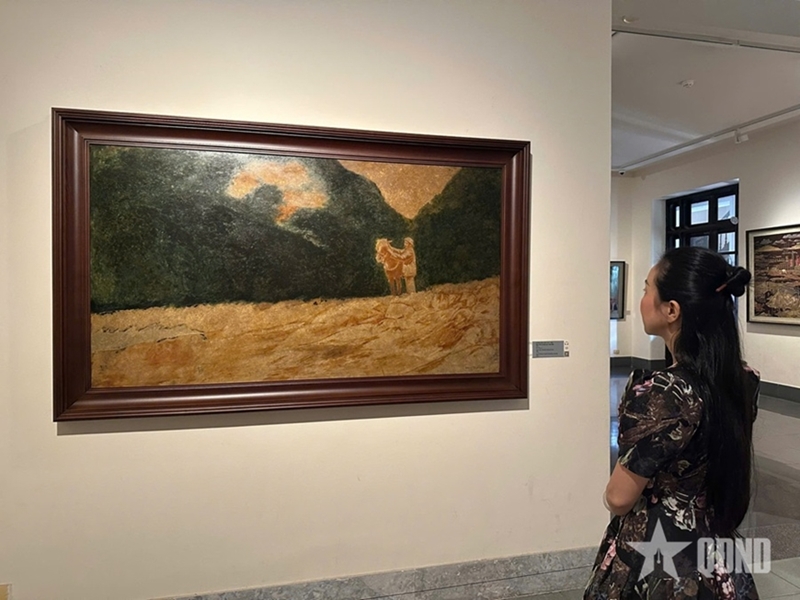
The lacquer painting, “Uncle Ho in the Viet Bac War Zone” by renowned painter Duong Bich Lien |
Created in 1946, the “Portrait of President Ho Chi Minh” is considered one of the earliest sculptures depicting Uncle Ho. While preparing for an art exhibition celebrating the National Day, Nguyen Thi Kim and several artists were invited to Bac Bo phu (the Tonkin Palace, which is now the Government Guest House) to observe and create works related to the President.
For more than 20 days, the sculptor quietly observed his expressions and gestures each morning in order to complete the piece. Cast in bronze, the sculpture portrays President Ho Chi Minh reading a book, his head slightly lowered and his face deep in thought. Its simple yet refined style captures his calm, modest demeanor and the concerns of a leader guiding the country during the early days of independence.
The work is not only the first sculpture of President Ho Chi Minh, but also an important artistic and historical document that helped shape his image in Vietnam’s revolutionary art.
The sculpture also carries a moving story of preservation. During the nationwide resistance war in late 1946, the artist’s family secretly buried it beneath the ancestral altar of the family chapel to protect it from destruction. Eight years later, after peace returned to Hanoi, the sculpture was recovered intact from the ground, reflecting the artist’s enduring faith in the revolution.
The work was recognized as a National Treasure in 2023 and is currently preserved at the National Museum of Vietnamese History.
More than 30 years later, the image of President Ho Chi Minh continued to be portrayed by artists. One of the most outstanding examples is the lacquer painting Uncle Ho in the Viet Bac War Zone, created by Duong Bich Lien in 1980.
The painting was based on sketches and observations the artist made during a trip to Viet Bac in 1952, when he had the opportunity to live and work near President Ho Chi Minh.
In the artwork, Uncle Ho appears calm and composed, holding the reins as if soothing the horse before crossing a fast-flowing stream. Duong Bich Lien used a restrained palette dominated by green and yellow tones, skillfully creating layers of space through lacquer techniques. Broad areas of color and smooth tonal transitions evoke the vast mountains and forests, both quiet and full of movement.
Against that backdrop, the image of President Ho Chi Minh and the horse forms a compact visual focal point. The contrast between the immense natural landscape and the small human figure highlights his calm and steady spirit in the face of hardship.
The painting was recognized as a National Treasure in 2017 and is currently displayed at the Vietnam National Museum of Fine Arts.
Though created in different historical periods and artistic forms, the two works share the same enduring value of honoring President Ho Chi Minh through authenticity and emotion. From the office of the nation’s early independence years to the forests of Viet Bac during wartime, his image emerges not only as a leader, but also as a close and humane figure who remains an enduring symbol in Vietnamese art.
Translated by Tran Hoai