Common language connects friendship
The Van Lang Vo Dao sect from Morocco was among the 16 international delegations from ten countries and territories, joining 41 domestic groups and 45 local delegations from Gia Lai province. Hala El Hsissen, a practitioner of this sect, noted that after practicing Vietnamese traditional martial arts for over 23 years, this was her third time attending the festival. The practitioner shared that the training helped forge bravery, willpower, and the Vietnamese martial spirit, while providing opportunities to interact with international peers sharing the same passion.
Head of Son Long Quyen Thuat delegation from France Xavier President expressed excitement about attending the festival in the region considered the cradle of Vietnamese traditional martial arts. He stated that masters and students were thrilled to visit and perform at the An Khe Truong relic site, the Quang Trung Museum, and Long Phuoc pagoda. This experience allowed them to not only connect with international friends but also absorb the essence of Vietnamese martial arts and the martial traditions of the Tay Son Thuong Dao region.
    |
 |
|
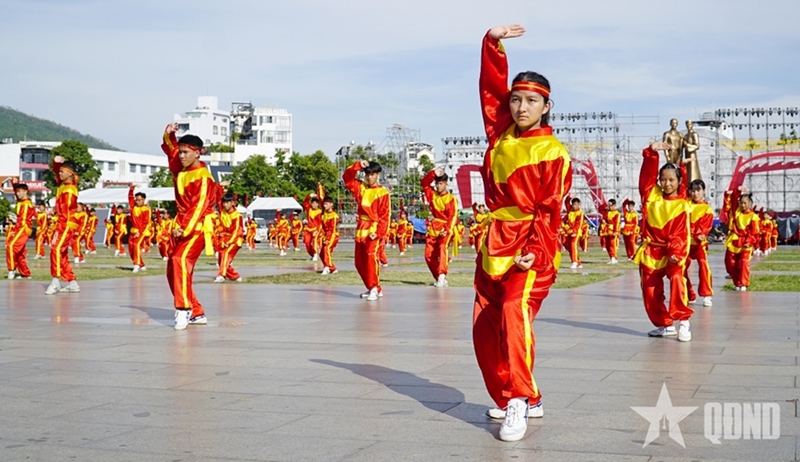
Performance of traditional martial arts at the ninth International Festival of Vietnamese Traditional Martial Arts in 2026. |
Over the 10-day event (July 26 to August 5), more than 2,240 masters, coaches, and practitioners engaged in various activities. Activities included offering flowers and incense at the Kinh Thien Altar and the Quang Trung Museum; a torch relay from the Tay Son Tam Kiet temple to the Nguyen Tat Thanh square; martial arts mass performances; and exchange programs at martial arts schools, historical relics, and tourist sites. The 15th National Traditional Martial Arts Club Championship and photo exhibitions were also held.
Master Le Xuan Canh of Le Xuan Canh Martial Arts School (Gia Lai province) observed that the ninth festival was organized more professionally and on a larger scale than the previous editions, featuring diverse activities and numerous delegations. The massive international turnout demonstrated the enduring vitality and profound humanistic values of Vietnamese traditional martial arts.
Nguyen Thi Thanh Lich, Vice Chairwoman of the Gia Lai Provincial People’s Committee and head of the organizing panel, emphasized that the event created a unique cultural exchange space where martial arts served as a common language fostering friendship, respect, and a desire for peace among nations.
Cultural and tourism highlights
Within Vietnamese martial arts, Binh Dinh traditional martial arts are considered the soul, closely linked to the nation’s history of national construction and defense. Recognized as a national intangible cultural heritage in 2012, it is currently being proposed by the Government to UNESCO for inclusion on the Representative List of the Intangible Cultural Heritage of Humanity.
Gia Lai province is actively and synchronously preserving and promoting these values. Pham Anh Tuan, Chairman of the Gia Lai provincial People’s Committee, affirmed that safeguarding traditional martial arts means protecting not just a martial discipline, but a part of the nation’s memory, bravery, and cultural identity.
According to the Chairman of the provincial People’s Committee, in Gia Lai’s new development space, traditional martial arts merge with the Central Highlands’ vast forests, the gong cultural space, and the Tay Son spirit. This cultural convergence creates a highly distinct and globally open Gia Lai. Moving forward, the province will strengthen the links between martial arts, culture, education, sports, and tourism. It aims to turn traditional martial arts into a signature cultural tourism product, encouraging the younger generation to learn and embody the martial ethos.
In reality, Binh Dinh province previously and Gia Lai province after the merger have enacted numerous policies to preserve and promote Binh Dinh traditional martial arts. Initiatives include boosting international media coverage, supporting martial arts schools, masters, and practitioners, and developing preservation projects linked to high-performance sports and local socio-economic development.
Gia Lai is currently outlining specific directions to introduce Binh Dinh traditional martial arts into schools, integrate them with traditional arts, build a brand identity, and design experiential tourism routes. By 2030, the province aims to have at least 10 martial arts schools meeting tourism standards and to complete the Binh Dinh Traditional Martial Arts Center to fulfill research, preservation, and training missions tied to tourism development.
Translated by Chung Anh