Nestled beneath rows of casuarina trees along the breezy coastline of Phuoc Hai commune, the site serves as the resting place of whales—revered by fishermen as “Ong” (the Whale God) or “Nam Hai Deity.” For generations, whales have been regarded as sacred beings believed to rescue fishermen in distress at sea.
    |
 |
|
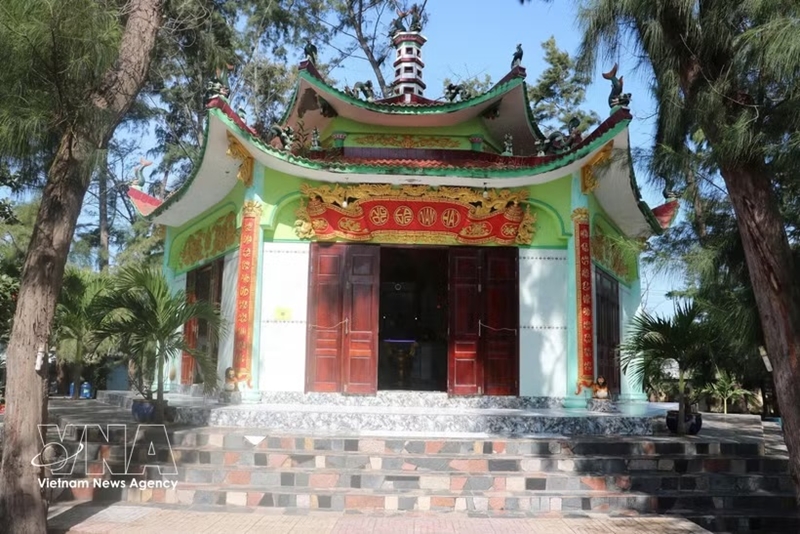
The Whale God temple is a place of worship located within Ngoc Lang Nam Hai in Ho Chi Minh City. |
The cemetery was established in 1991 on an area of about 6,000 sq m near the fishing village. Recognised in 2011 as the largest whale cemetery in Vietnam, it is now home to around 50 whale graves. Each burial follows solemn rituals conducted by fishermen whenever a whale is found stranded ashore or caught in fishing nets offshore.
Le Van Khoi, caretaker of the cemetery, said local fishermen promptly notify the fishing community upon discovering a stranded whale so that proper funeral rites can be held. Whales are honoured like family members, with ceremonies expressing gratitude and prayers for safe voyages and abundant catches. According to tradition, after three years, the remains are exhumed and transferred to the nearby Nam Hai Temple for continued worship.
For local fishermen such as Nguyen Van Hai, spiritual practices remain an integral part of daily life. Before heading out to sea, he visits Ngoc Lang Nam Hai to offer incense and pray for favourable weather and a safe journey.
Each year, on the 15th, 16th and 17th days of the second lunar month, fishermen in Phuoc Hai fishing village hold the Nghinh Ong (whale worshipping) Festival — the locality’s largest event—praying for peace and good fortune while reflecting the close bond between spiritual life and the livelihoods of coastal communities.
Beyond its spiritual significance, the whale cemetery reflects the cultural depth of coastal communities. Researchers note that the whale worship ritual originated from the Cham people’s culture before being integrated into the coastal life of Vietnamese people, becoming a defining feature of many fishing villages nationwide. Each year, about 15 - 20 whales are brought ashore and buried at the site by local fishermen.
According to Nguyen Hong Phuc, Vice Chairman of the Phuoc Hai communal People’s Committee, the whale cemetery and the Nghinh Ong Festival represent a distinctive spiritual space and a powerful cultural symbol tied to the history and development of the local fishing village. These values, he said, hold strong tourism appeal.
Efforts are underway to preserve and promote the site in tandem with tourism development. Local authorities are upgrading a traditional fisheries exhibition house, enhancing display spaces, and creating experiential areas showcasing fishing tools and practices. Digital technologies and communication campaigns are also being expanded to promote the cemetery and the festival to visitors.
Source: VNA