The shift aims to unlock new sources of growth, strengthen national soft power and create fresh momentum for development.
Six months after the resolution was issued, ministries, sectors and localities have moved swiftly to develop action plans and introduce new policy mechanisms. At the second meeting of the Central Steering Committee for the Development of Vietnamese Culture, Party General Secretary and State President To Lam acknowledged these early efforts but stressed that significant gaps remain between policy goals and tangible outcomes. He identified four gaps and outlined three major transformations to guide cultural development in the years ahead.
    |
 |
|
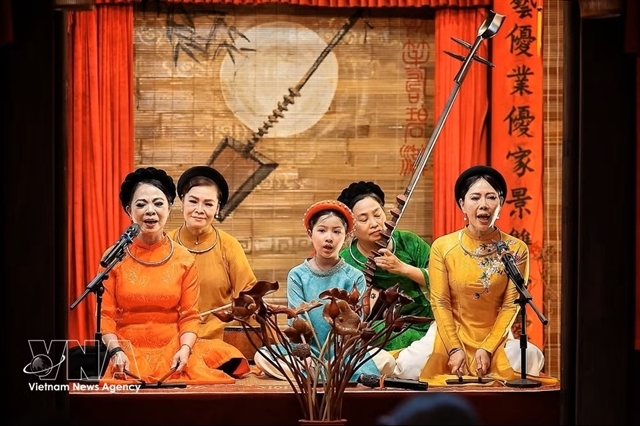
Three generations of female "xam" singers from Bich Cau Dao Quan perform together. |
The four shortcomings include the limited appeal of Vietnamese cultural values in the digital environment, the slow conversion of heritage into digital resources and intellectual property, insufficient capacity to create competitive cultural products, and an underdeveloped institutional framework for cultural industries. The three major shifts are viewing culture as a pillar of national development, promoting culture in both physical and digital spaces, and moving beyond preservation towards innovation and value creation.
Associate Professor, Dr. Do Hong Quan, President of the Vietnam Union of Literature and Arts Associations, said that the Party and State leader’s candid and pragmatic assessment after six months of implementing the resolution highlighted a persistent gap between policy and tangible outcomes, as well as between action programs and their real-world impact. Public spending on culture currently accounts for only around 1.5% of the State budget, falling short of the resolution’s minimum target of 2%.
Vietnam possesses more than 40,000 historical and cultural sites, nearly 70,000 items of intangible cultural heritage and 38 UNESCO-recognized heritage elements. However, much of this valuable resource has yet to be digitized, standardized or integrated into shared databases. Nor has it been effectively protected and commercialized as intellectual property or developed into digital knowledge and creative products serving education, cultural industries and artificial intelligence applications.
Professor Dr. Tu Thi Loan, President of the Thang Long Institute of Cultural Studies, said Vietnam’s greatest challenge lies not in the lack of heritage or creativity but in the absence of a complete ecosystem capable of transforming heritage into data, data into knowledge, knowledge into intellectual property, and intellectual property into marketable products and services. She stressed the need for a national cultural data infrastructure, a transparent legal framework governing heritage data, and stronger collaboration between the cultural, technology and business sectors.
She also called for more attractive financial policies, investment funds and intellectual property protection to encourage long-term investment in creative industries. A more integrated ecosystem linking artists, enterprises, technology, finance, education and international markets, she said, will enable cultural assets to become valuable economic resources.
Currently, cultural industries contribute around 4% of Vietnam’s GDP. Under Resolution 80, the sector is expected to account for 7% by 2030 and 9% by 2045. Experts believe that with coordinated reforms in institutions, technology, human resources and infrastructure, Vietnam can transform its cultural heritage into a powerful engine for innovation, economic growth and national soft power in the new era.
Source: VNA