In an interview granted to the Vietnam News Agency correspondent in Malaysia, Collins Chong Yew Keat, an analyst on foreign, security, and strategic affairs at University of Malaya (UM), noted that Vietnam has correctly recognized that its current growth model, heavily reliant on export-oriented production and foreign-sourced assembly, is gradually reaching diminishing returns.
    |
 |
|
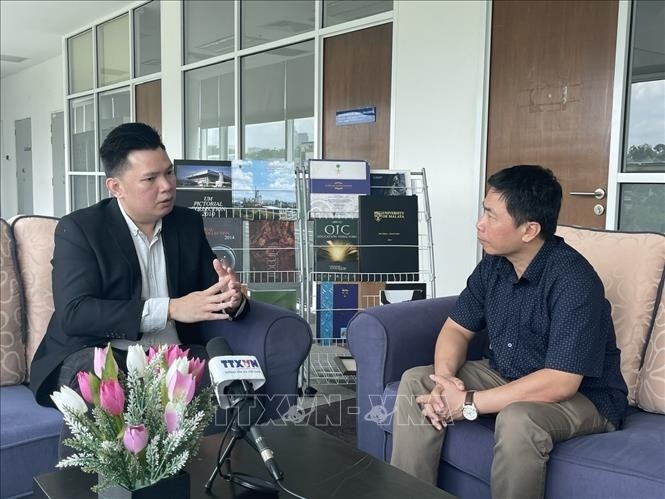
Collins Chong Yew Keat (left), an analyst on foreign, security, and strategic affairs at University of Malaya, in an interview granted to the Vietnam News Agency |
In the context of increasingly challenging global conditions due to trade fragmentation and geopolitical risks, the expert emphasized that sustaining 10% GDP growth will require a qualitative transformation, not merely quantitative expansion.
He said Vietnam’s high and sustainable growth hinges on a productivity boost, stronger domestic value creation, and a robust innovation and R&D ecosystem, with successful reforms key to achieving these ambitious targets.
Regarding the strategy of maintaining political stability while accelerating economic reforms, the expert said Vietnam’s approach helps strengthen confidence among regional investors thanks to policy continuity and quick mobilization of infrastructure and laborers. However, Collins also warned that too much caution in administration could potentially slow the implementation of high-value and innovation-led projects.
The analyst noted that compared with other ASEAN countries, Vietnam has an edge in growth momentum, scale, and strategic positioning. While Malaysia leverages institutional maturity and Indonesia its market size, Vietnam stands out as a large alternative production hub capable of quickly mobilizing its industrial resources.
However, Collins also highlighted risks, including overreliance on foreign assembly and emerging financial gaps in real estate and credit. He added that as Vietnam moves into sectors like semiconductors, AI, and robotics, it will face increasingly stringent institutional requirements.
Looking ahead, he sees strong potential for Vietnam to become a new growth engine for ASEAN, but noted that this hinges on the transition from cost-driven to capability-driven growth.
According to him, the next stage will depend on skilled labor rather than cheap labor, with education and health care as the core foundation of competitiveness. He stressed the importance of domestic technology and innovation, along with economic resilience tied to security across various sectors from energy to maritime trade.
From Malaysia’s perspective, Vietnam is both a key partner and a competitor in attracting high-quality FDI, Collins said, adding that regional partners expect Vietnam to remain committed to ASEAN integration and prioritize long-term productivity rather than relying solely on short-term incentives.
He also observed that outcomes from the past Party congresses and economic performance in recent years indicate that Vietnam is exercising strategic discipline toward 2030 and 2045, aiming to transform from a production hub into a connected economy driven by productivity and innovation.
Source: VNA