Bright spots
Economic and trade ties between Viet Nam and Laos have maintained strong growth. Bilateral trade rose by more than 20% annually on average during 2021-2025, while the commodity structure has become increasingly complementary, with industrial products, chemicals, raw materials, machinery and equipment gaining a larger share.
The two countries have established various frameworks to facilitate trade, including the 2015 Viet Nam-Laos Border Trade Agreement and the Viet Nam-Laos Trade Agreement that was signed in April 2024 and came into effect in February 2025.
    |
 |
|
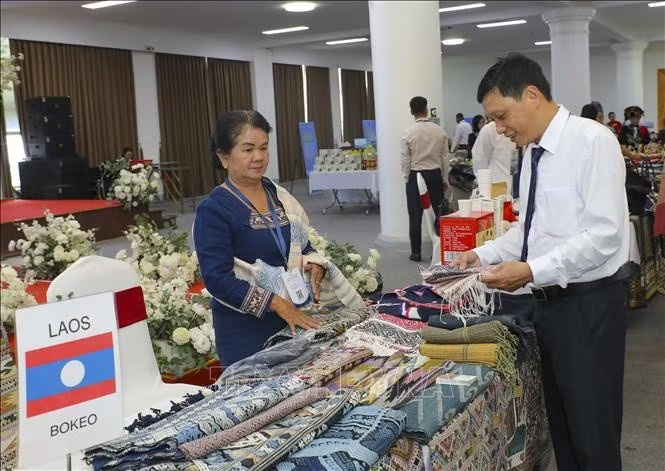
Delegates visit the exhibition booth showcasing products from Bo Keo province (Laos) at the 2026 Northern Region Trade Promotion and Import-Export Conference. |
They have also implemented the 2007 Hanoi Agreement on facilitating the movement of people, vehicles and goods through four pairs of international border gates. In August 2026, the two Ministries of Industry and Trade agreed to propose amendments to the agreement, targeting completion in 2027.
Agreements on border trade infrastructure connectivity and market management, signed in 2024, have strengthened the foundation for advancing bilateral trade.
Speaking at the recent Viet Nam-Laos Product Week, Deputy Minister of Industry and Trade Nguyen Viet Son said the two ministries have maintained close coordination, contributing to deeper economic and trade cooperation.
Lao Ambassador to Viet Nam Khamphao Ernthavanh said the event helped bring products closer to consumers while creating opportunities for businesses to connect directly and translate high-level cooperation agreements into concrete outcomes.
Bilateral trade reached USD 2.9 billion in 2025 and exceeded USD 1.6 billion in the first nine months of 2026, according to Tran Thi Tu Anh, Trade Counsellor and head of the Viet Nam Trade Office in Laos.
Viet Nam exports petroleum, iron and steel, machinery, transport vehicles and consumer goods to Laos, while importing ores, coal, rubber, timber, maize, electricity and other agricultural products and raw materials.
Improved border infrastructure and customs mechanisms have helped shorten clearance times and reduce logistics costs. Meanwhile, business cooperation is expanding beyond goods trading to production, supply-chain linkages and distribution networks.
Towards ambitious targets
Vietnamese investment in Laos continues to expand in both scale and quality, focusing on energy, agriculture, services and export-oriented manufacturing. Viet Nam ranks second among 53 countries and territories investing in Laos, with 435 projects and registered capital of about USD 8 billion.
The two countries aim to boost bilateral trade in 2026 towards the milestone of USD 10 billion by 2030, a target the Viet Nam Trade Office in Laos said is challenging but feasible as both Governments work to remove trade barriers, improve border-trade mechanisms, and strengthen transport and logistics connectivity.
Large Vietnamese projects in energy, minerals and high-tech agriculture are expected to create additional supply for Viet Nam and third markets once fully operational.
At a recent meeting with his Lao counterpart, Vietnamese Minister of Industry and Trade Le Manh Hung said the two sides should identify specific growth drivers by sector, product group and project to raise bilateral trade to USD 4 billion, then USD 5 billion and ultimately USD 10 billion.
The two ministries agreed to prioritize electricity, coal, petroleum, minerals, construction materials, machinery, chemicals, agricultural products and consumer goods, while strengthening trade promotion, business and supply-chain connectivity. Energy cooperation, especially electricity, and deeper processing of minerals will also receive greater attention.
According to Tu Anh, significant potential remains in infrastructure, energy, high-tech agriculture and services. Laos’ strategic location could help turn the landlocked country into a land-connected logistics hub, while stronger economic corridors, the Vientiane-Hanoi expressway and access to Vietnamese seaports such as Vung Ang could improve connectivity.
Counsellor and Head of the Economic and Trade Office at the Lao Embassy to Viet Nam Somsay Nonglard said Laos hopes to increase exports to Viet Nam while encouraging Vietnamese businesses to invest in agriculture, agro-processing, industry, energy, logistics, trade and services.
With Laos’ strengths in resources, agriculture, energy and connectivity complementing Viet Nam’s manufacturing, processing, distribution and logistics capabilities, the two countries can deepen value-chain links and jointly expand into third markets, he added.
Source: VNA