More than 120 delegates attended the conference, including leaders of central ministries and agencies, local officials, scientists, policy experts, diplomatic representatives, international organizations and businesses from Viet Nam, Laos, and Cambodia.
    |
 |
|
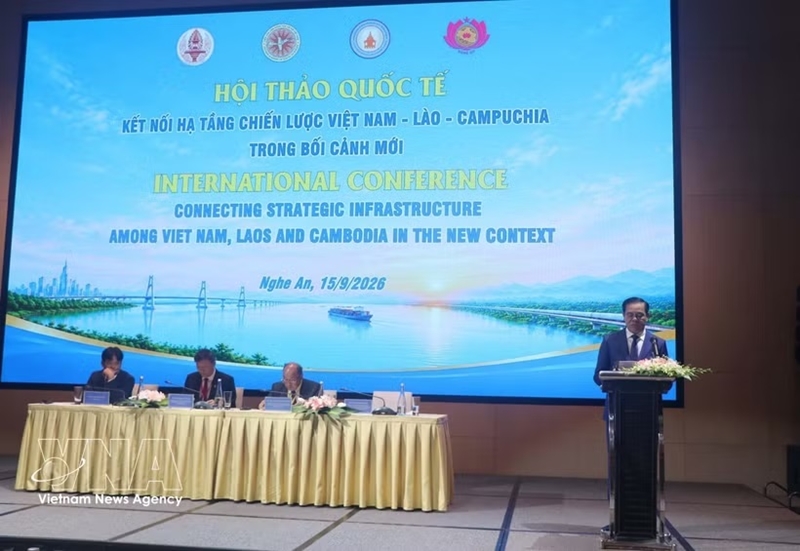
A view of the international conference in Nghe An province on September 15 to discuss strategic infrastructure connectivity among Vietnam, Laos, Cambodia |
Speaking at the event, Prof., Dr. Le Van Loi, VASS President, said the traditional friendship and comprehensive cooperation among Viet Nam, Laos and Cambodia are invaluable assets shared by the three nations.
Strengthening connectivity among the three countries would help them better leverage their respective advantages and expand links with broader regional frameworks, including the Greater Mekong Subregion (GMS) and ASEAN, he said.
Loi noted that the Fourth Industrial Revolution, digital transformation and sustainable development are changing the concept of strategic infrastructure. It now extends beyond physical infrastructure such as transport and energy to include institutional, digital and green infrastructure, such as data systems, telecommunications, smart power grids, renewable energy and green logistics.
The restructuring of supply chains and emerging non-traditional security challenges also require infrastructure systems that are more adaptable and resilient, he said.
Lao National Institute for Economic and Social Sciences President Leeber Leebouapao and Royal Academy of Cambodia President Sok Touch shared the view that upgrading and synchronizing infrastructure networks among the three countries is key to promoting sustainable development, narrowing development gaps, improving regional competitiveness and strengthening ASEAN centrality in Mekong subregional cooperation.
The Nghe An Provincial People’s Committee Chairman Vo Trong Hai said the province holds a strategic position on the East-West Economic Corridor and shares the longest land border with Laos among Viet Nam’s localities. It also has seaports and transport infrastructure linking it with other regions.
Nghe An sees stronger connectivity with localities in Laos and Cambodia as an important way to expand its development space, promote trade and deepen regional cooperation, Hai said.
He highlighted infrastructure connectivity plans, including the Vinh-Thanh Thuy expressway, as well as “soft connectivity” through cooperation in education and training, human resources development, science and technology, cultural exchanges and local-level partnerships.
The conference featured three specialized sessions with 10 scientific presentations and extensive discussions. Participants examined global and regional trends and the current state of connectivity, while discussing long-term development models and solutions to mobilize resources for major infrastructure projects.
Source: VNA