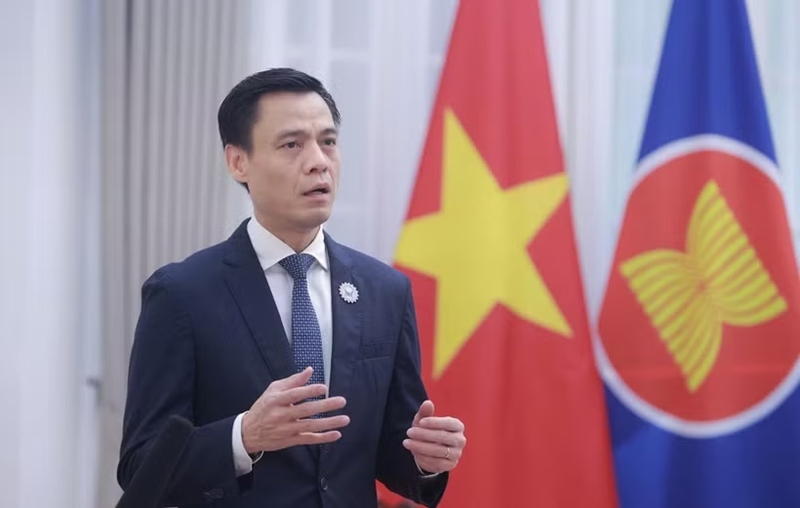
The statement was made by Deputy Minister of Foreign Affairs Dang Hoang Giang in an interview granted to the Viet Nam News Agency.
    |
 |
|
Deputy Minister of Foreign Affairs Dang Hoang Giang |
Giang noted that with a packed schedule of nearly 40 multilateral and bilateral engagements, the PM put forward important strategic orientations and proposals.
At the meetings, PM Le Minh Hung outlined three strategic orientations for enhancing ASEAN cooperation, namely building an environment of peace and stability; fostering dynamic, innovative and resilient shared development; and nurturing a shared identity to build a cohesive and sustainable ASEAN Community.
To enhance ASEAN’s central role and improve the implementation of commitments, he proposed that the bloc develop a strategic cooperation roadmap with its partners. This will enable ASEAN to proactively identify priorities and mobilize resources in line with the potential and cooperation needs of all parties.
In this spirit, PM Le Minh Hung put forward two specific initiatives - establishing an ASEAN space partnership for development and resilience, and promoting ASEAN as a pioneering region in implementing the International Decade of Culture for Sustainable Development initiative. Both proposals received recognition and active support from member states.
Giang noted that Viet Nam has been among the leading countries in implementing ASEAN commitments in recent years and earned high regard from other member states. They valued Viet Nam’s international role, expressed admiration for its achievements and development prospects, and proposed various practical areas for bilateral cooperation.
PM Le Minh Hung's participation and contributions at the meetings further reaffirmed that ASEAN is a strategically important space for Viet Nam’s security and development, he said.
In 2027, as Chair of the Asia-Pacific Economic Cooperation (APEC) forum, Viet Nam will seek to align the APEC and ASEAN agendas to mobilize additional resources for shared priorities, particularly sustainable growth, energy security and climate change response, said the Deputy FM.
Regarding the outcomes of the 49th ASEAN Summit and related summits, Giang said that the summits adopted and noted 117 documents, the highest number recorded at recent ASEAN summits.
After nearly 60 years of formation and development, ASEAN has achieved many strategically significant accomplishments and is now at a turning point in realizing the ASEAN Community Vision 2045. The bloc has numerous opportunities to expand cooperation, while facing major challenges in maintaining peace and stability and strengthening regional connectivity.
Against this backdrop, the 49th ASEAN Summit and related summits delivered a number of important outcomes. A highlight was the signing of the ASEAN Digital Economy Framework Agreement (DEFA), which will open up greater market access for businesses and could help the bloc’s digital economy reach 2 trillion USD by 2030, double the figure projected under the previous baseline scenario.
Early implementation of the upgraded ASEAN Trade in Goods Agreement (ATIGA) is expected to simplify procedures, boost intra-regional trade and strengthen regional supply chain connectivity. Member states also agreed on various measures to enhance energy cooperation and connectivity, including promoting power grid interconnections and coordinating efforts to ensure oil supply security.
Partner countries reaffirmed their respect for ASEAN’s central role and agreed to step up coordination in areas matching the bloc’s needs and each partner’s strengths. ASEAN and its partners also agreed on new cooperation programs, particularly in non-traditional security, artificial intelligence, science and technology. The partners reiterated their support for ASEAN’s central role in contributing to peace and stability in the region and the world.
The resumption of the Mekong-Japan and Mekong-Republic of Korea Summits after a six-year hiatus was another notable development. It has given fresh impetus to sub-regional cooperation, strengthened links between Mekong cooperation programs and ASEAN’s priorities, and helped narrow the development gap.
Giang said that Singapore, which will assume the ASEAN Chairmanship in 2027, is expected to put forward new initiatives and areas of cooperation to advance the ASEAN Community Vision 2045, with a focus on strengthening intra-bloc cooperation and expanding ties with partners.
Source: VNA