In an interview with the Viet Nam News Agency's correspondent in Kuala Lumpur, Sim said the address was particularly significant as ASEAN had begun implementing the ASEAN Community Vision 2045. He noted that Viet Nam has connected the bloc's traditional diplomatic principles with practical measures to strengthen economic resilience, advance technology and reinforce multilateral institutions.
He identified three major challenges facing ASEAN: intensifying major-power competition; growing economic vulnerability to external shocks such as trade tensions, supply chain disruptions, and energy insecurity; and rising expectations from the international community and people for delivering tangible results rather than political declarations.
    |
 |
|
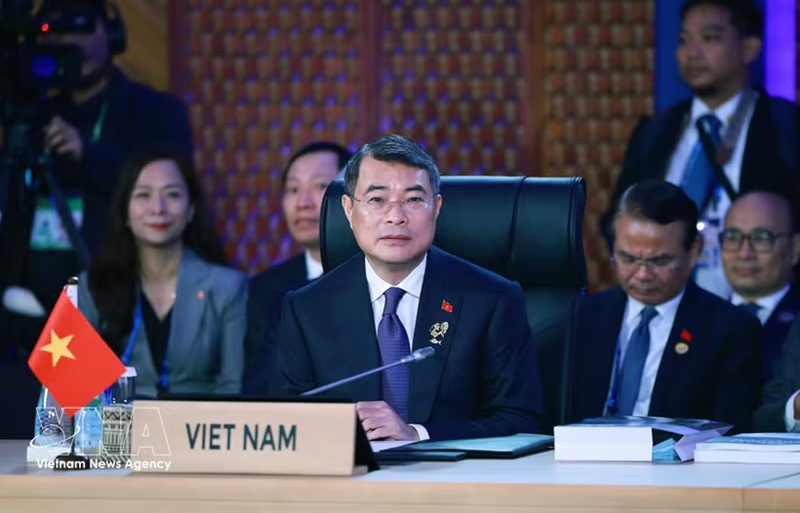
Prime Minister Le Minh Hung attends the plenary session of the 49th ASEAN Summit on November 15, 2026. |
Against this backdrop, he said, the Vietnamese leader's message presented three key pillars for regional cooperation.
Under the first pillar, Viet Nam emphasized that a peaceful and stable environment is essential for economic development. PM Le Minh Hung called for stronger diplomatic dialogue, trust-building, defense and security cooperation, and respect for international law.
Viet Nam also proposed improving the effectiveness of the ASEAN Legal Experts' Forum on Public International Law and establishing clear procedures for information sharing and coordinated responses to emergencies.
Enzo Sim said these proposals reflected Viet Nam's consistent preference for addressing differences through multilateral diplomacy and existing legal frameworks rather than military confrontation. Practical crisis-response mechanisms would also help ASEAN overcome differences in national priorities.
The second pillar focuses on strengthening economic resilience and strategic connectivity. Rather than focusing solely on trade liberalization and market opening as in the past, Viet Nam has shifted its focus toward building resilience in foundational systems, including energy infrastructure, technological capabilities and supply chain security.
Viet Nam called for effective implementation of the ASEAN Digital Economy Framework Agreement (DEFA) and reaffirmed its readiness to contribute to the ASEAN Power Grid and the Manila Energy Initiative.
The Malaysian researcher particularly highlighted the unique “Space for Development and Resilience” initiative proposed by Viet Nam, which seeks to promote satellite data sharing, space research, training and investment in the space economy.
Viet Nam also proposed developing a list of priority ASEAN strategic infrastructure projects toward 2040. According to the analyst, these initiatives could support weather forecasting, disaster management and maritime surveillance while opening up opportunities in higher-value economic sectors.
The third pillar highlights human resources and social development as foundations for regional integration.
The Vietnamese PM stressed investment in high-quality human resources, digital skills training, expanded social protection and more flexible labor mobility.
Viet Nam also pledges to work with Indonesia, Thailand and other ASEAN members to accelerate the effective operation of the ASEAN Center for Public Health Emergencies and Emerging Diseases (ACPHEED).
In addition, Viet Nam encourages cultural cooperation and the development of creative industries in connection with the U.N. International Decade of Culture for Sustainable Development.
Enzo Sim said economic growth alone could not ensure sustainable development without social equity and public welfare. Investment in people and health security would strengthen public confidence in regional integration.
Assessing the broader foreign policy implications, he identified three features of Viet Nam's approach: maintaining ASEAN's central role in maintaining strategic autonomy and balancing ties with major powers, moving from implementing regional commitments toward actively shaping the ASEAN agenda, and aligning national development priorities with the bloc's common interests.
He noted that Viet Nam's initiatives in space cooperation, emergency response, infrastructure connectivity and digital transformation demonstrated its willingness to take a more proactive role in regional affairs.
He said the PM's address had offered a practical roadmap for a more resilient ASEAN, although its success would ultimately depend on the political commitment of all member states and their ability to translate pledges into concrete action.
Source: VNA