The visit, made at the invitation of Lao Prime Minister Saleumxay Kommasith, takes place as the Viet Nam-Laos relationship continues to develop substantively.
Viet Nam and Laos are close neighbors sharing a border, the Truong Son Range and the Mekong River. Their longstanding friendship and special solidarity were founded by President Ho Chi Minh, President Kaysone Phomvihane and President Souphanouvong, and have been nurtured by generations of leaders and people of both countries.
    |
 |
|
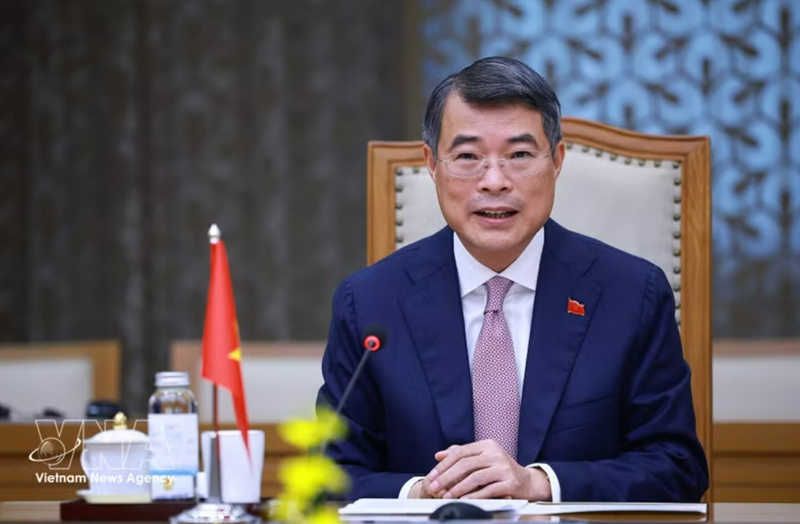
Prime Minister Le Minh Hung |
The two countries established diplomatic relations on September 5, 1962. On July 18, 1977, they signed the Treaty of Friendship and Cooperation, providing an important political and legal foundation for strengthening bilateral ties and supporting each country’s cause of national construction and defense.
In February 2019, the two countries elevated their relationship to one of “great friendship, special solidarity and comprehensive cooperation.” During General Secretary of the Communist Party of Viet Nam Central Committee and President To Lam’s state visit to Laos in December 2025, the leaders agreed to add “strategic cohesion” to the bilateral relationship, reflecting their shared vision, intertwined strategic interests and determination to pursue long-term cooperation for sustainable development, self-reliance and shared prosperity.
High-level exchanges have remained frequent. Through these exchanges, the two sides have agreed to enhance information sharing and experience exchange in implementing the new-term resolutions of their respective Parties and socio-economic development plans for 2026-2030.
Economic, trade and investment cooperation is increasingly viewed as a key component of strategic cohesion. Bilateral trade reached 3 billion USD in 2025 and 1.6 billion USD in the first eight months of 2026. The two countries are working toward a 5-billion-USD trade target and ultimately 10 billion USD.
As of August, Viet Nam had 301 investment projects in Laos with total registered capital exceeding 7 billion USD, ranking second among foreign investors in the country. In the first eight months of this year alone, Vietnamese businesses registered 21 new projects worth nearly 700 million USD, four times the figure recorded in 2025.
Infrastructure connectivity is considered a priority. Viet Nam has strengths in markets, production and processing capacity, seaports and international economic integration, while Laos has potential in energy, natural resources and agriculture, as well as an important position in regional connectivity. Better transport links between Laos and Vietnamese economic centers and seaports will help shorten transit times, reduce logistics costs and improve the competitiveness of goods from both countries.
Defense and security cooperation remains an important pillar, contributing to political stability, national defense and security, and social order in both countries. Cooperation in education, human resources development, culture, tourism and people-to-people exchanges has also produced positive results. In 2025, Viet Nam provided Laos with 1,160 scholarships under bilateral agreements, plus 25 additional scholarships, while Laos offered 60 scholarships to Vietnamese students.
According to Vietnamese Deputy Foreign Minister Nguyen Manh Cuong, PM Hung’s visit, his first official visit to Laos, provides an opportunity for the two Governments to discuss directions and measures to strengthen cooperation in the new period, with a focus on implementing agreements and commitments reached by the two countries’ high-ranking leaders.
The visit is expected to create new momentum for economic, trade and investment cooperation, infrastructure connectivity, education and training, human resources development, science and technology, and emerging areas of cooperation. It will also help strengthen people-to-people exchanges, particularly among young people.
Lao Ambassador to Viet Nam Khamphao Ernthavanh highlighted four priority areas for effectively realizing the strategic cohesion between the two countries: economic and infrastructure connectivity; human resources development; science, technology and digital transformation; and stronger connections between localities and people.
The two sides also regard the visit as practical preparation for the 65th anniversary of diplomatic relations and the 50th anniversary of the Treaty of Friendship and Cooperation, both to be celebrated in 2027.
The addition of “strategic cohesion” is intended to translate the longstanding special relationship into concrete and effective cooperation. As Ambassador Khamphao put it, the key is for words to be matched by action, with practical results rather than declarations alone.
Source: VNA