The ambassador highly valued the visit, made at the invitation of PM Saleumxay Kommasith from October 8-9, describing it as an important event for the great friendship, special solidarity, comprehensive cooperation and strategic cohesion between Laos and Viet Nam.
    |
 |
|
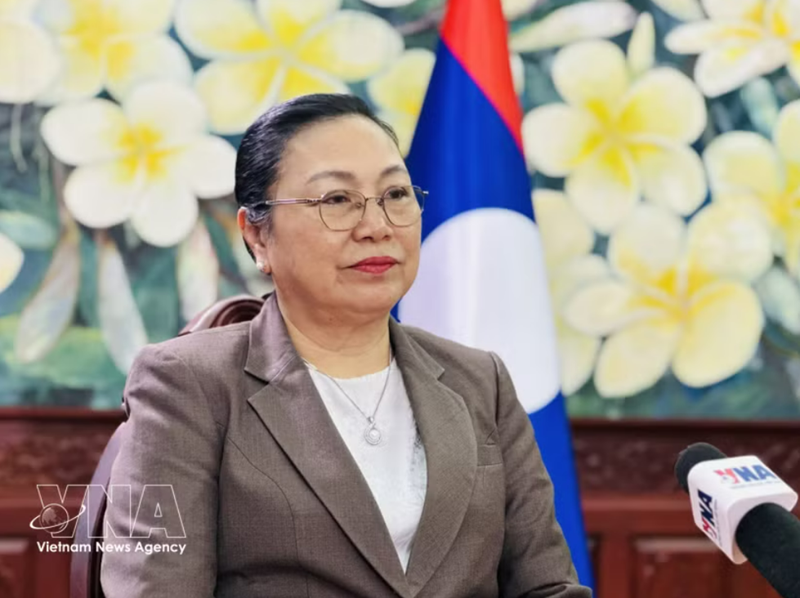
Lao Ambassador to Viet Nam Khamphao Ernthavanh grants an interview to the Viet Nam News Agency ahead of Prime Minister Le Minh Hung’s official visit to Laos. |
The trip, the first to Laos by PM Le Minh Hung since he assumed office, will reaffirm the determination of the two countries’ leaders to implement their reached agreements and common perceptions; and also contribute to putting into practice cooperation plans and programs, particularly those agreed at the 48th meeting of the Viet Nam-Laos Intergovernmental Committee, the diplomat said.
Khamphao said the two countries are making efforts to ensure that economic ties develop in line with their strong political relations. Bilateral trade reached nearly 3 billion USD in 2025 and approximately 1.65 billion USD in the first eight months of 2026.
Viet Nam remains one of the leading investors in Laos, with investment increasingly focusing on quality projects in energy, mining, agriculture and services. She expressed her hope that PM Le Minh Hung’s visit will provide fresh impetus for economic cooperation and mutual development.
She said cooperation would be further expanded in the time ahead, especially in the digital economy, e-commerce, innovation, energy, agriculture and high-quality human resources. The ambassador also suggested the two countries create favorable conditions for their businesses to study each other’s markets and capabilities and implement agreements reached by their leaders.
Regarding the “strategic cohesion”, the diplomat said the concept reflected the leaders’ shared view that all agreed projects and agreements should be implemented and translated into concrete results. To realize it, she identified four priority areas.
First, economic and infrastructure connectivity should be strengthened. With a shared border of more than 2,000 km, the development of transport, logistics, energy, border gates and digital infrastructure is essential to bringing the two countries closer and meeting new development requirements.
Second, the two sides should step up human resources development. Khamphao said education cooperation has been intensified, with more than 1,300 scholarships provided annually for Lao students to study in Viet Nam, alongside regular exchanges and specialized research programs for Lao officials. The two countries have also agreed to establish a Lao-Viet Nam Friendship University in Laos, which is currently being implemented.
Third, science, technology and digital transformation should become a stronger focus. Against the backdrop of rapid digital economic development, Laos and Viet Nam should step up the sharing of experience and collaboration in data, e-commerce, innovation, cybersecurity and digital infrastructure in service of their people and businesses.
Fourth, connectivity between localities and people of the two countries should be enhanced. The ambassador stressed that bilateral ties should not be confined to the central level but should extend to localities and communities. Greater exchanges among provinces and cities, particularly among young people, will help strengthen their understanding of the special relationship and carry forward the legacy built by previous generations.
She emphasized that strategic cohesion should mean turning words into action and ensuring substantive and effective implementation rather than stopping at declarations.
For infrastructure connectivity, Khamphao described transport and logistics as the most important link in Laos’ current development as the country is aims boost connectivity with the region and the world.
The two sides have discussed and prioritized major connectivity projects, including the Hanoi-Vientiane expressway and the Viet Nam-Laos railway. According to the ambassador, these projects will provide valuable support for Laos in improving access to maritime transport through Viet Nam.
If the projects, particularly transport routes expected to be completed by 2030, are implemented effectively, the movement of Lao goods to the sea and regional markets will become faster and more efficient, reducing transport costs and delivery times while ensuring product quality, she assessed.
Energy cooperation is another important area, Khamphao said, noting Laos’ potential in hydropower, wind and solar energy, and expressing her hope that Viet Nam will continue to invest in the power sector, particularly large-scale wind power projects.
The two countries share more than 2,000 km of border, with numerous adjoining localities, which facilitates border trade, thus benefiting border residents, the ambassador stressed.
She also showed her wish that Laos and Viet Nam will continue working together to develop connecting routes and accelerate projects already agreed upon. Successful connectivity in transport, energy, trade and digital transformation will provide an important foundation for deeper strategic cohesion and bring greater benefits to the two peoples.
The diplomat affirmed that the great friendship, special solidarity, comprehensive cooperation and strategic cohesion between Laos and Viet Nam constitute the most important foundation for bilateral ties, particularly political and economic cooperation. She stressed that the younger generation has a responsibility to inherit, preserve and further develop the relationship for generations to come.
Source: VNA