The site supports education and scientific research, ecological restoration, and awareness campaigns on forest protection, the environment, and biodiversity preservation.
“Lost” in tropical botanical garden
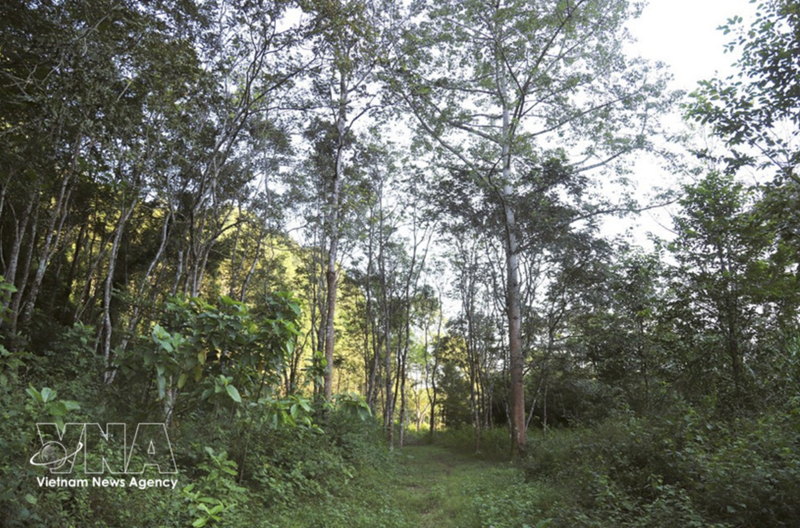
Tran Duc Long, head of the Office for Science – Technology and International Cooperation under the reserve’s management board, said after more than two decades, the garden now sprawls across nearly 11 ha, divided into nine functional zones. Its primary mission is to conserve the genetic resources of rare, native and economically valuable plant species. To date, more than 120 indigenous species have been planted, with numerous rare species now forming closed-canopy forest patches.
    |
 |
|
At outlying botanical garden of Pu Huong Nature Reserve |
Adjacent to the garden stands the Pu Huong Nature Reserve Museum, packed with around 150 animal specimens, including fish, amphibians, reptiles, mammals and insects. Standouts include specimens of wildcats, white-cheeked gibbons, langurs, Asiatic black bears, civets and saola horns, complemented by displays of butterflies, freshwater fish and snakes. The museum also features more than 500 plant specimens, notably green ironwood, Parashorea chinensis, Nageia fleuryi, ebony and Anoectochilus orchids. All of them showcase the genetic jackpot inside the Pu Huong ecosystem, one of three special-use forests within the core zone of the Western Nghe An Biosphere Reserve recognized by UNESCO in 2007.
Since 2023, the museum has featured open nature-culture exhibits, perfect for scientists to expand research in their biological fields, and tourists to explore further into the scientific realm while taking in the exhibits.
Remarkable conservation and scientific value
Dr. Nguyen Thanh Chung from the Nghe An Forest Inventory and Planning Division called the garden a big deal, for the province, and for all of Vietnam's efforts to protect different kinds of plants and animals. It's a science center for saving plants, learning about them and carefully using them, plus it gives real help for taking care of, protecting and restoring this special forest area, he said.
Situated at the heart of the Western Nghe An Biosphere Reserve corridor and within the biodiversity-rich core zone of the northern Truong Son mountain range, the garden features typical vegetation types, how the plants grow, which species live symbiotically, and how they interact in the wild.
Chung noted that the garden provides a platform for conserving plant genes, particularly endangered, rare and endemic species. Beyond conservation, it operates as a research hub for botany, forest ecology, biodiversity conservation, and climate change studies.
Vo Minh Son, Director of the Pu Huong Nature Reserve Management Board, said the team is turning the garden into a top spot for eco-tourism. The plan is to connect it with nearby tourist places so the whole area benefits. They want to attract students, teachers and scientists for research, and also bring in regular visitors who want to hike through western Nghe An's wild areas and feel like they're in a real-life nature show.
Source: VNA