Nature here retains its pristine and distinctive beauty, with vast mangrove forests and rich ecosystems at Ca Mau Cape, where each sunrise unfolds a scene both expansive and peacefully captivating. This is a common impression shared by many visitors when arriving at the “Southernmost tip of Vietnam.”
    |
 |
|
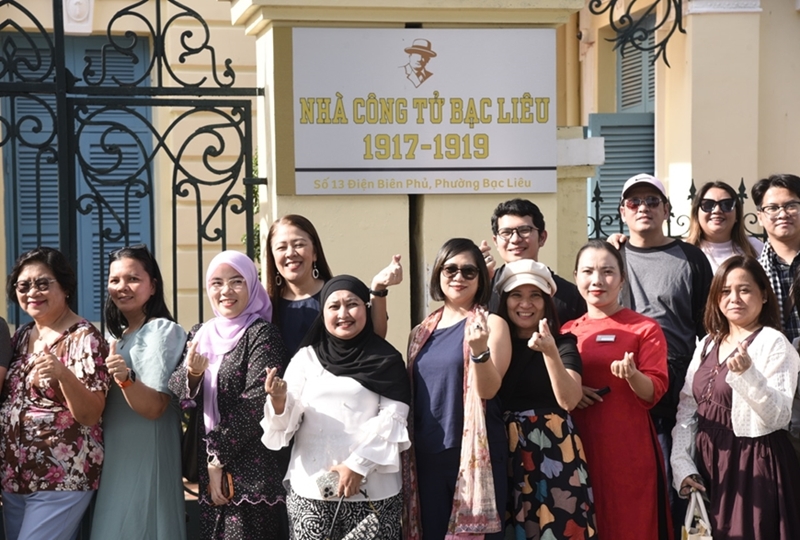
Malaysian and Philippine tourists take commemorative photos at the Cong ty Bac Lieu House relic site. |
Ms. Carmelita G. Bunao, President of the Independent Travel Agencies and Tour Operations Association of the Philippines, shared that she explored Northern Vietnam, discovering the green lakes of Hanoi, the magnificent Ha Long Bay, and well-developed, modern tourist destinations. However, when she came to Ca Mau, “it was a completely different land, where there is a stronger focus on eco-tourism development.” As a member of the Philippine Ecotourism Committee, she assessed that Ca Mau possesses many natural resources that can be leveraged to promote tourism growth.
Attentively, Ca Mau boasts rich indigenous culture that reflects the identity of Southern Vietnam. These include the cultural space of Don ca tai tu (Southern amateur music), recognized by UNESCO as an intangible cultural heritage of humanity; the Nghinh Ong Festival; traditional craft villages producing dried seafood and salt associated with coastal livelihoods; and the interwoven cultures of the Kinh, Khmer, and Hoa communities. Cultural and historical narratives, from the resilience of people who live by the sea and protect forests to stories of Cong tu Bac Lieu (Bac Lieu playboy), serve as both valuable heritage and unique materials for developing distinctive tourism products.
Currently, Ca Mau has 12 key tourist sites and is gradually affirming its position on Vietnam’s tourism map. The province has approved the master plan for the Ca Mau Cape National Tourist Site by 2050 and identified the Nha Mat-Bac Lieu area as a potential national tourism zone. Establishing these two focal development areas not only helps define spatial identity and branding, but also reflects a long-term vision with a clear strategy to build competitive tourism products.
According to Nguyen Quoc Thanh, Director of the provincial Department of Culture, Sports and Tourism, once positioned at the national level, these areas will receive support in infrastructure, promotion, and planning, creating a solid foundation for systematic and well-oriented development.
Compared to other localities in the region, Ca Mau faces several challenges in tourism development, including its distance from major tourist markets, limited transport infrastructure, low connectivity, and a shortage of high-end products and services. However, rather than viewing these as obstacles, the province considers them a driving force for restructuring and breakthrough development. The strategy of developing two national tourism areas reflects strong determination to turn challenges into opportunities and elevate its tourism profile.
Pham Manh Cuong, Secretary General of the Vietnam Travel Association, noted that “With its unique natural and cultural advantages, Ca Mau can fully develop tourism in a green and sustainable direction.”
Within the broader trajectory of Vietnam’s tourism sector, Ca Mau is steadily asserting its position through its own identity. Its pristine nature, distinctive culture, and clear strategic orientation form a solid foundation for the province’s tourism sector to confidently expand toward national and international recognition.
Translated by Chung Anh