More than six decades later, memories of springtime spent around the tunnels continue to resonate among local communities, who proudly recount stories of wartime perseverance to visitors exploring the National Historical Site.
An underground stronghold
During the war, Ky Anh Tunnels lay approximately 7km from the center of the former Saigon administration and just 2km from a U.S. military base. The network functioned as a crucial logistical corridor, enabling the movement of food supplies and revolutionary cadres between eastern lowland communes of Thang Binh and Tam Ky and resistance bases in the western mountainous region.
    |
 |
|
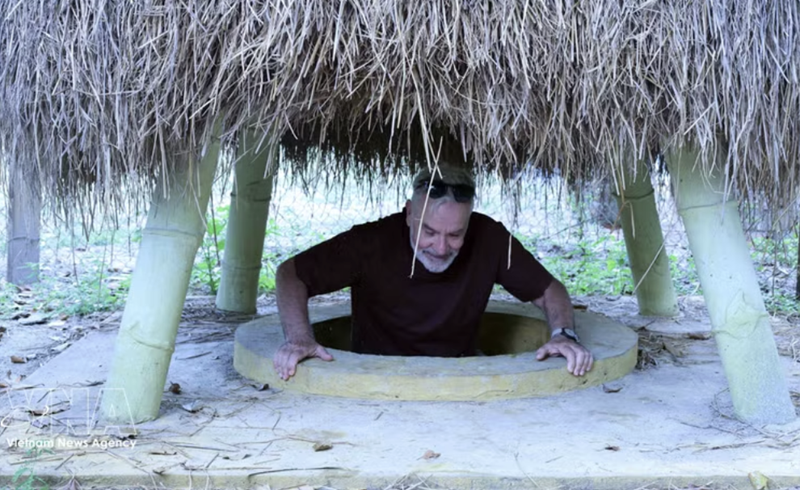
A visitor at a tunnel entrance located within a resident’s garden at Ky Anh Tunnels. |
Visitors are often astonished to learn that beneath vast stretches of white sand lies a remarkably durable and well-organized underground system. Ingeniously designed, the tunnels provided shelter for revolutionaries from large-scale search-and-destroy operations conducted by U.S. and allied forces while supporting guerrilla attacks that disrupted enemy operations.
Excavated between mid-1965 and 1967, the tunnels were built in a winding grid-like layout stretching 32km in total length. Passageways measured between 0.5 and 0.8 meters wide and nearly one meter high, concentrated mainly in Thach Tan and Vinh Binh villages.
Le Khac Phien, a resident of Thach Tan village who had recently joined the Party at the time, recalled taking part in discussions on excavation plans. With only 28 households, most of them revolutionary families, the village maintained strict secrecy throughout construction. Although the area was dominated by loose white sand, workers discovered a dense clay layer about 70cm below ground, roughly 1.2 meters thick, which proved suitable for tunneling.
|
|
 |
|
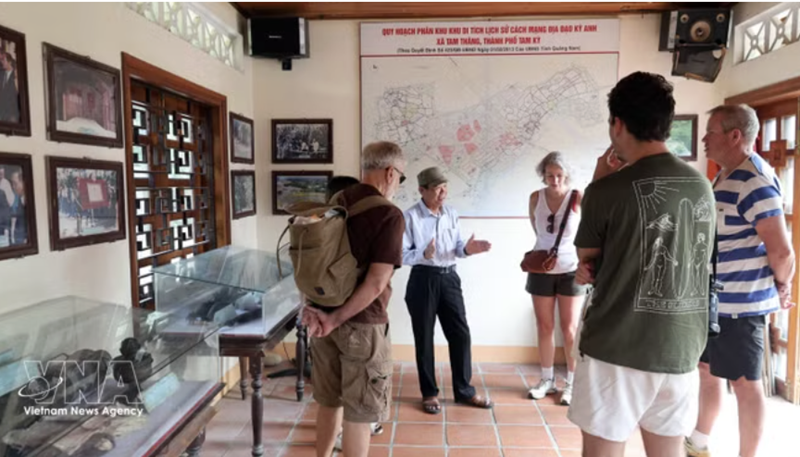
International visitors learn about the formation and history of Ky Anh Tunnels. |
As enemy patrols were usually carried out during daylight hours, excavation work took place from evening until dawn. Residents worked in small teams, digging separate sections that were later connected into a vast underground network linking neighboring villages.
Despite wartime hardship and shortages, the arrival of the Lunar New Year always brought hope. Local cadres and residents held a firm belief in eventual national reunification and the dream of families across North and South being reunited.
A gateway for international understanding
After discovering information about Ky Anh Tunnels online, Dutch visitor Sandra Woudstra chose the site as a stop during her Lunar New Year journey to Vietnam with friends.
She said the historical accounts sparked her curiosity, but the reality was even more impressive. Using only basic farming tools, residents managed to construct in secret a 32km tunnel system over several years. Life underground was cramped and often flooded, yet people endured and continued fighting - a reflection, she noted, of their unity, resilience and deep patriotism.
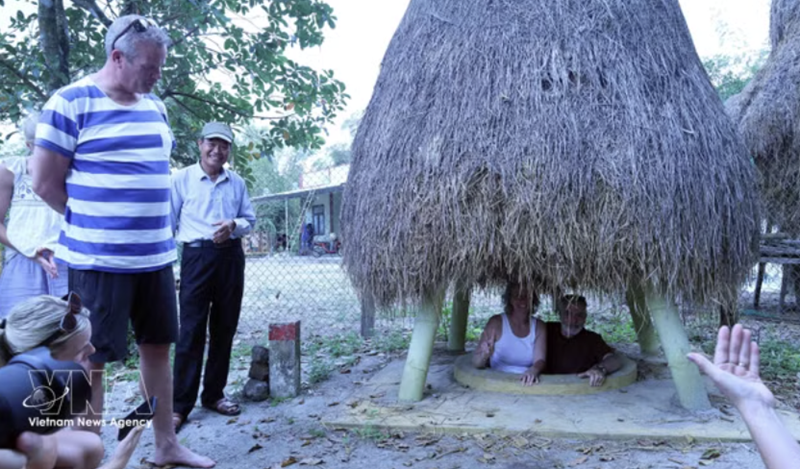
Over time, some sections of the tunnels collapsed or were buried by sand. Authorities have since restored several segments, allowing visitors to descend underground and re-emerge through hidden exits along roadsides or beneath straw stacks in villagers’ gardens.
Italian tourist Mario Valerio Dattola described his experience walking through the tunnels, where water still flows beneath visitors’ feet, as both exciting and moving. He highlighted the ingenuity of communication methods between villagers above ground and revolutionary forces below, including signals transmitted through wells and candlelight cues, illustrating the close cooperation between civilians and resistance fighters during enemy sweeps.
|
|
 |
|
Visitors climb out through a tunnel entrance located in a resident’s garden at Ky Anh Tunnels. |
Huynh Kim Ta, a local guide who shares stories of the tunnels with visitors daily, said international tourists commonly express admiration for the Vietnamese people’s determination, desire for peace and unwavering courage in their struggle for national independence and reunification against a far stronger adversary.
Today, Ky Anh Tunnels National Historical Site attracts between 12,000 and 15,000 domestic and international visitors each year. The site is also frequently chosen by organizations, schools and institutions for educational tours, historical research and Party membership induction ceremonies.
Da Nang authorities are working to enhance tourism development at the site, aiming to transform Ky Anh Tunnels into a distinctive experiential tourism product in the city’s southern area. The initiative is expected to promote community-based tourism while offering international visitors deeper insight into Vietnam’s historic struggle for independence and reunification.
Source: VNA