Vietnam has strong potential to develop this form of tourism thanks to its thousands of long-established craft villages. From Van Phuc silk in Hanoi and Ninh Van stone carving in Ninh Binh to Bau Truc pottery in Khanh Hoa, Phuoc Kieu bronze casting in Da Nang, and brocade weaving in Central Vietnam and the Central Highlands, each community preserves distinctive craftsmanship and cultural traditions.
    |
 |
|
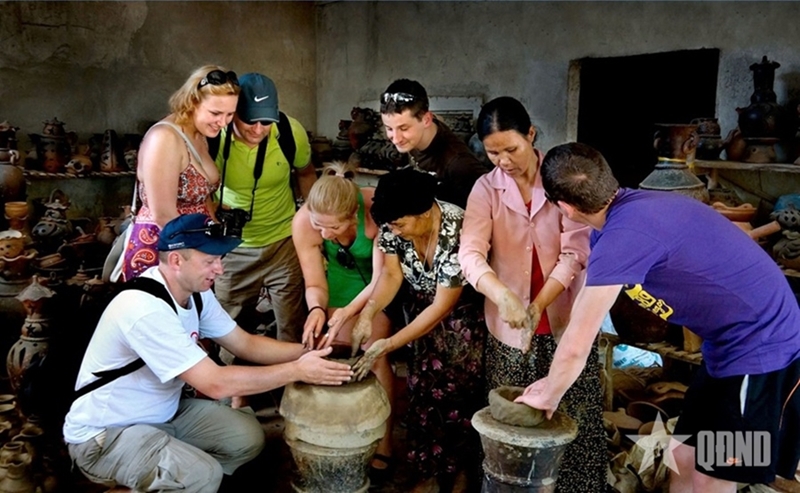
International visitors experience pottery making at Bau Truc pottery village in Khanh Hoa. |
That potential has already proved viable. Since the early 2000s, Bat Trang pottery village in Hanoi has offered pottery-making activities for visitors, becoming a successful model of craft village tourism.
Beyond preserving cultural heritage, the craft village tourism generates direct economic benefits. It provides residents with additional income, creates jobs, and helps revive traditional crafts at risk of disappearing. Handicrafts sold directly to visitors can also serve as a form of “on-site export,” generating economic value while introducing Vietnamese culture to domestic and international tourists.
However, many craft villages still struggle to offer experiences attractive enough to encourage longer stays. Infrastructure remains inadequate, with many destinations lacking demonstration spaces, accommodations, and dining services. Some hands-on activities are superficial, leaving visitors to spend less than an hour taking photos before moving on.
Many handicraft products have also been slow to adapt their designs to market demand. Although artisans possess extensive skills and experience, many lack expertise in interpretation, hospitality, and business. Cooperation between craft villages and tour operators remains limited, resulting in short visits and low tourist spending. Without stories about the people, history, and cultural values behind their products, craft villages risk becoming overly commercialized and losing the identity that makes them distinctive. Despite Vietnam’s large number of craft villages, only a few have effectively tapped their tourism potential and generated significant revenue.
To address these challenges, craft village tourism is gradually shifting from sightseeing and shopping toward hands-on experiences, where each product tells a story and each artisan becomes a cultural ambassador. Villages are building brands around their history, people, and local identity while developing more creative and sustainable products.
The State is investing in infrastructure, providing financial support, and training residents in tourism skills. Tour operators need to work more closely with craft villages to develop attractive itineraries that encourage visitors to stay longer and spend more. Promotion through digital platforms, festivals, fairs, and tourism programs should also be strengthened, while younger generations are encouraged to use technology to find new ways of telling stories of traditional crafts.
With systematic investment, craft village tourism can provide sustainable livelihoods while preserving and promoting Vietnamese cultural identity. More broadly, it can transform craft villages into living cultural spaces where heritage is passed on, local economies gain new momentum, and Vietnam’s soft power is strengthened.
Translated by Tran Hoai