The patient, named T.D.H., born in 1974, residing in Hac Thanh ward, Thanh Hoa province, had a medical history of hypertension, abdominal aortic aneurysm, and dyslipidemia. While having breakfast at a local eatery, he suddenly lost consciousness and collapsed to the floor. The incident occurred rapidly and unexpectedly.
    |
 |
|
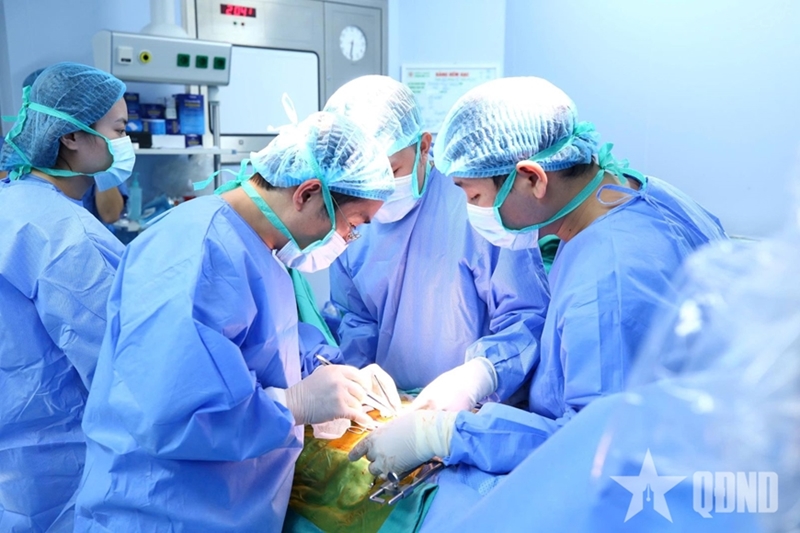
Doctors of the Central Military Hospital 108 perform surgery. |
Immediately upon noticing the situation, the restaurant owner initiated chest compressions for the patient. Cardiopulmonary resuscitation was maintained continuously while awaiting the ambulance and during transport to Thanh Hoa Provincial General Hospital, lasting nearly one hour.
At the hospital, advanced cardiopulmonary resuscitation was continued. Doctors performed chest compressions, multiple defibrillations, and applied advanced emergency measures. The total time from cardiac arrest to the return of spontaneous circulation was nearly two hours, an exceptionally long duration for an out-of-hospital cardiac arrest case.
After spontaneous circulation was restored, the patient was urgently transferred to the Central Military Hospital 108. He was admitted to the Cardiovascular Intensive Care Unit in deep coma, on mechanical ventilation, with unstable hemodynamics and dependent on three high-dose vasopressors.
The treatment team, led directly by Assoc. Prof., Dr. Do Van Chien, Deputy Head of the Cardiovascular Intensive Care Unit, received and assessed the patient. Based on clinical data, electrocardiography, and the course of prior resuscitation, the team determined that the cause of cardiac arrest was acute myocardial infarction complicated by malignant arrhythmias.
The patient was indicated for emergency coronary angiography and intervention. Lesion assessment was performed using intravascular ultrasound (IVUS), allowing precise identification of plaque characteristics and the degree of coronary stenosis. An optimal revascularization strategy tailored to the patient’s condition was developed. Coronary stent implantation was carried out promptly, safely, and effectively. Following the intervention, the patient’s hemodynamics improved markedly, vasopressor doses were gradually reduced, and emergency continuous renal replacement therapy was initiated to support organ function.
The patient’s level of consciousness improved steadily day-by-day. Early extubation was achieved. After seven days of intensive treatment, the patient had sound mind, with good mobility and no recorded neurological sequelae. He was discharged after two weeks of treatment.
According to Assoc. Prof., Dr. Do Van Chien, cardiac arrest is one of the most critical emergencies in medicine, especially when it occurs outside the hospital. International statistics show that survival rates after out-of-hospital cardiac arrest are only about 8% - 12%, while survival without severe neurological sequelae ranges from just 3% - 5%.
Each minute without effective circulation increases the risk of death and irreversible brain injury. Successfully saving and fully restoring a patient after nearly two hours of cardiac arrest is an extremely rare outcome. This result reflects the comprehensive and advanced level of emergency care, resuscitation, and cardiovascular intervention at the Central Military Hospital 108.
The patient’s recovery was the result of a persistent and uninterrupted chain of emergency care. Timely bystander chest compressions played a decisive role in the initial minutes. Safe transportation helped maintain basic resuscitative measures. Prolonged cardiopulmonary resuscitation at the provincial level laid the foundation for subsequent treatment. Advanced cardiovascular critical care and precise coronary intervention at the tertiary level ultimately provided the patient with a real chance of survival.
The case also highlights the central role of cardiovascular intensive care doctors who work at the final line, where the boundary between life and death is extremely fragile. Every treatment decision requires experience, bravery, and close coordination.
Recognizing that the quality of cardiac arrest resuscitation largely depends on early intervention and the competence of providers, the Cardiovascular Intensive Care Unit places strong emphasis on training. Doctors and nurses regularly participate in basic and advanced cardiac arrest resuscitation training. These training activities are conducted within the hospital and extended to lower-level healthcare facilities.
The overarching goal is to shorten the duration without effective circulation, increase survival rates, and reduce neurological sequelae. With this orientation, the Cardiovascular Intensive Care Unit continues to affirm its core role in training, providing professional support, and standardizing emergency procedures, thereby improving treatment quality and bringing chances of life to patients.
Translated by Chung Anh