Amandeep Singh Gill, U.N. Under-Secretary-General, the Secretary-General’s Envoy on Technology and also a member of the U.N. Secretary-General’s High-level Advisory Body on artificial intelligence (AI), together with a U.N. delegation, are in Vietnam to attend the 6th ASEAN Digital Ministers’ Meeting.
    |
 |
|
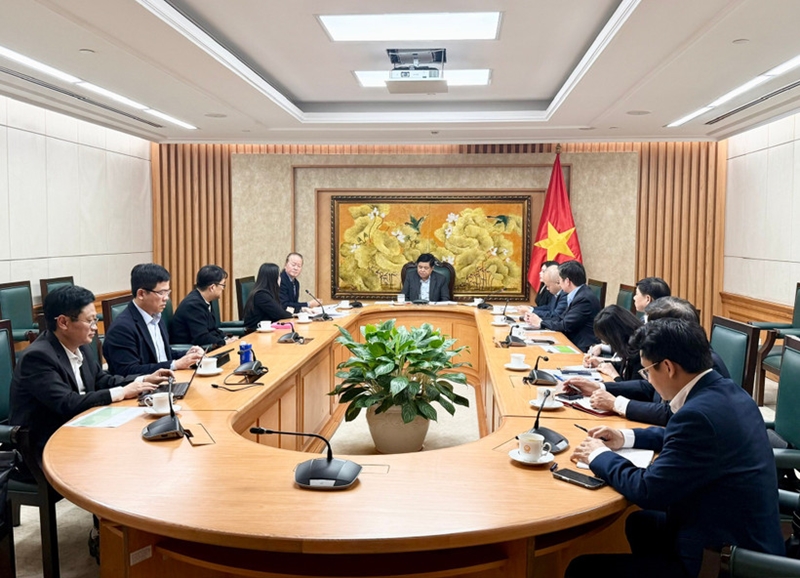
Deputy Prime Minister Nguyen Chi Dung receives a delegation of Seoul Semiconductor Co., Ltd. led by its CEO Lee Chung-hoon in Hanoi on January 16. (Photo: Government Portal) |
Informing his guest about some of Vietnam’s achievements in sci-tech development, innovation, and digital transformation, Dung highlighted that the country and the U.N. have recorded progress in their sci-tech relations, with cooperation in strategic areas matching global trends and bilateral cooperation demand.
Vietnam hopes for continued support and assistance from the U.N. to ensure effective implementation, thereby contributing to common development in the region and the world, he remarked.
Calling on the U.N. to create favorable conditions for Vietnam to carry out specific cooperation aspects, the Deputy PM proposed the world’s largest multilateral organization expand cooperation in building digital capacity for Vietnamese experts and scientists in its activities.
On behalf of the Government, Dung thanked and asked the Under-Secretary-General as well as his colleagues to keep supporting and promoting collaboration activities with Vietnam in science – technology, innovation, and digital transformation.
He also wished the Vietnam – U.N. cooperation to grow further, generating tangible benefits for regional and global scientists, enterprises, and people.
The same day, the Vietnamese Deputy PM received a Seoul Semiconductor delegation led by its CEO Lee Chung-hoon, who said the firm, established in 1992, is the world's third-largest corporation in the research, development, and manufacturing of LED components.
Seoul Semiconductor boasts annual revenues exceeding 1 billion USD, a network of nearly 30 offices in about 70 countries, and manufacturing facilities in the RoK, the US, China, and Vietnam. It currently holds around 16,000 patents and is setting new standards in the optoelectronics industry.
In Vietnam, the Seoul Semiconductor Vina Co., Ltd. has registered an investment worth 525 million USD in the Dong Van I Industrial Park, Ninh Binh province, producing optical semiconductor products. The project is divided into four phases, with three phases already completed and operational since January 2017, having disbursed 470 million USD, he noted.
Applauding the firm’s productive performance and contributions in Vietnam, Dung said Vietnam targets growth of at least 10% for 2026 and considers science – technology, innovation, and digital transformation as a key development driver. It has identified 11 groups of strategic technologies, including semiconductor and AI.
He said Vietnam started work on a hi-tech semiconductor manufacturing plant on January 16 to serve domestic chip research, design, and production, a strategic project showing Vietnam’s ambition to catch up, keep pace with, and surpass others in the global semiconductor value chain.
The Deputy PM suggested Seoul Semiconductor scale up its investment and business operations in Vietnam, assist local enterprises to join its production chain, and foster ties in training semiconductor manpower.
Source: VNA