Resolution 72 not only focuses on health care but is also closely interlinked with other sectors, helping to build a solid foundation for sustainable national development and create momentum for Vietnam to “take off” and further integrate into the world.
On September 9, 2025, the Politburo promulgated Resolution 72-NQ/TW on some breakthrough solutions to enhance the protection, care and improvement of public health, reaffirming the Party’s deep commitment to safeguarding the health of every citizen, with the overarching goal of building a healthy Vietnam.
    |
 |
|
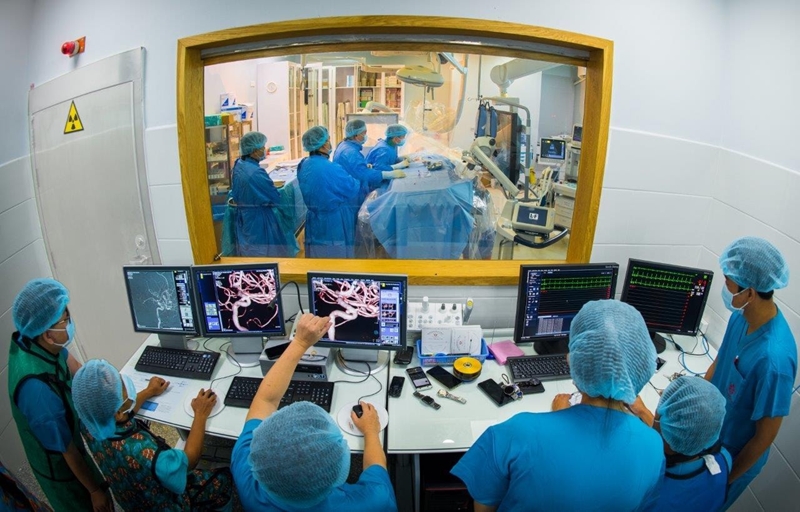
Digital transformation in health care is being promoted strongly. (Photo: Organizing Board of the Technology with Heart Awards 2024, co-hosted by the VNA and Viettel) |
Resolution 72 offers a comprehensive approach to the factors that collectively shape public health, including physical and mental well-being, life expectancy, quality of life, and equitable access to essential services, particularly for the poor and vulnerable groups. It also covers disease prevention and preventive medicine, digital transformation, reform of governance mindset, and mobilization of investment resources tied to the responsibilities of relevant agencies.
According to Minister of Health Dao Hong Lan, Resolution 72 holds strategic, comprehensive and long-term significance and, above all, is action-oriented, serving as “a resolution for the implementation of other resolutions.” It introduces a series of supplementary and strengthened policies that further concretize existing Party guidelines, while identifying breakthrough tasks and solutions to address long-standing bottlenecks and constraints. This resolution is expected to meet the requirements of sustainable national development and public expectations, advancing progress towards the two strategic centenary goals for 2030 – the Party's 100th founding anniversary, and for 2045 – the 100th anniversary of national independence.
The resolution was developed on the principle of not replacing previous Party resolutions and directives, but rather addressing new, important, and high-impact issues. Its purpose is to remove main bottlenecks and create breakthroughs in public health protection, care, and improvement, contributing to the achievement of the country’s strategic goals. It sets out five guiding viewpoints, five groups of specific targets for 2030 with a vision to 2045, six groups of breakthrough tasks and solutions, and responsibilities for implementation.
A major highlight of Resolution 72 is the shift from “treatment” to “prevention,” placing preventive and grassroots health care at the core. This will ensure that citizens receive quality health services and comprehensive health management directly at commune-level clinics.
Alongside strengthening disease prevention and control and upgrading the grassroots healthcare system, the resolution sets a roadmap to 2030 with a vision to 2045, introducing breakthrough policies to remove long-standing bottlenecks.
In particular, the resolution highlights the role of the private health sector as a key driver. It sets up favorable conditions for this sector to make investment and grow, helping to reduce pressure on the public health system and raise the quality of healthcare services. Supportive policies include allocating clean or reclaimed land for medical projects, allowing flexible land-use changes for health facilities, prioritizing site clearance and quick handover for those projects, waiving land-use fees, cutting land rent and related taxes for domestic health establishments, and exempting corporate income tax for both public and non-profit private facilities. In addition, surplus government office space can be given to health facilities, and private institutions can lease State-owned buildings as allowed by regulations.
These policies are not only groundbreaking but also demonstrate the Party’s strong recognition of the private sector’s role in public health care.
Tangible progress
Thanks to the strong attention of the Party and State, Vietnam’s healthcare sector has achieved significant progress in recent years.
Key health indicators have steadily improved, with several exceeding international benchmarks: average life expectancy has reached 74.7 years, while healthy life expectancy is 65.4 years.
|
|
 |
|
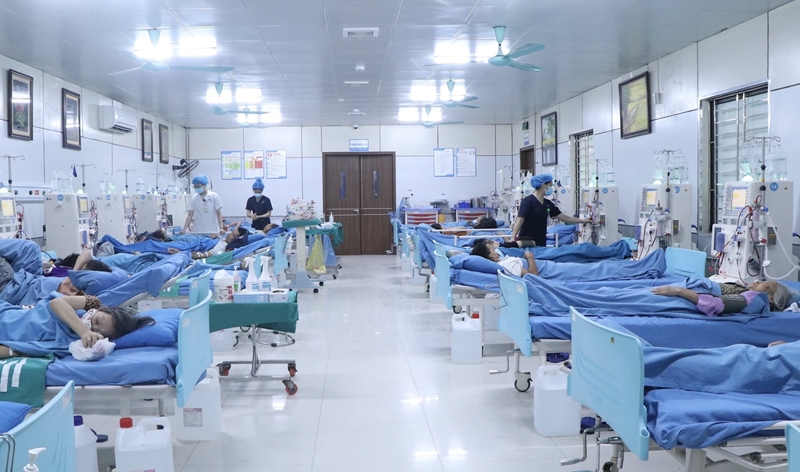
Hospital beds rise from 24 per 10,000 people in 2015 to 34 per 10,000 people in 2024. |
Legal and policy frameworks have continued to improve, with nine laws and four ordinances issued in areas such as preventive healthcare, medical examination and treatment, population, health insurance and pharmaceuticals. The healthcare network has expanded nationwide: 99.6% of communes, wards and towns now have medical stations, and the number of hospitals increased from 1,162 in 2011 to 1,665 in 2024. Hospital beds rose from 24 per 10,000 people in 2015 to 34 per 10,000 people in 2024. The health workforce has also grown in both quantity and quality, with the number of doctors rising from 8 per 10,000 people in 2015 to 14 per 10,000 people in 2024.
Service quality continues to improve; expanded immunization coverage is close to 95%; many dangerous diseases, including COVID-19, have been contained or eliminated; and various advanced medical techniques have been successfully deployed.
Health insurance coverage has risen rapidly, reaching 94.2% of the population in 2024. Pharmaceutical and vaccine production capacity has also strengthened as the number of pharmaceutical plants increased from 158 in 2015 to 240 in 2024, and Vietnam now produces 10 of the 12 vaccines used in the national expanded immunization program.
Building on these achievements, Resolution 72, an action-oriented policy reflecting the Party and State’s strong commitment to public health, is expected to usher in a new phase of development for Vietnam’s healthcare sector, contributing to the vision of a healthy, strong, and prosperous Vietnam in the new era.
Source: VNA