Binh made the statement at a reception on August 27 for Silvia Danailov, UNICEF Representative in Viet Nam, and Pauline Tamesis, U.N. Resident Coordinator in Viet Nam.
    |
 |
|
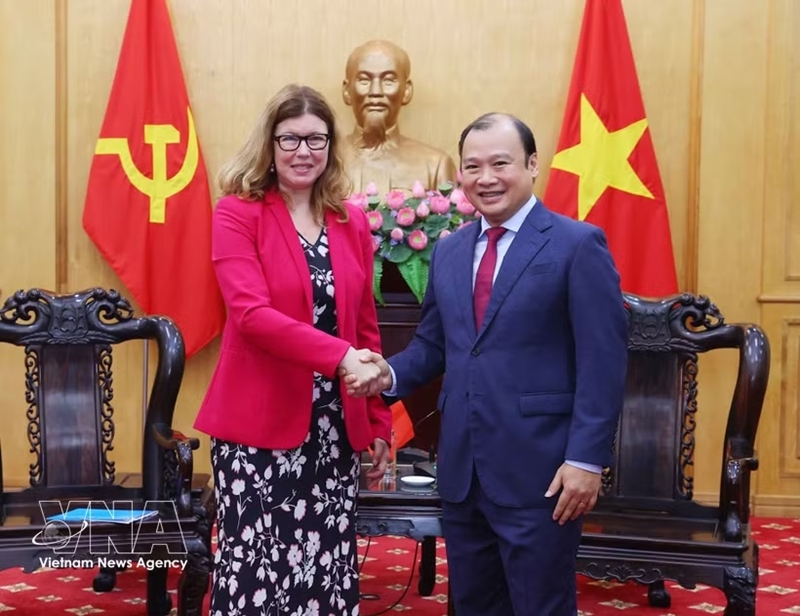
Assoc. Prof., Dr. Le Hai Binh, Member of the Party Central Committee and Permanent Vice President of the Ho Chi Minh National Academy of Politics (right) and Silvia Danailov, UNICEF Representative in Viet Nam at their meeting on August 27 |
The two sides reviewed cooperation outcomes and discussed orientations for 2026–2031, focusing on children's rights and sustainable development. They noted that the HCMA-UNICEF partnership has grown more effective, substantive and in-depth, with strategic programs closely aligned with the Party and State's priorities in child protection, care and education.
Through the partnership, the academy has stayed up to date with international standards and gained access to new knowledge on children's rights, social development and modern public governance, helping improve theoretical research and policy advice. Children's rights have also been incorporated into training programs for leaders and managers, alongside advanced approaches such as results-based management (RBM).
Joint research has produced practical knowledge products, including the report "50 Years of Progress for Children in Viet Nam, Opportunities and Investments for Future Generations," contributing to child-centered policymaking and improved public services.
Binh affirmed that child care, protection and education remain strategic priorities of the Party and State, with children at the center of the country's human development strategy and as the future owners of the nation.
He said the HCMA attaches great importance to its partnership with UNICEF and wants to fully tap its potential in the new period.
Tamesis said investment in children is investment in both the present and future of a country. She stressed the importance of integrated investment linking "hard" infrastructure with "soft" social infrastructure, including education, nutrition and online safety.
Viet Nam is at a pivotal stage on its path toward the 2030 Agenda, she said, adding that comprehensive investment in children would help nurture healthy and knowledgeable future generations and lay a firm foundation for modern and sustainable development.
Danailov appreciated the efforts and priority given by the Party, Government and HCMA to child development. She affirmed UNICEF's readiness to provide technical support and connect the academy with leading international experts in theoretical research, policy advice and the development of an equitable public governance ecosystem.
She expressed hope that the two sides would prepare the necessary technical content for a new Memorandum of Understanding on cooperation for 2026–2031, creating a solid foundation for achieving long-term strategic goals.
To elevate their partnership, the HCMA and UNICEF agreed on strategic cooperation orientations for 2026–2031, under which they will step up research and policy advice on children's rights amid new development conditions, focusing on practical issues such as the impacts of new growth models, urbanization, migration and climate change on children and families.
Priority will be given to strengthening child protection institutions in the digital economy, managing cybersecurity risks and conducting long-term assessments of social service delivery capacity for the 2030–2045 period.
Children's rights will continue to be integrated extensively into training and capacity-building programs for leaders and managers at all levels through specialized materials on public policymaking, results-based management, data-driven policy analysis and child protection in the digital environment.
The two sides also agreed to jointly organize annual forums and scientific seminars to share new knowledge and support the development of inclusive policy recommendations.
To begin implementing these orientations in 2026, they concurred on specific activities, including a research project on evidence-based development and policy advice on children's rights and inclusive development, as well as a capacity-building program to enhance local leaders' and managers' capacity in children's rights, providing grassroots officials with modern governance skills.
Source: VNA