Ho Chi Minh City currently has 20 operational data centers and nine proposed projects, according to the municipal Department of Science and Technology. New projects are moving beyond traditional data centers toward large complexes integrating AI and other digital infrastructure.
    |
 |
|
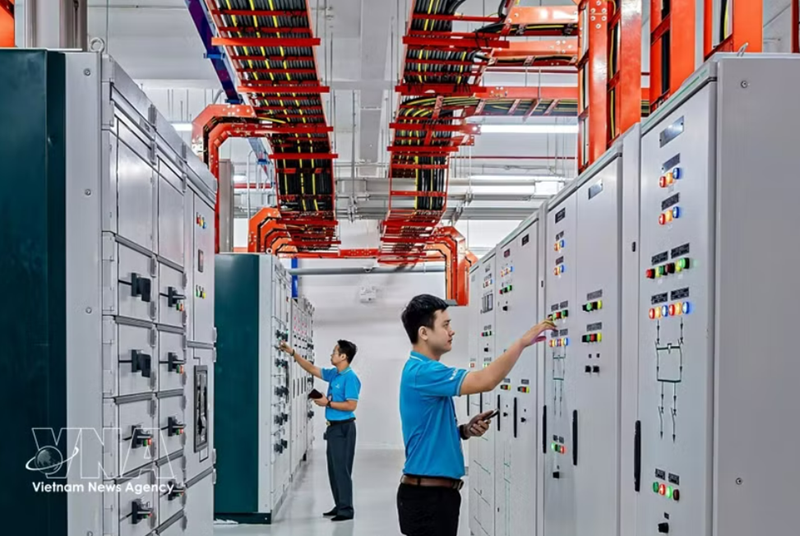
VNPT’s data center (IDC) at Hoa Lac Hi-Tech Park, the largest of its kind in Viet Nam, is equipped with state-of-the-art technologies and fully meets international technical standards. |
Among the most notable is the SGI-HCM Campus data center and AI complex at Tan Phu Trung Industrial Park, invested in by Kinh Bac City Development Holding Corporation (KBC) in partnership with Accelerated Infrastructure Capital (AIC) and VietinBank. The project has an estimated investment of about 2.1 billion USD and received its investment registration certificate on July 21.
Another major proposal is a 2-billion-USD AI super data center by UAE-based G42, Microsoft, FPT Corporation, Viet Thai Group and VinaCapital. The project is expected to contribute to economic growth and strengthen Viet Nam’s appeal to foreign investors.
In late July, Ho Chi Minh City authorities and an inter-agency working group met with G42, Microsoft and other investors to discuss the Trusted Data Agreement and related legal issues. Investors are continuing to refine the project and study potential locations.
Several other large projects are also being carried out or proposed at the Saigon Hi-Tech Park, including those involving BW Industrial Development, Warburg Pincus and Digital Realty; Sembcorp-BB Holding; NTT Global Data Centers; and CMC Corporation. Their investment values range from 250 million USD to 850 million USD.
The surge comes as demand for data infrastructure grows rapidly. Savills Viet Nam forecasts that the country’s data center capacity could reach around 950 MW by 2030, up from about 524.7 MW in 2025. Market revenue is projected to exceed 3 billion USD by 2031, with annual growth of more than 20%.
John Campbell, Director of Industrial Services at Savills Viet Nam, said Viet Nam was at the beginning of a significant data center development cycle. He noted that demand had existed for years, supported by the country’s young population, high technology adoption and rapid digitalization.
Large cloud service providers have also been showing interest in Viet Nam for the past four to five years, indicating that demand is not new but that the market is becoming increasingly ready for faster growth.
Regulatory changes are providing additional momentum. Since 2025, foreign investors have been allowed to own 100% of companies providing data center services, removing one of the barriers that previously limited international investment in the sector.
The race is about more than land
Unlike conventional industrial real estate, where land, location and infrastructure access are key considerations, data centers require a much more complex combination of conditions.
Power supply is the most critical factor. Large data centers consume huge amounts of electricity and require a stable, uninterrupted supply, with sufficient backup capacity and an increasing focus on clean energy.
Andrew Green, Head of Data Centre Group, Asia Pacific at Cushman & Wakefield, said data center development was shifting from locations with good connectivity to markets capable of supplying electricity on a large scale. This trend is creating new growth corridors and pushing investment beyond traditional data center hubs.
Data connectivity is another essential factor. Large data centers need reliable international Internet connections, particularly submarine cables and stable landing stations. As cloud computing, AI and cross-border data services expand, connectivity is becoming an increasingly important part of a data center’s value.
This is encouraging projects to cluster around areas where different layers of infrastructure converge, including hi-tech and industrial parks, logistics hubs and major cities.
Data regulations and information security are also becoming increasingly important. According to Savills, tighter personal data protection rules are likely to encourage businesses to store and process more data in Viet Nam, increasing demand for facilities that meet international standards.
For banks, financial institutions and government agencies, requirements are even higher, with data centers needing advanced information security standards. As a result, the value of a data center cannot be measured simply by land area or power capacity, but also by its security, reliability and operating standards.
Savills Viet Nam said improvements in the legal framework and progress in resolving land, approval and project implementation issues at hi-tech parks were creating tangible changes in the market.
From a real estate perspective, data centers are emerging as a distinct segment from factories and logistics warehouses. They require large capital investment, lengthy preparation and strict technical assessments. Land leases of 10-30 years are becoming common as investors seek long-term stability for assets with long operating lives.
This is also creating opportunities for industrial property developers. Rather than simply providing land, developers need to offer integrated infrastructure covering electricity, connectivity, security, cooling, telecommunications and long-term capacity expansion.
Source: VNA