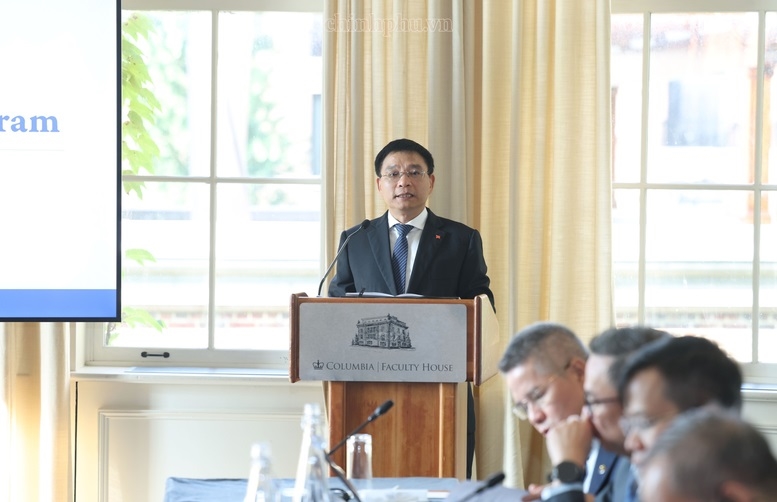
Speaking at the opening ceremony on August 24, Thang emphasized Viet Nam is entering a new strategic development phase with a long-term vision and strong aspiration to realise its two centenary goals, becoming a developing country with modern industry and upper-middle income by 2030, and a high-income developed country by 2045.
    |
 |
|
Deputy Prime Minister Nguyen Van Thang speaks at the opening ceremony. (Photo: chinhphu.vn) |
Viet Nam values international knowledge and experience from leading academic institutions such as Columbia University in pursuing these strategic goals, he stressed.
He highlighted the practical relevance of discussions at VLP 2026, which cover issues such as safe artificial intelligence (AI) governance, digital finance, cloud computing, banking modernization, capital markets, and national technology strategies.
The Deputy PM expressed his hope that in-depth discussions would provide diverse perspectives and scientific and practical foundations for Viet Nam’s policymaking, while helping translate bilateral cooperation between Viet Nam and the U.S. into concrete and substantive projects.
Prof. Nguyen Thi Lien Hang, Director of the Weatherhead East Asian Institute at Columbia University, described VLP 2026 as an important milestone following the success of the Viet Nam Executive Leadership Program (VELP), which has been held for nearly two decades.
She said the program’s topics address pressing issues facing both Viet Nam and the U.S., expressing her hope that the discussions would foster open and substantive exchanges, generate new development ideas for Viet Nam and contribute to advancing its ties with the U.S.
Hang also shared plans to develop the Center for Global Viet Nam at Columbia University, which aims to establish a sustainable academic platform for research and cooperation in policy, leadership, culture, arts and internship programs, contributing to deepening the Viet Nam - U.S. comprehensive strategic partnership.
VLP 2026 concentrates on assessing the outlook and major developments in the global economy and major economies, as well as major transformation trends and their impacts on Viet Nam’s economy; exploring new growth drivers; and recommending solutions to boost growth and build a new development model for Viet Nam.
It is expected to continue serving as a strong knowledge bridge and a trusted policy advisory forum, helping enhance mutual understanding, reinforce trust, and open up practical cooperation opportunities between Viet Nam and the U.S.
During exchanges with experts from the university, Deputy PM Thang and members of the Vietnamese delegation shared key measures to achieve double-digit economic growth goal, strengthen economic self-reliance, and promote balanced, sustainable, and mutually beneficial trade relations with partners.
They also highlighted Viet Nam’s orientations for renewing its development model, building a framework for safe AI development and developing digital financial infrastructure, while suggesting leading U.S. scholars share policy advice and experience with Viet Nam.
The program will run until August 26, with symposiums focusing on cloud computing and the financial services sector in Viet Nam, global trade and supply chains, and mobilization of resources for Viet Nam’s new development model.
Source: VNA