The strategy pivots Viet Nam toward AI research and development tied to economy-wide transformation. Instead of retrofitting AI into existing products and processes, the plan treats AI as a core capability from problem identification through design, organization and operations.
    |
 |
|
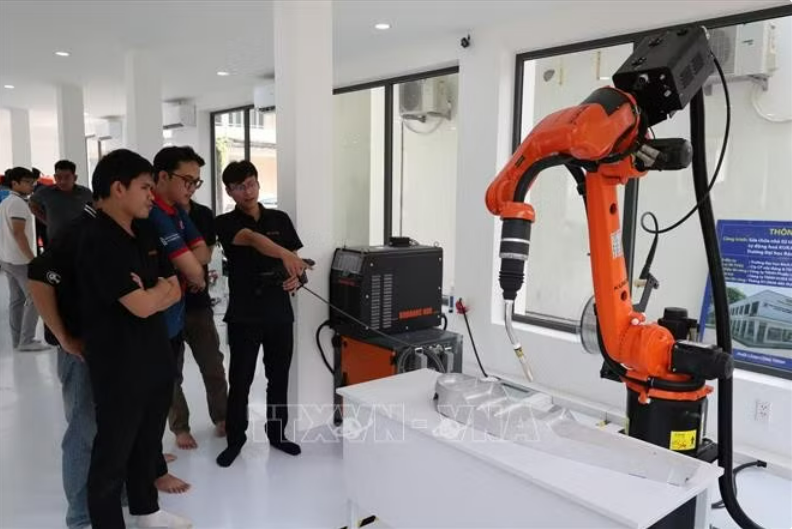
(Photo for illustration: The strategy pivots Vietnam toward AI research and development tied to economy-wide transformation) |
AI is cast as a lever to redesign governance, production, business and services; lift productivity; improve state efficiency and corporate competitiveness; spur innovation and create new products, services and business models. Workforce, infrastructure and data form the foundation, while AI mechanisms and governance are the breakthrough.
Workforce development is foundational. Viet Nam will prioritize training AI professionals, top-tier talent and experts; expand retraining and AI skills across the labor force, and push AI literacy society-wide.
The strategy shifts focus from isolated technology skills to building capacity to deliver practical products, services and value through AI. It introduces policies to draw leading AI experts, overseas Vietnamese specialists and foreign researchers.
Vietnamese AI companies are seen as the core force for national AI research, development and deployment. The State will push firms beyond adding AI to existing offerings and toward AI-native products, services, business models and governance from the outset, while promoting “Make in Viet Nam” AI products, platforms, services and solutions.
By 2030, the strategy targets Viet Nam among Southeast Asia and Asia’s leading AI hubs in research, development, application and co-creation, with strong domestic capabilities in AI mastery and governance.
AI will be integrated across governance, public services, production, business, scientific research, innovation and daily life, lifting productivity, quality, efficiency and competitiveness.
Viet Nam aims to rank among Southeast Asia’s top three in AI R&D, have AI integrated into and supporting 100% of online public services, and use AI to process 100% of administrative procedure dossiers.
It will also build at least five national shared AI platforms, create at least 10 Vietnamese AI brands able to compete globally and regionally, and develop at least eight Vietnamese-language AI models.
By 2045, Viet Nam aims to be among Asia’s top 10 in AI research, development and national transformation. AI is expected to drive productivity, innovation and value creation, helping Viet Nam escape the middle-income trap and become a high-income developed economy by 2045.
Under that vision, AI will become the dominant operating platform for the State, economy and society. Governance mechanisms, business processes, products, services, production methods and critical infrastructure would be progressively designed and run on AI platforms.
Viet Nam will also develop an ecosystem of AI enterprises capable of competing globally and regionally, positioning itself as a global and regional hub for AI R&D, production and supply of AI products, services and solutions.
The strategy also sets out six groups of breakthrough solutions, starting with institutional, policy and legal reforms to create an open framework for rapid AI development and application.
It also demands stronger national coordination and clearer accountability. Heads of ministries, agencies and localities will be directly accountable to the Government and the PM for hitting assigned AI transformation targets.
The State will fund tasks through commissioning, assignment and bidding, while fostering public-private partnerships, attracting international investment, and studying interest-rate support and tax incentives for AI research, development and management.
Other measures include expanding international cooperation, developing standards and technical regulations, building bilateral and multilateral AI programs, increasing exchanges of postgraduate researchers and engineers with leading global research centers, raising public awareness of responsible AI use, and regularly updating indicators to assess AI transformation.
Source: VNA