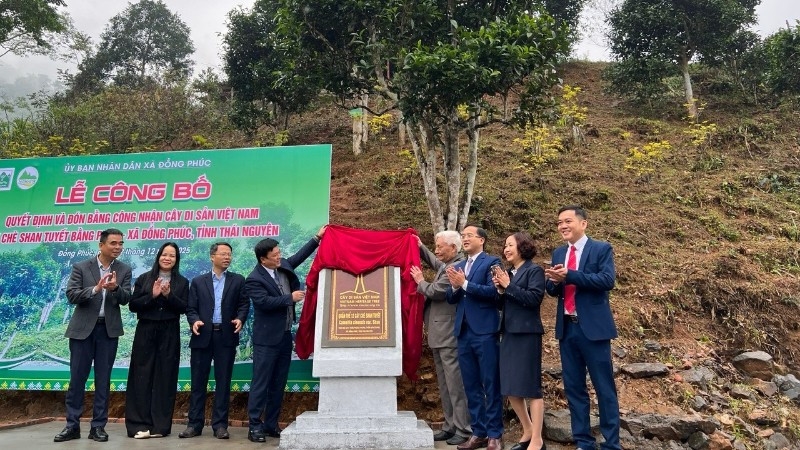
Dr. Nguyen Ngoc Sinh, President of the Vietnam Association for Conservation of Nature and Environment (VACNE), handed over the certificate to Dong Phuc commune on the day. On this occasion, the commune People’s Committee and units signed a memorandum of understanding on cooperation in investment, production, and consumption for Shan Tuyet tea products.
    |
 |
|
12 ancient Shan Tuyet tea trees win national heritage. |
The recognition honors the biological, cultural and historical values of these centuries-old Shan Tuyet tea trees – natural treasures deeply woven into the livelihoods, traditions and identity of local ethnic communities. The title affirms the community’s commitment to preserving and promoting the value of this iconic local tea variety.
Speaking at the ceremony, Chairman of Dong Phuc commune People’s Committee Trieu Quang Hung said the recognition is not only a source of pride for local tea growers but also a great honor for the commune’s Party organization, authorities and residents.
He noted that the Shan Tuyet variety’s distinct biological characteristics and cultural-historical value present strong potential for eco-tourism, agricultural experiences and the development of high-value OCOP products under the Bang Phuc Shan Tuyet brand.
He called for continued support from provincial authorities, specialized agencies, research institutes and enterprises to help the commune conserve the heritage trees, build the local tea brand and strengthen value-chain linkages.
According to Deputy Director of the Northern Mountainous Agriculture and Forestry Science Institute and Vice Chairman of the Vietnam Tea Association Nguyen Ngoc Binh, scientific assessments confirm that the Bang Phuc ancient Shan Tuyet cluster is an exceptionally rare indigenous gene source. The trees have survived for hundreds of years, naturally adapting to the climate and soil conditions of the northeastern highlands.
Beyond their genetic value, the ancient trees form part of the native forest ecosystem, helping retain water, prevent soil erosion and safeguard biodiversity. Protecting the Shan Tuyet cluster therefore contributes directly to local ecological preservation.
Source: VNA