Reviewing the sector’s performance in the past five years, the minister said the scale of the national education system continued to expand across all levels, with more than 24.5 million learners nationwide. Major goals on universal education and literacy were basically achieved, while the proportion of trained workers holding diplomas or certificates reached nearly 30%. By the end of 2025, the number of university students stood at around 225 per 10,000 people, meeting the targets set for the five-year period.
    |
 |
|
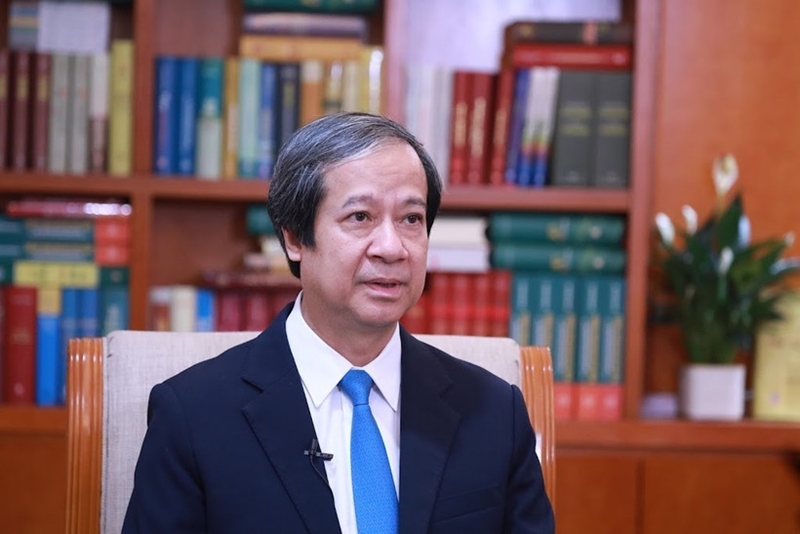
Minister of Education and Training Nguyen Kim Son |
A key highlight was the successful rollout of the 2018 General Education Programme from grades 1 to 12 in line with the approved roadmap. The shift from knowledge-based teaching to the comprehensive development of learners’ qualities and competencies has produced tangible results. Vietnam has continued to rank among the world’s top performers at regional and international academic Olympiads, reflecting both strong mass education and elite training, noted the official.
Higher education and vocational education recorded notable progress through enhanced autonomy, expanded training in high-tech fields, and stronger links with labor market demand. In 2025, over 33% of students were enrolled in STEM-related disciplines, supporting the country’s long-term need for high-quality human resources. Many Vietnamese universities have also improved their international standing, appearing in global and regional rankings, he added.
The education sector demonstrated resilience during the COVID-19 pandemic by rapidly shifting to online teaching and learning under the motto “schools may close, but learning must not stop”. This period created strong momentum for digital transformation, including the development of digital learning materials, open educational resources, and nationwide education databases. Digital platforms are now used for high school graduation exams and university admissions, improving transparency and efficiency.
Human resources development remained a central priority. The teaching workforce expanded in both scale and quality, supported by additional staffing allocations, better policies and improved entry standards for teacher training institutions. By 2025, more than 33% of lecturers at higher education institutions held doctoral degrees, marking steady progress in academic capacity.
Entering 2025, identified as a pivotal year between two Party Congress terms, the education and training sector proactively launched strategic tasks without waiting for the conclusion of the 14th National Party Congress. Following the issuance of the Politburo’s Resolution No. 71-NQ/TW on breakthroughs in education and training development, the ministry submitted several major draft laws and resolutions to the National Assembly, including those on teachers, education, higher education and vocational education, as well as policies on tuition support and a national target program for education modernization in the 2026–2035 period, he said.
Looking ahead, Son emphasized that the next phase will require renewed thinking and stronger determination. Priorities include institutional reform, mobilization of resources, modernization of educational infrastructure, accelerated digital transformation, and the controlled and effective application of artificial intelligence. At the same time, the sector will continue to promote equity in access to education, particularly for learners in disadvantaged, border and island areas.
These efforts aim to modernize Vietnam’s education system, improve quality and fairness, and provide a solid foundation for human development and national growth in the new development stage.
Source: VNA