Huyen said technology and the Internet have made Vietnamese language teaching and learning more accessible. Online teaching tools, language-learning applications and a growing range of Vietnamese entertainment content, including films, music, TikTok videos and YouTube programs, are providing learners with more opportunities to engage with the language.
Government support has also expanded. In 2025, the Vietnamese Embassy in China organized Vietnamese language classes for the Vietnamese community and citizens living in the country. The State Committee for Overseas Vietnamese has also held training courses, both in person and online, to equip overseas Vietnamese teachers with language-teaching methods.
    |
 |
|
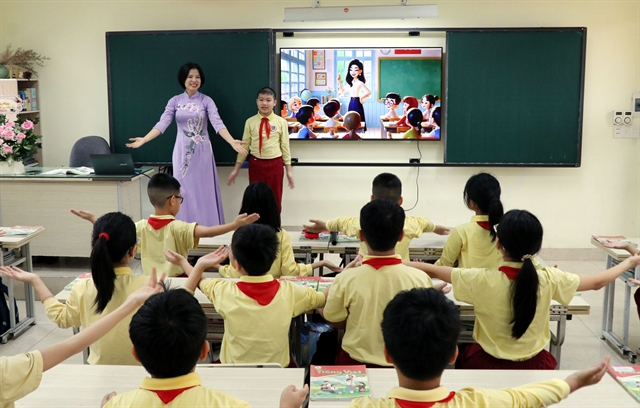
A digital-learning-themed "Nam Dinh – The Essence of Craft Villages" lesson, taught by Pham Thi Hoa, a teacher at Pham Hong Thai Primary School in Nam Dinh Ward, Ninh Binh province |
Having taught at the embassy's program, Huyen said she has seen strong commitment among Vietnamese parents to passing on their language and cultural heritage to their children. Their determination, she noted, is a major source of encouragement for teachers.
However, maintaining a Vietnamese-speaking environment remains the biggest challenge. Young people born and raised overseas often use the local language as their mother tongue, while Vietnamese is spoken mainly at home. As a result, they may gradually lose fluency, mispronounce words or become reluctant to speak Vietnamese.
To address this, Huyen has adopted more creative and interactive teaching methods, using Vietnamese culture as a gateway to language learning.
She introduces students to Vietnamese festivals and traditions, encouraging them to compare these with their Chinese counterparts. Such activities help spark interest in the language while deepening students' appreciation of their Vietnamese heritage.
Songs, poems, word-guessing games and pictures also make lessons more engaging. Practical activities, such as role-playing market shopping, preparing Vietnamese dishes and ordering food at Vietnamese restaurants, allow students to use the language in everyday situations and see its practical value.
Beyond teaching overseas Vietnamese, Huyen also introduces Vietnamese language and culture to Chinese students at her university, helping broaden the country's cultural reach. She said Chinese students are particularly interested in three aspects of Viet Nam: cuisine, history and heritage, and traditional arts.
Pho, banh mi and Vietnamese coffee are among their favorite topics. Others are keen to explore the Nguyen Dynasty, Hoi An ancient town, Ha Long Bay and Champa relics. Traditional art forms, including water puppetry, cheo (traditional opera) and Hue royal court music, have also attracted considerable interest.
However, many other distinctive Vietnamese cultural values remain relatively unknown internationally. These include Dong Ho and Hang Trong folk paintings, Vietnamese poetry, folk songs and proverbs, as well as village traditions and beliefs associated with wet-rice cultivation.
Huyen suggested using more creative digital and cultural initiatives to introduce these heritage values to international audiences. Short videos on TikTok, Instagram and YouTube could showcase the making of traditional paintings, banh com (cakes made from young green rice flakes) and scenes of rice cultivation and harvesting on terraced fields.
Exhibitions in China and pocket-sized bilingual publications featuring Vietnamese poetry, folk songs and proverbs could also help local audiences gain a deeper understanding of the country's culture and everyday life.
Source: VNA