At the meeting, participants also discussed the committee’s draft working program for 2026, and the proposal on reviewing and evaluating the institution of public defenders.
Reports showed that during the past term, Party Committees and Organizations at all levels have focused on leading, directing and institutionalizing the Party's guidelines on judicial reform, the building and improvement of the socialist rule-of-law State, and the streamlining of the judicial apparatus.
    |
 |
|
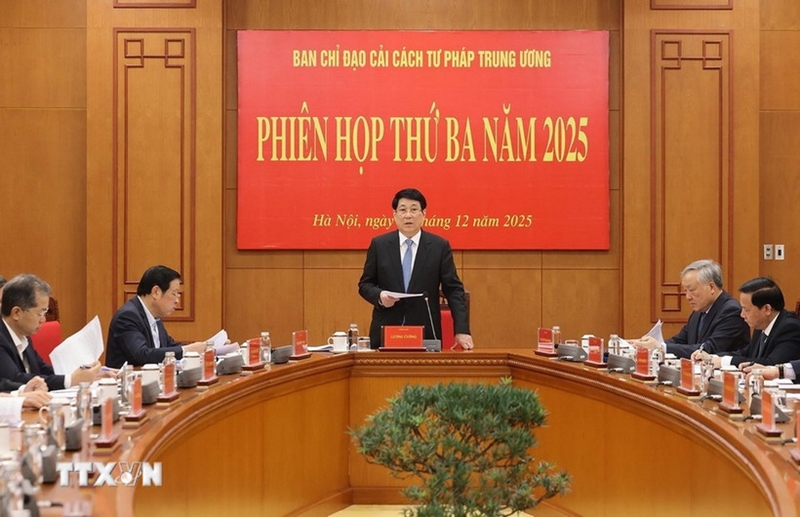
State President Luong Cuong addresses the third meeting of the Central Steering Committee for Judicial Reform in Hanoi on December 25. |
The steering committee has advised the Politburo in leading judicial and judicial reform work, with notable achievements including the National Assembly and its Standing Committee promulgating or amending 23 laws, five resolutions and four ordinances related to the judicial sector. Criminal, civil and judicial procedure laws have been developed and improved in a relatively comprehensive and synchronous manner, meeting practical requirements.
Judicial and judicial-support institutions have continued to be consolidated and reorganized in line with the policy of streamlining the political system. Power control and the prevention of corruption and misconduct in judicial activities have been strengthened. The contingent of judicial and judicial-support officials has grown in both quantity and quality, while many judicial-support activities have been socialized, contributing effectively to investigation, prosecution and adjudication.
Mechanisms for the Party's leadership and supervision by the National Assembly, People’s Councils and the Vietnam Fatherland Front have continued to be renewed in a more substantive and effective manner. Judicial reform outcomes have contributed significantly to combating crimes, protecting human rights and citizens’ rights, safeguarding legitimate interests of the State, organizations and individuals, maintaining political security and social order, and promoting socio-economic development and international integration.
The steering committee also pointed out existing shortcomings and their causes, and proposed eight key orientations for judicial reform in the next term.
Regarding the institution of public defenders, the steering committee noted that while it holds historical and socio-political significance and contributes to protecting defendants’ rights and supervising judicial power, it has largely ceased to operate in practice in recent years. This is due to limited professional capacity, insufficient litigation skills and incomplete supporting policies. The committee, therefore, called for more concrete solutions, clearly assigned responsibilities and an appropriate implementation roadmap.
Concluding the meeting, President Cuong stressed that the session had fulfilled its agenda with a high sense of responsibility. For the 2026-2031 period, he urged continued thorough implementation and institutionalization of the Party's guidelines, especially those of the 14th National Party Congress, and further renewal of law-making and law enforcement.
He also called for stronger inter-agency coordination, timely and effective implementation of tasks, and greater attention to building a high-quality judicial workforce, linking performance with appropriate personnel policies.
For the institution of public defenders, the President asked for further adjustments and supplements in line with the Party’s policy of placing the people at the center, ensuring that the State is of the people and for the people.
The State leader requested the Party Central Committee’s Commission for Internal Affairs fully absorb opinions raised at the meeting and finalize the judicial reform review and orientations for submission to competent authorities.
Source: VNA