Over recent months, the city has taken concerted actions to prepare for this historic development, from spatial planning and infrastructure development to human resources training and partnership mobilization. Essential conditions for IFC operations are now fundamentally in place.
    |
 |
|
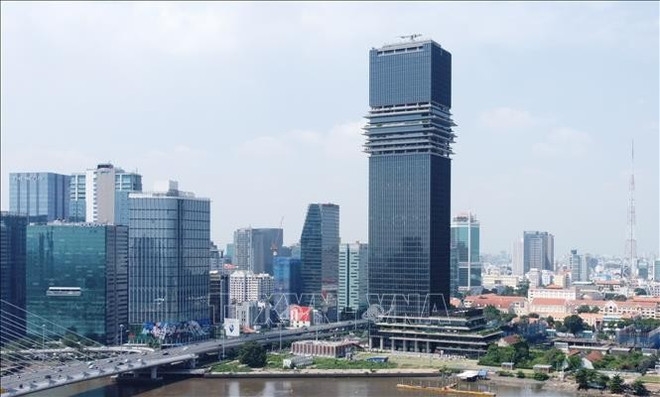
Saigon Marina IFC building is the first private project contributing to realizing the goal of developing an international financial center in Ho Chi Minh City. |
According to the master plan, the Ho Chi Minh City IFC will cover around 898 hectares across Sai Gon and Ben Thanh wards and Thu Thiem urban area (An Khanh ward), forming a financial and service cluster along the Sai Gon River that closely connects the current downtown area with the eastern urban zone.
This location is considered strategic as enterprises, financial institutions, research bodies and offices in the zone will enjoy preferential mechanisms and policies from the Government, including incentives on taxation, utilities and operational costs.
Alongside physical planning, the city has prioritized digital infrastructure development, as it is working with tech giants such as NVIDIA, Intel, Viettel and FPT to build modern IT systems that meet the operation requirement of an IFC following global standards. The IFC will feature comprehensive broadband infrastructure, full 5G coverage and prioritized power and water supply to meet the high operational demands of financial institutions.
Deputy Director of the municipal Department of Finance Quach Ngoc Tuan said IFC construction will take place in three phases, with the final focusing on building a large-scale, world-class financial hub in Thu Thiem, envisioned as a future “Wall Street of Southeast Asia.”
Under the Government's Decree 323/2025/ND-CP on establishing IFC Vietnam, Ho Chi Minh City is expected to develop into a comprehensive international financial hub with a full ecosystem of services and products. The southern metropolis has already set up strategic cooperation with major global partners, notably the signing of an agreement with the world’s second largest stock exchange Nasdaq that will support the development of an international stock exchange using its leading technologies.
Beyond traditional capital markets, the city is also moving toward emerging financial sectors. At the recent Autumn Economic Forum in Hanoi, it signed a Memorandum of Understanding (MoU) with Binance, through which the two sides will explore ways to advance blockchain and digital asset development. Meanwhile, green finance, fintech, innovative financial services and a commodities exchange are also being actively promoted to enhance Vietnam’s participation in global value chains.
High-quality human resources are considered a decisive factor. The University of Economics – Ho Chi Minh City has partnered with the New York Institute of Finance, while the Vietnam - Germany University is cooperating with Goethe University Frankfurt to organize advanced training programs in IFC governance and risk management, helping prepare future IFC management teams for both the city and Da Nang.
Investor interest is also increasing. According to the Ho Chi Minh City Institute for Development Studies, more than 50 investors and organizations have expressed interest in participating in the IFC in the city, with many ready to become founding partners. Representatives from Binance and Ant International affirmed their commitment to supporting the city in building a transparent, innovative and sustainable international financial hub.
Despite remaining challenges, with harmonious preparation in infrastructure, technology, product development and human resources, the Ho Chi Minh City IFC is expected to create fresh momentum for growth, strengthen national competitiveness and elevate Vietnam’s standing in the global financial system.
Source: VNA