The resolution reaffirms Hanoi’s dual role as the nation’s political – administrative center and a leading growth powerhouse. With ambitions that extend well beyond the next century, the capital is expected to unlock new space, potential and opportunities to drive economic breakthroughs, including the pursuit of double-digit growth, commensurate with its status as the capital of a future high-income developed country. Hanoi is also tasked with generating strong spillover effects to catalyze development across the Red River Delta, the Capital Region, the northern key economic region and the country at large.
    |
 |
|
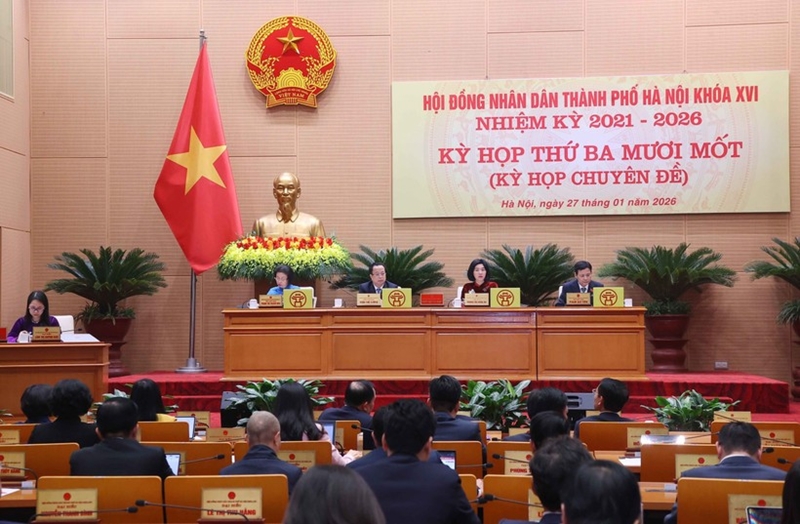
Hanoi's 100-year master plan resolution is adopted at the 31st session of the municipal People's Council on January 27. |
Under the master plan, nine growth poles are identified to guide spatial and infrastructure development. These include the Central Urban Area on the right bank of the Red River, encompassing the historical core and expanded zones as the capital’s cultural, historical and political heart, alongside an Olympic urban area. The northern pole (Dong Anh – Me Linh – Soc Son) is positioned as an integration-driven hub for international services, trade, finance and logistics linked to Noi Bai International Airport and high-tech industries.
The eastern pole (Gia Lam – Long Bien) is designed as a gateway and service center with large-scale commercial complexes and modern logistics facilities connected to National Highway 5 and Hanoi – Hai Phong Expressway. The southern pole (Thuong Tin – Phu Xuyen) will serve as the central urban zone planned. Meanwhile, the pole of industrial and logistics powerhouse will combine high-tech industry and agriculture with multimodal transport linked to a proposed second airport south of Hanoi, high-speed rail and river ports.
Additional poles include Van Dinh – Dai Nghia in the south as an ecological and heritage-oriented riverine city; the southwestern pole (Xuan Mai – Chuong My) focused on education, health care and eco-tourism; the western pole (Hoa Lac) as a science, technology, innovation and education hub centered on Hoa Lac Hi-Tech Park and Vietnam National University; the northwestern pole (Son Tay – Ba Vi) as a cultural, historical and resort city associated with national defense and security safeguarding tasks; and the Red River corridor as a special landscape space for finance, services, trade and tourism.
The resolution also delineates nine major urban centers with specialized functions, ranging from political and administrative hubs and international integration to logistics, heritage, education, health care and innovation, distributed across areas south and north of the Red River, the eastern zone, the Olympic urban area, and centers in Phu Xuyen, Van Dinh – Dai Nghia, Xuan Mai, Hoa Lac and Son Tay.
To underpin development, nine strategic spatial axes and economic corridors are established along key transport routes. These include the Nhat Tan – Noi Bai/Bac Thang Long – Noi Bai axis developing an airport city model linked with Noi Bai International Airport; the West Lake – Co Loa – Gia Binh Airport axis linking Hanoi with emerging northeastern economic zones; the National Highway 5/Hanoi – Hai Phong Expressway corridor as a smart logistics, service and trade artery to seaports; and National Highway 1A/Phap Van – Cau Gie as the principal economic corridor connecting the capital with southern regions.
Other corridors cover National Highways 21B/21C as a dual industrial-logistics and green cultural axis; National Highway 6/Ha Dong – Xuan Mai fostering eco-urban chains towards the northwest; Thang Long Boulevard/West Lake – Ba Vi linking the central city with Hoa Lac and Ba Vi National Park; National Highway 32/West Thang Long Road towards Son Tay and the upper Red River region; and the Red River scenic boulevard, envisioned as a central green and creative axis symbolizing a modern and civilized Hanoi.
The plan sets clear targets, with urban construction land projected to account for 45–50% of the city’s natural area by 2045 and 55–60% by 2065, with a ceiling of up to 70% by 2100 if conditions allow. Population is expected to reach 15–16 million by 2045 and 17–19 million by 2065, while remaining below 20 million in the long term to ease urban pressure. The urbanization rate is targeted at over 75% by 2045 and more than 90% by 2065.
Hanoi aims for average GRDP growth of over 11% annually in 2026–2030. Per capita GRDP is hoped to exceed 12,000 USD by 2030, rising to around 45,000 USD by 2045 and approximately 100,000 USD by 2065.
Social goals include basically eradicating household poverty under national multidimensional standards by 2030, raising the Human Development Index to about 0.92 by 2045 and 0.95 by 2065, achieving a happiness index of 9.5 out of 10 by 2045, and increasing average life expectancy to around 80 years. Environmental bottlenecks are to be largely resolved by 2030, with priority given to tackling flooding, traffic congestion, pollution and urban order problems as the capital advances its long-term development agenda.
Source: VNA