The “four strategic shifts” that General Secretary and President To Lam laid out at the recent third plenum of the 14th Party Central Committee form a unified chain to modernize governance, he said.
The first shift targets stronger Party leadership and sharper institutional operations. It builds on two years of aggressive apparatus streamlining and a new two-tier local administration model. With the framework in place, the focus now is getting it to run smoothly.
    |
 |
|
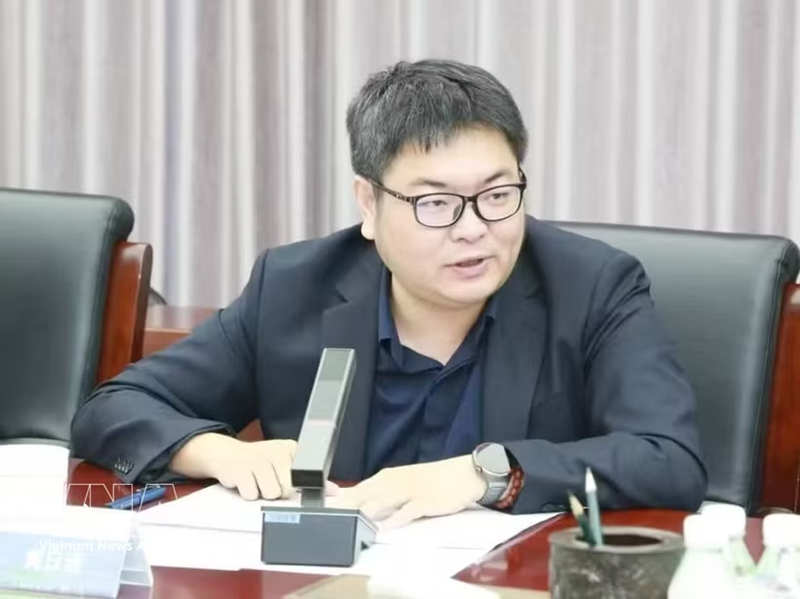
Prof. Huang Rihan, Director of the Maritime Silk Road Institute at Huaqiao University |
The second aims to unify governance of development spaces. It takes on the fragmented oversight of land, seas and natural resources that has long caused bottlenecks and wasted valuable resources.
The third pivots the economy toward a model powered by productivity, knowledge, technology and a quality workforce. It strikes at the core issue as national prosperity ultimately hinges on innovation and highly skilled talent.
The fourth moves risk management from reaction to proactive prevention, spotting trouble early and acting well before a crisis hits. In a world where risks can go viral in an instant, that’s a practical play.
Huang stressed that China and Vietnam, both socialist nations led by communist parties, are each hunting for a development path that fits their own conditions. Mutual learning is an invaluable asset in the relationship between the two parties and nations.
Real transformation isn’t hard to announce, but hard to deliver. The top Vietnamese leader’s insistence that the plenum's outcomes must be reflected in tangible changes shows Vietnamese leaders have a sharp read on both the global and domestic pictures. That, Huang added, has given foreign scholars, including those in China, a lot more faith in Vietnam’s economic future.
For neighboring China, Vietnam’s economic momentum is genuinely good news, he said.
First and foremost, execution has to be all-in. The recent mergers and institutional reforms touched every level of government, but the new structure needs real backup, especially personnel, funding and data at the commune and ward level - the front line closest to citizens. In fact, those resources often fail to meet demand.
Decentralization and delegation of authority must go hand in hand with granting autonomy over financial resources, personnel and information systems. Otherwise, the stronger the transfer of authority downward, the more likely grassroots authorities will hit bottlenecks.
The top leader’s rule that every decision must spell out its goals, tasks, authority, responsibilities and deadlines targets a familiar problem: policies that look great on paper but collapse during rollout. This, he stressed, is a clear and important compass.
Second, the transformation must be substantive. Jumping from a cheap labor model to one driven by productivity and innovation demands a long-term commitment to education and sci-tech investment. When courting foreign capital, Vietnam shouldn’t settle for building assembly plants. Instead, negotiations should incorporate technology transfer, links to domestic supply chains and talent development, thus gradually building its own growth drivers. China and Vietnam have plenty of room to team up on all of that. Railways, digital economy and green energy are huge doors for Vietnam’s industrial upgrade.
Third, Vietnam must hold its ground. In today’s world, traditional and non-traditional security issues are tightly intertwined, while supply chain, climate and data risks can easily trigger chain reactions. By pursuing a foreign policy of independence and self-reliance and maintaining a peaceful and stable external environment, Vietnam is creating the space necessary to carry out its domestic transformation, which is particularly important amid a volatile global landscape.
As the two countries build a China-Vietnam Community with a shared future that carries strategic significance, Vietnam’s successful makeover will also lift regional prosperity and stability, he said.
The two sides have a lot of potential to win together by sharing experience in national governance and connecting the Belt and Road Initiative with the “Two corridors, one economic belt” plan. If done right, each country’s growth becomes a wide-open door for the other, he added.
Source: VNA