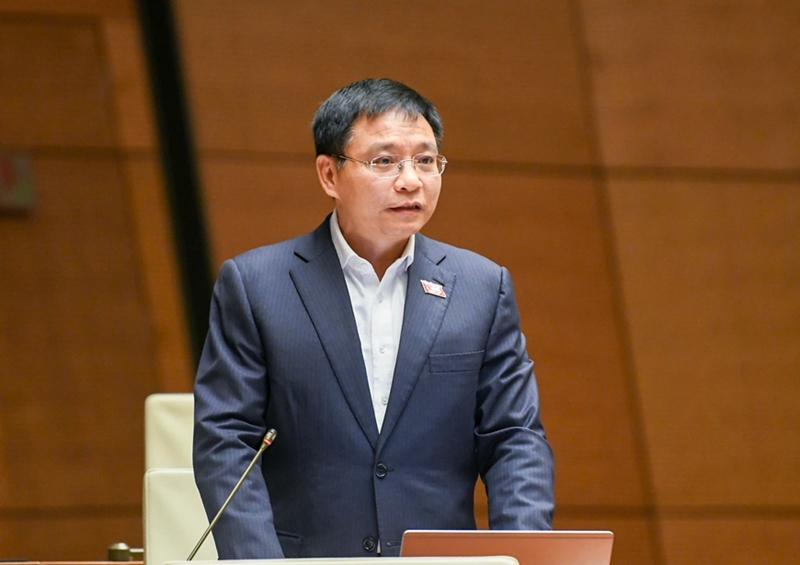
Speaking during a question-and-answer session on financial affairs at the second session of the 16th National Assembly on November 12, Thang said Viet Nam’s public debt, external borrowing and government debt remained well below the limits set by the legislature. This provides room to mobilize ODA and other sources of financing to support economic development.
However, he cautioned that Viet Nam can no longer access low-cost ODA loans, making careful evaluation of borrowing costs, construction conditions and contractor selection essential to ensure the safe and efficient use of funds.
    |
 |
|
Deputy Prime Minister Nguyen Van Thang answers questions about financial affairs at the second session of the 16th National Assembly on November 12, 2026. |
He said ODA resources should be directed toward large-scale projects with clearly demonstrated socio-economic and financial benefits, rather than dispersed among numerous smaller projects.
On mobilizing private-sector capital through public-private partnerships (PPP), particularly for transport and infrastructure development, Thang pointed to practices in developed countries. Under these arrangements, companies may finance construction and recover their investment through user fees while earning a reasonable return. Alternatively, they may take over State-built infrastructure to operate and maintain it.
Viet Nam has adopted both approaches and established a legal framework through the 2020 Law on Public-Private Partnership Investment, which includes incentives for businesses to participate in such projects, he said.
The country has mainly relied on the model in which private investors fund construction and recoup their costs through user charges. Under the law, State capital contributions can account for around 50% of a project's total investment, rising to 70% in special cases, depending on the project's characteristics and effectiveness.
Thang noted that a number of earlier PPP projects faced financial difficulties because investors had to shoulder the entire investment burden. The introduction of State participation in risk-sharing has since helped improve the financial viability of most projects undergoing assessment.
|
|
 |
|
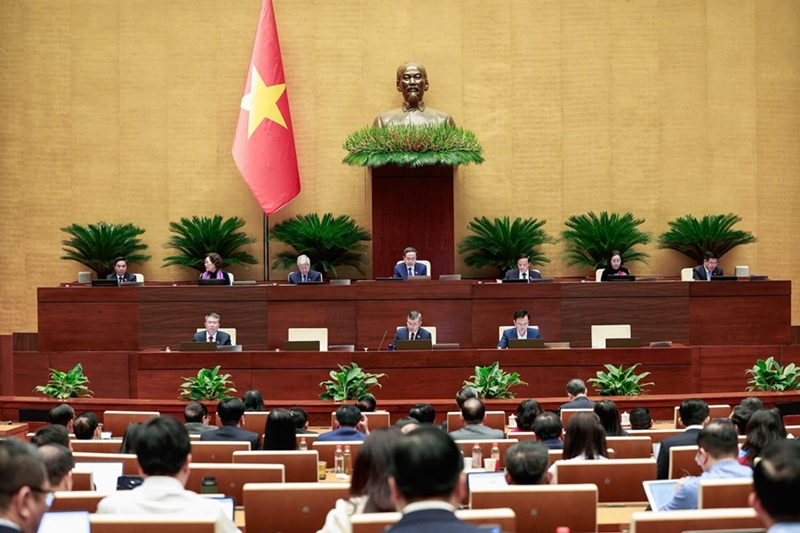
An overview of the question-and-answer session |
For the operation and maintenance (O&M) approach, the Ministry of Finance and the Ministry of Construction are developing a pilot program to auction or tender toll-collection rights for a number of projects, particularly sections of the North-South Expressway.
This arrangement could make projects more attractive to private investors by limiting their exposure to risks associated with site clearance, construction and price fluctuations. Existing PPP regulations also allow risk-sharing if actual revenues fall short of projections and provide for State buybacks under certain exceptional circumstances, he said.
Turning to public investment, Thang said the Government was taking decisive steps to achieve full disbursement of allocated capital. A 100% disbursement rate is projected to add 1.7 percentage points to economic growth and support the target of growth exceeding 10% in 2026.
At the session, National Assembly President Tran Thanh Man recognized improvements in financial and budget management, public investment and support for businesses. However, he also highlighted a number of unresolved challenges, including sluggish capital disbursement, funds awaiting allocation, and obstacles affecting ODA and PPP projects.
Other concerns included tax administration for e-commerce and businesses operating on digital platforms, as well as companies' difficulties in accessing financing and participating in global value chains.
The N.A. President called on the Government and relevant agencies to refine regulations on public investment, accelerate disbursement and redirect capital from stalled projects to those with better implementation prospects. He also stressed the need for tighter oversight of advance payments and their recovery, better preparation of ODA projects and closer coordination with development partners.
He further urged agencies to strengthen the legal framework for PPP investment and resolve outstanding transitional Build-Transfer (BT) projects by December 31, 2027. Other measures include studying the establishment of a PPP project development fund, improving tax administration for digital businesses and foreign service providers, and continuing tax, fee and land-rent relief alongside appropriate business support measures in 2027.
Translated by Chung Anh