Addressing questions from National Assembly deputies and voters on November 12, the Prime Minister outlined the Government’s priorities for balancing economic expansion with financial stability and sustainable development.
Inflation control remains a top priority
Reporting to the National Assembly, PM Le Minh Hung said the Government would continue to place inflation containment, currency stability and strong macroeconomic fundamentals at the heart of its policy agenda.
A package of coordinated measures has been rolled out to ease input costs and reduce pressure on households and businesses. These include tax cuts, exemptions, reductions and extensions; a 2% cut in electricity prices; and a policy to reduce income tax by 30% for businesses and household businesses in 2026-2027.
    |
 |
|
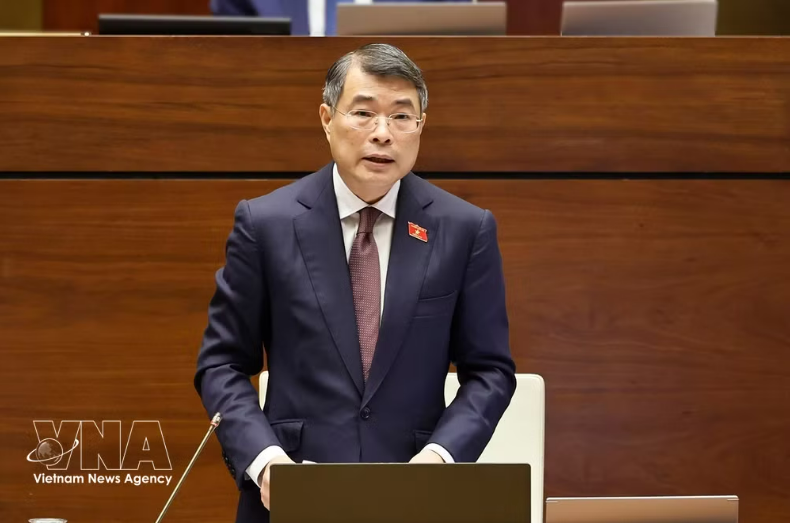
Prime Minister Le Minh Hung answers N.A. deputies' questions. |
The tax measures are expected to lower State budget revenue by 256.7 trillion VND (about 10 billion USD) in 2026. The Government has also taken steps to manage monetary policy and the prices of goods and services.
These interventions helped keep average consumer price index (CPI) growth at 4.57% in the first 10 months of the year, PM Le Minh Hung said, describing the outcome as encouraging given mounting inflationary pressures worldwide.
At the same time, the Government has worked to channel resources into the economy and strengthen major growth drivers and sectors.
By the end of September, total social investment had reached 3.11 quadrillion VND, marking a 15.1% increase, according to figures updated through October. State budget revenue for the first 10 months was estimated at 2.44 quadrillion VND, up 11% year on year and equivalent to nearly 96.4% of the full-year target.
Public investment disbursement totaled nearly 708.6 trillion VND, or more than 74% of the annual plan. The disbursement rate was 19.7% higher than a year earlier, with the amount paid out increasing by more than 217 trillion VND.
Foreign direct investment (FDI) continued to perform strongly. Registered FDI reached 54.85 billion USD in the first 10 months, up 74% year on year, while disbursed capital rose 13.1% to 24.08 billion USD. Import-export turnover exceeded 1 trillion USD for the first time, and Viet Nam recorded a trade surplus of 7.31 billion USD in October alone.
The Government also allocated around 578 trillion VND from recurrent expenditure to healthcare, education and social welfare during the first 10 months.
A series of income and welfare policies took effect on July 1. The statutory pay rate was raised by 8%, while allowances for commune-level officials and civil servants increased from 25% to 55%. Healthcare workers also became eligible for higher allowances, ranging from 30% to 80%.
Other initiatives include expanded access to health checkups, higher allowances for teachers, broader provision of free textbooks, and increased funding for healthcare and education facilities and equipment.
Mobilizing resources for ambitious growth targets
Looking ahead, the PM said the Government would strive to achieve growth of more than 10% for the full year of 2026 while keeping inflation at around 4.5%. This would provide a foundation for the 2027 economic plan and the 2026-2030 development period.
Under the socio-economic development plan approved by the National Assembly on November 7, Viet Nam has set a 10% growth target for 2027, with inflation projected to remain at around 4.5%. The plan also establishes 45 key socio-economic indicators and 11 groups of major tasks and solutions.
|
|
 |
|
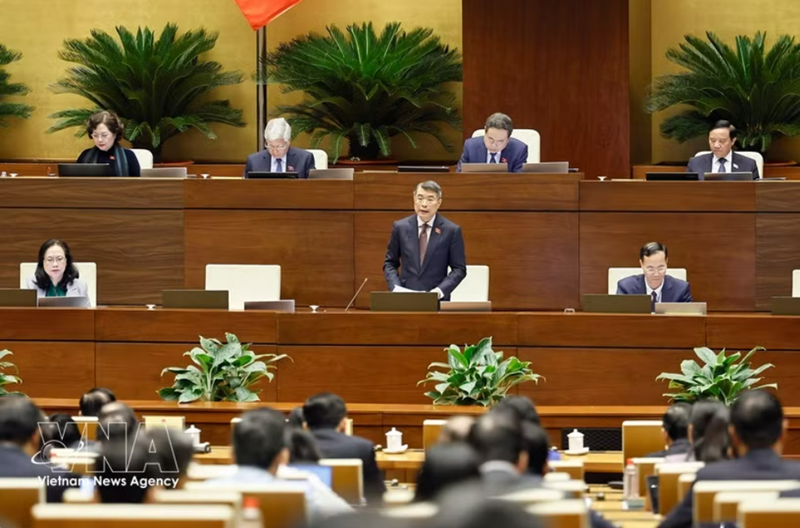
Prime Minister Le Minh Hung addresses the question-and-answer session of the N.A.'s second session. |
Meeting the growth target will require the economy to mobilize resources on a much larger scale. Government calculations put the required total social investment for 2027 at 36-38% of GDP, or approximately 6-6.4 quadrillion VND. State budget-funded development investment is expected to reach around 1.76 quadrillion VND, accounting for 27-29% of the total.
To secure the necessary funding, the Government plans to strengthen revenue collection, curb recurrent spending and improve the efficiency of public investment. It will also explore bond issuance, ODA loans and credit resources, while encouraging investment by State-owned enterprises and attracting more domestic private capital and FDI.
In parallel, efforts will be made to build a modern capital market for medium- and long-term financing, with the aim of attracting international investment funds and more stable, long-term foreign portfolio investment.
The Prime Minister stressed that mobilizing capital must go hand in hand with improving productivity, product quality and competitiveness. The Government will also pursue more substantive digital transformation in State management and public services, while strengthening the administrative and management capacity of local authorities.
Maintaining stability while improving people's lives
Despite the focus on accelerating growth, the Government will continue to regard macroeconomic stability and inflation control as essential priorities, the PM said.
Policy measures will include flexible coordination of macroeconomic instruments, ensuring sufficient supplies of petroleum and electricity, and carrying out comprehensive sectoral reforms to lower intermediate costs. The Government will also work to secure supplies of essential goods, ensure transparent pricing and strictly address violations, while preparing proactive management scenarios and assigning specific CPI control targets to localities.
On social welfare, PM Hung reaffirmed that people must remain at the center of development, both as its driving force and its ultimate beneficiaries. Economic growth, he said, must advance alongside social progress and equality, strengthen welfare systems and improve people's material and spiritual well-being, ensuring that development gains are shared by all.
The Government will prioritize action programs to implement resolutions adopted by the Party Central Committee, the Politburo and the National Assembly on developing culture, education and healthcare.
It will also strengthen disaster response and climate change adaptation, improve rural infrastructure and ensure the effective implementation of the integrated National Target Program.
Translated by Song Anh