To make the model more effective, however, bottlenecks in personnel, data, resources and coordination mechanisms identified in the third round of inspection and supervision by the Politburo and Party Central Committee Secretariat must continue to be addressed.
The findings of the Politburo’s third round of inspection and supervision in 2026 of the Standing Boards of provincial and municipal Party Committees showed the proactive and determined efforts of Party committees at all levels, while highlighting bottlenecks that need to be removed to ensure smoother and more effective operations.
    |
 |
|
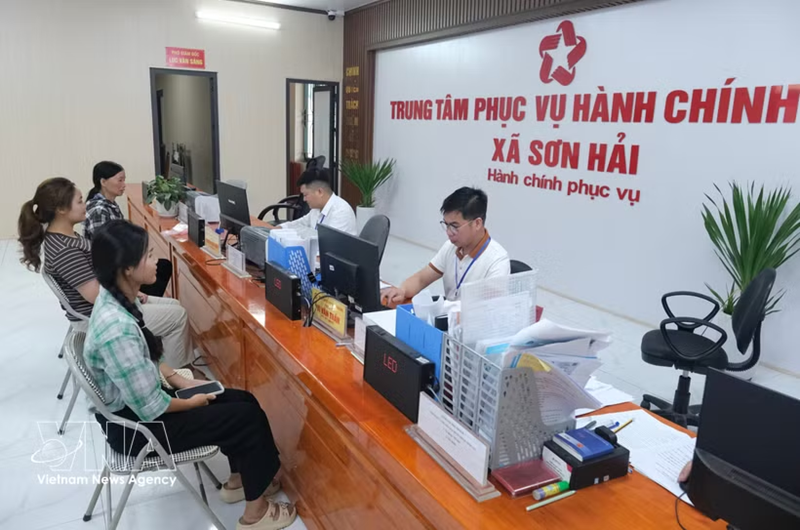
Residents at the Public Service Center of Son Hai Commune (Bac Ninh) to handle public administrative procedures |
Ho Chi Minh City is a clear example. Despite its extensive administrative scope, with 173 affiliated Party organizations, the municipal Party Committee has maintained solidarity and stability, directed personnel work without allowing gaps in authority, and gradually shifted its focus from “stabilizing the apparatus” to “improving personnel quality and implementation effectiveness.” The city has introduced transitional mechanisms for decentralized personnel management and applied technology and KPIs to assess implementation outcomes.
Meanwhile, Hai Phong has pursued its double-digit growth target, expanded development space and created new growth drivers, including a specialized economic zone, the master plan for the southern coastal economic zone and a free trade zone. It has also addressed difficulties facing 91 of 151 projects. The organization and operation of the city’s two-tier local administration have basically stabilized and become effective.
Phu Tho province has made its mark in removing digital transformation bottlenecks, while maintaining economic growth among the country’s top 10.
The process has consistently received close attention and clear guidance from the central level. At a conference on the draft report on the third inspection and supervision of the Standing Board of the Ho Chi Minh City Party Committee, National Assembly President Tran Thanh Man stressed that “decentralization must enable the apparatus to handle work more quickly, stay closer to the people and operate more effectively, but must not lead to fragmented responsibility or create large disparities in the quality of governance among localities.”
In the same spirit, Prime Minister Le Minh Hung asked the Standing Board of the Hai Phong Party Committee to prepare a pool of leaders with strategic thinking, development-oriented governance capacity and strong public-service implementation capabilities. The spirit of innovation in leadership and direction from the central level must reach all levels of Party organizations.
The National Assembly and Government are also urgently reviewing and cutting administrative procedures and shifting towards data-driven governance, while issuing a decision to terminate the validity of Decision 241/QD-TTg in line with the two-tier local administration model and the new planning system.
In the same spirit, Prime Minister Le Minh Hung has urged the Standing Board of the Hai Phong Municipal Party Committee to develop a cadre of leaders with strategic vision, the ability to shape and drive development, and strong implementation capacity. The central-level drive for innovation in leadership and direction must also reach every level of Party organization.
However, implementation has also exposed difficulties. The workload at the grassroots level has increased sharply following decentralization, while advisory capacity in many places remains limited, with shortages of specialists in information technology and data. The situation in Cao Bang illustrates that much work remains to be done.
The third round of inspection and supervision by the Politburo and Party Central Committee Secretariat found that Cao Bang still had 14 of the 20 shortcomings identified in the second round that were being addressed. Regarding the organization of the two-tier local administration model, only two of eight tasks had been completed. The province also had 96 vacant positions on Party Committees at commune level across 37 communes and wards, as well as six vacant positions on the Standing Boards of Party Committees in six units.
Notably, after the transition to the two-tier model, requirements placed on commune-level authorities have increased significantly, while personnel capacity, management mechanisms and supporting conditions in some areas have not been adjusted accordingly.
In response, the central level instructed Cao Bang to “not use objective difficulties to explain subjective delays,” requiring the province to fill vacant positions while transferring or seconding suitable personnel to remote, disadvantaged and border areas, prioritizing officials specializing in information technology, digital transformation, construction, and natural resources and environment. Personnel placement must be based on work requirements rather than individual preferences.
More than a year of implementation has shown that the two-tier local administration model can operate stably and establish tangible links with people’s lives, provided emerging bottlenecks are frankly recognized and promptly addressed. The key lesson is that the delegation of authority must go hand in hand with stronger implementation capacity and close inspection and supervision.
As the central level continues to improve the legal framework and local authorities work together to resolve practical obstacles and close gaps in human resources and mechanisms, the two-tier local administration model will be able to further enhance its capacity, effectiveness and efficiency, contributing to a streamlined political system that better serves people and businesses.
Source: VNA