The interview came ahead of the Viet Nam Culture Day (November 24), the Great National Unity Festival (November 18), and the Viet Nam Culture-Great National Unity Week from November 18-24.
Thuong said preserving national identity starts at home, from Vietnamese conversation, stories about grandparents and ancestors, to Lunar New Year (Tet) and Mid-Autumn celebrations and traditional customs. Affection, filial piety, sharing and mutual aid keep members tied to one another and to the homeland.
    |
 |
|
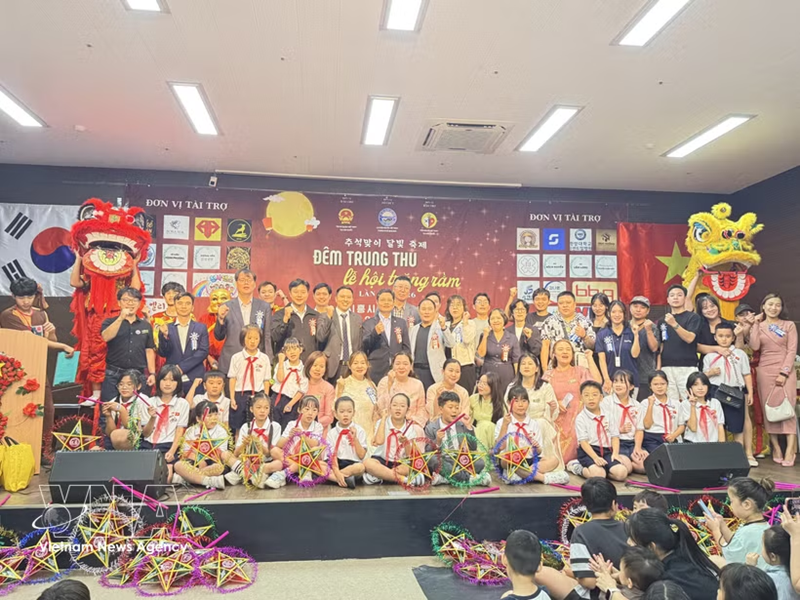
Participants pose for a photo at the 2026 Mid-Autumn Festival for overseas Vietnamese in the Republic of Korea |
Community activity must give OVs room to meet, practice culture and nurture patriotism. Cultural festivals, the Hung Kings commemoration, Tet celebrations, Vietnamese classes and children’s activities are meant to give children direct cultural experience. Vietnamese language is the thread holding memory, family feeling and generations together. Identity preservation must run alongside integration, so OVs adapt to Japan and stay proud of their roots.
Cay Tre Vietnamese Language School runs in-person classes in Kansai and online to fit children’s circumstances. Thuong said teaching should link to stories, singing, folk games, history, food and customs. Contests, exchanges and recognition can make learning enjoyable. Families, schools, associations, representative agencies and domestic educators need to coordinate on teacher support, materials and class sustainability.
Citing the Politburo’s Resolution 23-NQ/TW dated August 2, 2026 on overseas Vietnamese affairs, she said unity must reflect community diversity. Long-settled residents, new families, students, workers, entrepreneurs, intellectuals and Japan-born youth have different needs and need shared spaces to talk and cooperate.
Linking generations combines the experience and cultural capital of older Vietnamese with the knowledge, languages, technology and energy of younger ones. Associations need to respect differences, share information, coordinate and support each other. Culture, education, sports, charity and help for the disadvantaged can build trust through concrete action.
She said she wants the State to keep backing Vietnamese teaching, cultural preservation and links between OV experts, intellectuals and entrepreneurs and domestic localities. Representative agencies should act as connectors and help associations coordinate; community groups need transparent, professional and accessible operations with more focus on youth.
Regarding the Viet Nam Culture-Great National Unity Week, she said it gives families, associations, Vietnamese schools and youth a platform to enjoy community festivals, traditional ao dai, cuisine, music, books, exhibitions, inter-generational exchanges and charity toward Viet Nam.
Beyond cultural promotion, the OV community can link schools, research bodies, businesses and social organizations in both countries, help find partners, develop products and open markets. Cultural and educational cooperation can cover publishing, translation, materials exchange, teacher training and arts.
To unlock that resource, Viet Nam needs regular connection mechanisms, an expert and partner database, sectoral forums and focal points to receive and support proposals. Feasible initiatives should be piloted, assessed and scaled.
In her view, Viet Nam can learn how to pair heritage preservation with community education and modern-life products. Traditional materials can become books, films, design, digital content, educational games and cultural tourism, provided original values and accuracy are respected.
Products aimed abroad need quality, copyright, language, communications and distribution. OV artists, intellectuals, teachers, translators and entrepreneurs can help with local audience insight. Clear goals, concrete mechanisms and staying power will let Vietnamese culture bind the community, drive development and act as a friendship bridge to the world, she added.
Source: VNA