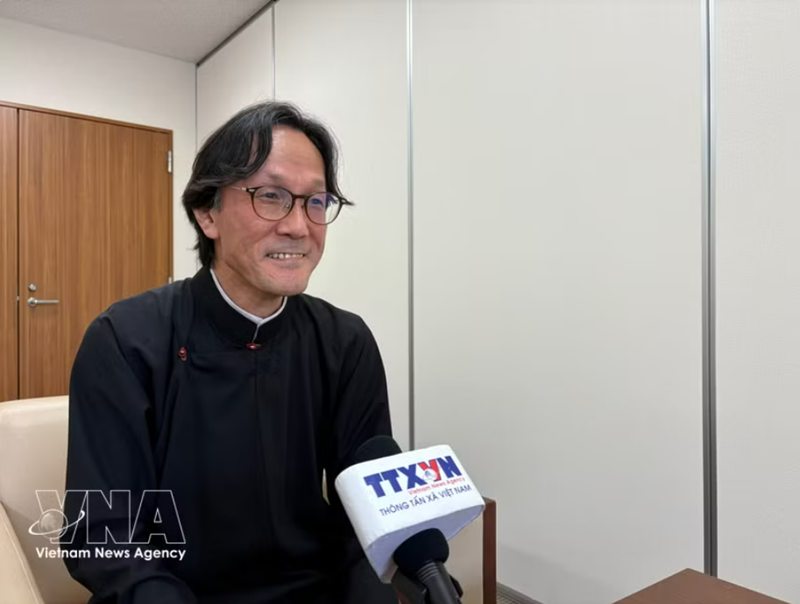
Speaking to Viet Nam News Agency correspondents in Japan on the occasion of being named a “Vietnamese Language Ambassador,” Shimizu said Viet Nam’s foreign policy is closely linked to the characteristics shaped by its history and culture. Throughout its history, the country has interacted with many major powers and diverse cultures while preserving its independence and national identity.
    |
 |
|
Prof. Shimizu Masaaki from Osaka University of Japan |
Rather than rejecting outside factors, Viet Nam has selectively and flexibly adopted them and adapted them to its own conditions and identity, he noted.
As a researcher of the history of the Vietnamese language, he said the same characteristic can be seen in the language’s development. Vietnamese has absorbed influences from Chinese, French and other languages without losing its distinct identity. Through the selective adoption and Vietnamizing of external elements, the language has grown into a rich linguistic culture.
In his view, this demonstrates the resilience and distinctive approach that Viet Nam has developed and preserved throughout its history.
Assessing Viet Nam’s foreign policy amid global and regional uncertainties, the expert said it is increasingly difficult for any country to rely on a single partner. Given its geographical position and historical background, Viet Nam needs to build and maintain relations with many countries.
Shimizu stressed the importance of distinguishing flexibility in diplomacy from a lack of an independent stance. By remaining steadfast on fundamental principles such as independence, self-reliance and national interests, Viet Nam can engage flexibly with individual partners while developing cooperation with as many countries as possible. Such an approach is increasingly relevant in a complex and unpredictable international environment.
Beyond state-to-state relations, he highlighted the importance of mutual understanding among peoples, saying that political and economic ties may change according to international circumstances, but trust built between peoples can endure longer.
Regarding his new role as a Vietnamese Language Ambassador, he said learning a foreign language is more than acquiring a communication tool. It helps learners understand how native speakers view the world, the values they cherish and how they build relationships with others.
Although many Vietnamese are living, working and studying in Japan, opportunities for Japanese people to learn Vietnamese and understand Vietnamese culture have yet to match the strong development of bilateral relations, Shimizu said, describing this as an area with considerable potential.
The expert stressed that while diplomacy is often viewed as relations between governments, its deeper foundation is people-to-people connections. Increasing the number of Japanese learning Vietnamese therefore means ensuring more people genuinely understand Viet Nam and creating more bridges between the two countries.
Drawing on his research and teaching experience, he observed a distinctive feature of Vietnamese culture: placing importance on relationships with others and keeping flexibility in interacting with others while at the same time maintaining one’s own position and identity.
When communicating in Vietnamese, people are generally mindful of who they are speaking to and of their own position within the relationship, the Japanese researcher said.
He stressed that this cultural trait mirrors Viet Nam’s foreign policy – flexible in approach but steadfast in core values.
As Vietnamese Language Ambassador, Shimizu hopes to make Vietnamese more accessible in Japanese society, including among schools, businesses, local communities and families of Vietnamese origin. He expects the language will be recognized as a valuable social and cultural resource capable of connecting the two peoples.
He expressed his hope for more opportunities for Japanese people to engage with Vietnamese language and culture, and that Vietnamese-origin children in Japan will be further supported to appreciate their homeland's language and heritage.
Shimizu affirmed that the Comprehensive Strategic Partnership between Viet Nam and Japan is built not only on political and economic cooperation, but also on connections between individuals, adding through Vietnamese, people of the two countries can understand and respect each other and build lasting trust.
Source: VNA