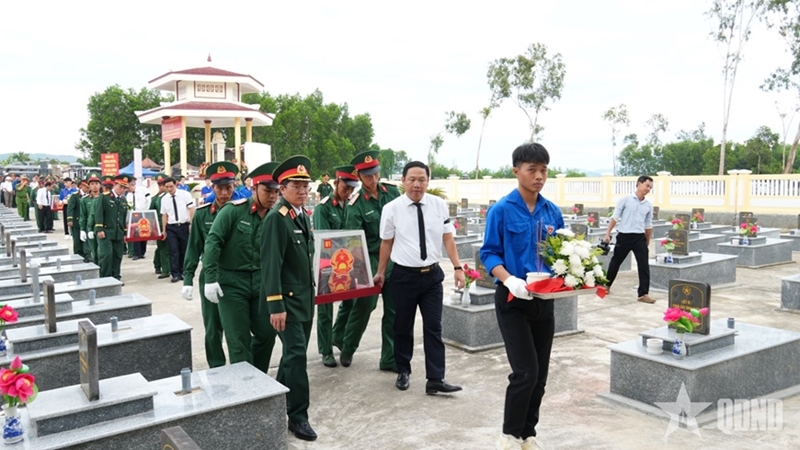
On August 30, at An Hoi Bac 1 War Cemetery in Nghia Giang commune, Quang Ngai province, a memorial and burial ceremony was held for the remains of five martyrs recently recovered from the Go Tram area in An Son village.
    |
 |
|
The memorial service and burial ceremony held at An Hoi Bac 1 War Cemetery in Nghia Giang commune, Quang Ngai province |
The remains were located based on information provided by witnesses, who said the area had once stood shelters for troops during the resistance war against U.S. imperialists. After days of surveying, excavating and expanding the search area, forces recovered the five sets of remains along with several related artifacts.
The Quang Ngai provincial Military Command has also deployed Team K53 to Laos and Cambodia for the 2026-2027 dry-season search and recovery of martyrs’ remains. The team has collected 67 leads, including 20 concerning martyrs’ graves or areas where remains may still be located. After verifying all the leads, the team assessed 13 as highly reliable and included them in its search plan, comprising eight areas in Laos and five in Cambodia.
In Da Nang, during excavation and sample collection at Dai Chanh War Cemetery in Phu Thuan commune, forces discovered an artifact engraved with the name, year of birth, unit and date of death of a martyr. Found at grave No. 345, Row 1, Section B4, the artifact bears the inscription: “Nguyen Toan Quyen, born in 1954, unit CB72, died on November 27, 1972.” The Da Nang municipal Military Command is coordinating with relevant agencies and local authorities to verify the information and locate the martyr’s relatives and comrades.
The command calls on veterans, comrades, relatives and anyone with information about martyr Nguyen Toan Quyen to contact the Da Nang municipal Military Command or the Phu Thuan commune Military Command to provide information and assist with verification.
In Thanh Hoa province, the Steering Committee for the Search, Recovery and Identification of Martyrs’ Remains (Steering Committee 515) is collecting and handing over remains samples at Quan Hoa and Muong Lat Martyrs’ Cemeteries. The two cemeteries contain 234 graves, including 99 whose identities remain unknown. Working teams have been established to ensure that excavation, sample collection, preservation, coding, data digitization, record management and transportation to DNA testing facilities are conducted in accordance with professional procedures and regulations, helping ensure accurate and objective identification.
In Quang Tri province, a memorial and burial ceremony was held at Hai Lang War Cemetery in Dien Sanh commune for the remains of 13 martyrs recovered from the Cau Nhi area of Nam Hai Lang commune. The Quang Tri provincial Military Command has coordinated with relevant agencies and units to verify information and conduct searches in the area, bringing the total number of remains recovered there to 42 after decades of searching.
In Lao Cai province, Steering Committee 515 held a conference to collect information and historical documents supporting the search for and recovery of martyrs’ remains at K30 Fortress in Residential Area 26, Lao Cai ward. Delegates reviewed historical documents and archival records concerning forces that defended the fortress during the war to protect the Northern border in 1979. They initially agreed that the seven sets of remains found at K30 Fortress belonged to personnel of the armed forces of Hoang Lien Son province, now Lao Cai province.
In Phu Tho province, Steering Committee 515 organized the collection of remains samples for DNA testing at Tam Nong War Cemetery. Of the cemetery’s 279 graves, samples were collected from 41 unidentified graves. Tam Nong is the last of 128 martyrs’ cemeteries in the province where samples from unidentified remains needed to be collected. At the end of Phase 1 of the campaign, Phu Tho had reviewed and excavated 4,694 unidentified martyrs’ graves, reaching 100 percent of the number of graves scheduled for sample collection.
Translated by Tran Hoai