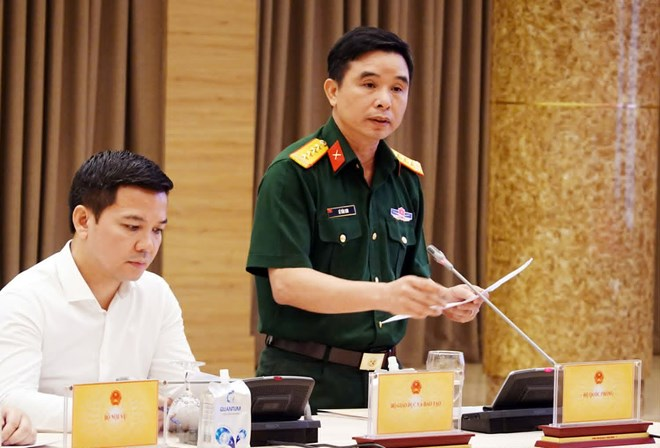
Addressing the Government's regular press conference, Colonel Le Van Son, Deputy Director of the Social Policy Department under the General Department of Political Affairs of the Vietnam People's Army, described the campaign, lasting from March 15, 2026 to July 27, 2027, as a comprehensive effort aimed at achieving breakthroughs in locating, recovering and identifying fallen soldiers.
It focuses on five major objectives: recovering remains of about 7,000 martyrs; collecting samples from around 230,000 unidentified graves at martyrs' cemeteries; conducting DNA testing on approximately 18,000 sets of remains; establishing a genetic database of relatives of unidentified martyrs; and completing unexploded ordnance clearance in key former battlefields, including Vi Xuyen in Tuyen Quang province, and Lao Cai and Lang Son provinces.
    |
 |
|
Colonel Le Van Son - Deputy Director of the Department of Social Policy, General Department of Political Affairs of the Vietnam People's Army informs about the implementation of the "Operation 500 days and nights searching, gathering and identifying martyrs' remains." |
To support the work, the Ministry of National Defense has assigned quotas to military regions and units based on field surveys and verified information. Nationwide, 32 search and recovery teams with around 1,500 personnel are currently carrying out operations.
Son said a newly adopted approach has produced encouraging results. The initiative involves reviewing documents and information supplied by organizations and individuals both inside and outside Vietnam, followed by expert workshops to verify suspected mass grave locations.
As a result of two workshops held in Quang Ngai province and Ho Chi Minh City, one set of remains has been recovered in Quang Ngai, while excavation at a suspected mass grave site in Le Thi Rieng Park of Ho Chi Minh City is scheduled to begin on July 6.
Search operations have also become more efficient through the combined use of map coordinates, on-site surveys, witness accounts and ground-penetrating radar, improving accuracy while reducing excavation time and workload.
The Ministry of National Defense has issued procedures for collecting, digitizing, transporting and preserving samples from unidentified remains, and organized training for local authorities nationwide. More than 300 sampling teams, involving around 3,500 personnel, have been established across the country.
To improve traceability and minimize errors, Viettel Group has developed a digital management system that records and stores information throughout the sampling process.
On the identification front, the Ministry of Home Affairs advised the Government to issue Resolution No.26/NQ-CP, establishing special mechanisms to facilitate DNA sampling, testing and identification of unidentified remains. It also introduced regulations governing coordination and the allocation of responsibilities among DNA testing centers.
Meanwhile, the Ministry of National Defense has deployed 330 demining teams, comprising more than 5,000 personnel and equipped with over 1,300 specialized vehicles and machines, to clear unexploded ordnance in priority areas.
To date, the campaign has collected samples from more than 27,000 graves, with over 20,000 transferred to DNA testing centers after meeting technical requirements. More than 7,000 hectares of land have been cleared of unexploded ordnance, including over 3,000 hectares in the former battlefield of Vi Xuyen, representing more than 70% of the planned clearance target.
The Ministry of Public Security has also collected nearly 95,000 DNA samples from relatives of fallen soldiers, with more than 50,000 already analyzed and integrated into the national genetic database, Son added.
Source: VNA