Undiscovered mass grave in a garden
Based on information from Bui Van Thanh and revolutionary veteran Truong Quang Chuong, we visited Bui Van Bao’s house in Mai Xa village. Before 2000, authorities exhumed a “group grave” containing nine sets of remains here. Following the 1968 Tet Offensive, while establishing a military post, enemy forces used bulldozers to push fallen soldiers' bodies into a burial pit.
    |
 |
|
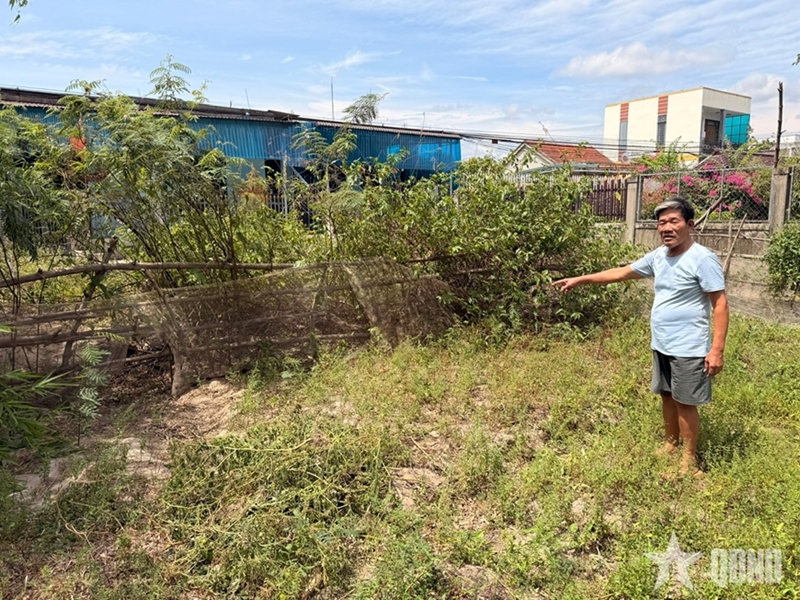
Truong Quang Phuc points to the suspected mass grave area near his garden. |
Bao settled on this land in 1988, after which his business faltered and his health deteriorated. Around 1998, while clearing a path and excavating the foundation of a former cowshed, his family discovered numerous intertwined remains. Locals had to count nine skulls to separate and assemble the bones before placing them in urns for reburial at the Gio Linh War Cemetery. As he saw us off, Bao expressed his painful belief that more remains might still lie beneath the concrete driveway in front of his gate.
Explaining the issue of “unidentified” martyrs’ graves, Truong Quang Chuong noted that due to limited facilities and technology at that time, many remains lost their identifying information when transferred to the Gio Mai commune Martyrs’ Cemetery (now Cua Viet commune).
Moving another kilometer to Truong Quang Phuc’s house, we heard about a fully identified set of remains found beneath a bougainvillea tree at his front gate years ago.
About 20 meters from Phuc’s house is an abandoned plot of land belonging to Le Thi Sanh. Phuc recalled that on the afternoon of the 1968 Lunar New Year’s Eve, a bomb struck the shelter in Sanh’s house, killing many regular soldiers and guerrillas. Villagers buried their bodies collectively next to a bomb crater in the garden. Although relatives of the martyrs have organized multiple excavations over the years, no remains have been found. Phuc expressed his hope that authorities would soon examine and survey the area.
Valuable records of a former political officer
Veteran Hoang Van Thi (born in 1947), former Political Officer of Commando Team 4 under the B5 Front, shared the brutality of the war through his diary pages. By 1972, Team 4 had lost 22 men, particularly during the battle of Quan Ngang (in Gio Linh) in the summer of 1969. Due to leaked information, Vietnamese troops fell into the enemy’s “scorched earth” trap and suffered heavy casualties.
|
|
 |
|
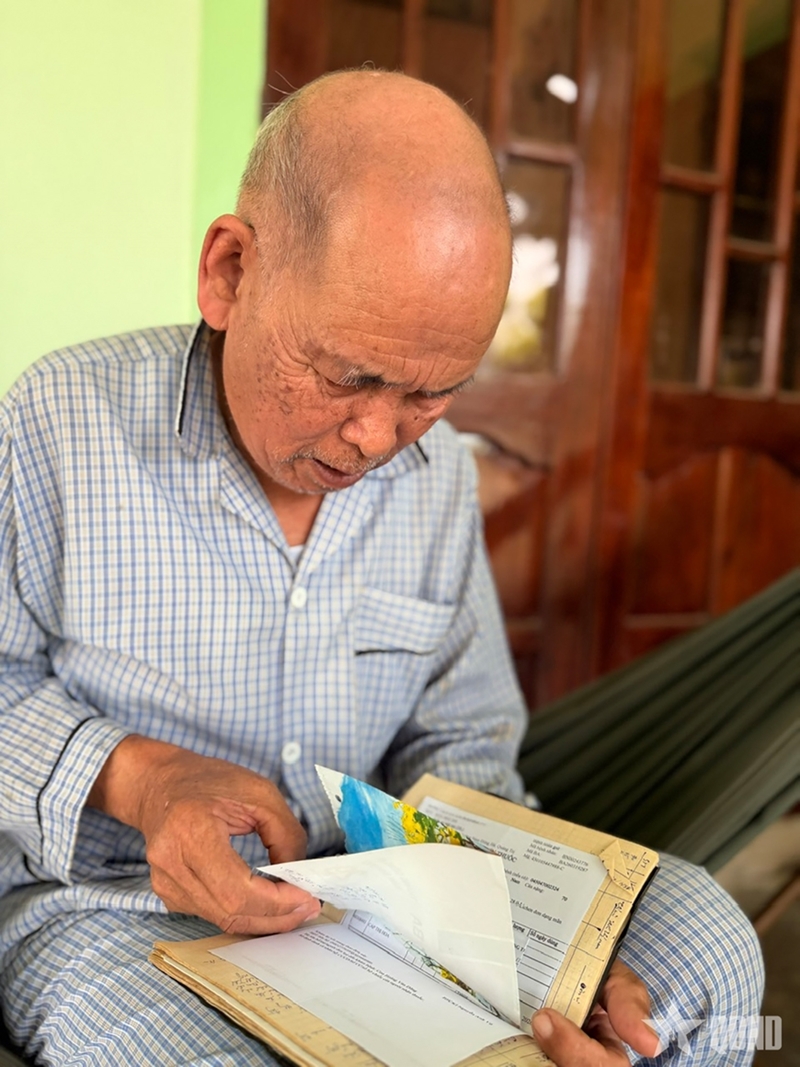
Veteran Hoang Van Thi and his wartime notebooks. |
After a night of fighting, only 11 survivors retreated but were relentlessly pursued by enemy armor. A severely wounded soldier named Chau asked to be left behind to avoid slowing down the unit. When the fighting subsided, the team returned to search for him, and miraculously, Chau had survived for three days by chewing leaves around his hiding spot. Thi also could never forget the image of a soldier who used a bowl to cover his open stomach wound, continuing to fight until his last breath.
Recalling the battle on January 20, 1968, at Bau Dong forest in Mai Xa village, Thi noted that the unit lost seven comrades, including martyr Nguyen Hoc from Lam Xuan village and commander Nguyen Tien Bao from Hanoi. For nearly 60 years, he has treasured his battlefield notebooks, which meticulously detail each battle and list his comrades.
In the late afternoon, wind from the Hieu River rustled through the vibrant bougainvillea trellises in the now-peaceful Mai Xa village. Bathed in the fading sunlight, the veteran carefully flattened each yellowed page, expressing deep longing for his fallen comrades.
Translated by Minh Anh