During the campaign, technology is helping connect fragmented information, creating new opportunities to restore the identities of fallen soldiers and ending the decades-long wait of many families.
Race against time
Recent discoveries of fallen soldiers’ remains across Vietnam, as well as in Laos and Cambodia, have drawn widespread attention. Behind each report of a newly located burial site, excavated grave, or collected biological sample is the persistent and silent work of thousands of officers, soldiers, and experts.
After more than four months, the campaign has recovered the remains of nearly 1,400 fallen soldiers and collected tens of thousands of samples from remains and relatives for DNA testing.
Each figure reflects more than simply the volume of work. It also carries the hope of a homecoming after years, and in some cases decades, of waiting.
    |
 |
|
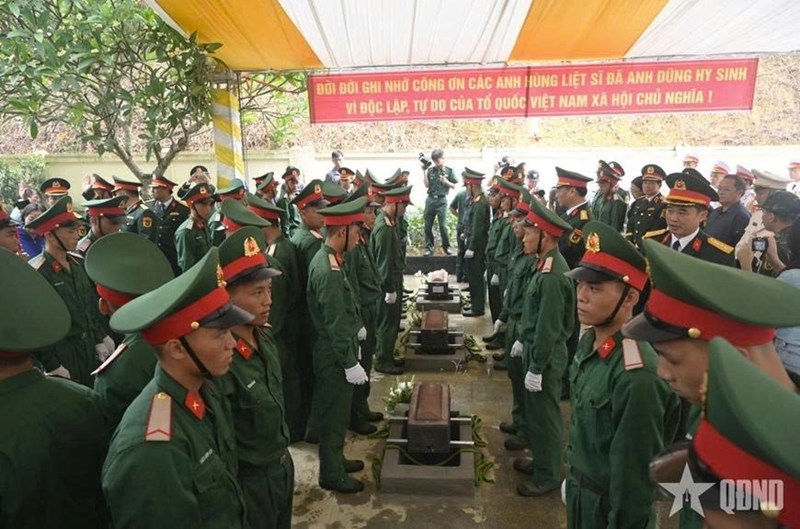
Bat Xat commune, Lao Cai province, holds a memorial, funeral, and burial ceremony for fallen soldiers’ remains in June 2026. (Photo for illustration) |
Searching for and identifying fallen soldiers is an exceptionally difficult task. Decades have passed, altering terrain and landmarks, while traces of former battlefields have been transformed by time and socio-economic development. Many witnesses are now elderly and their memories have faded, while relevant records may be scattered among numerous agencies, units, and localities.
Information about fallen soldiers also exists in many different forms, such as paper records, maps, combat diaries, archival documents, grave diagrams, keepsakes, or the memories of former comrades and local residents. Some clues may consist of no more than a single written line, the former name of a place, or a detail passed down through generations. Unless these fragments of information are digitized, standardized, and connected, cross-referencing them on a large scale is extremely difficult.
Meanwhile, the process from receiving an initial lead to identifying a fallen soldier involves numerous stages and the participation of multiple forces, including those surveying sites, verifying witness accounts, conducting excavations, collecting samples, managing remains, performing DNA testing, matching relatives’ data, and completing records. A missing link or delayed update at any stage can affect the entire process.
Entrusted with the mission by the Ministry of National Defense, Viettel Group has developed an ecosystem of digital platforms to digitize operational processes, integrate data, and help specialized agencies make decisions based on accurate and timely information.
The solutions focus on two major objectives of supporting the search and recovery of remains and helping identify fallen soldiers. For search and recovery, Viettel has deployed seven solutions covering public tips, campaign management, record digitization, grave information, and progress monitoring.
Two hotlines, 18008022 and 0965.001222, staffed by 15 dedicated operators, have received more than 10,000 reports, including thousands of leads related to fallen soldiers and hundreds concerning relatives. The campaign’s Facebook and TikTok channels have generated nearly 24 million impressions and provided additional public leads for verification.
Notably, a management and reporting system also consolidates data from localities in real time, allowing coordinating agencies to monitor recovered remains, areas cleared of unexploded ordnance, collected samples, samples sent for DNA testing, and other operational indicators.
For a nationwide campaign, real-time data reduce fragmented reporting and information delays while helping direct resources where they are most needed. Technology cannot replace officers and soldiers working in the field, but it can help guide their efforts and shorten the search.
“The greatest value of technology in the 500-day campaign does not lie in the number of software solutions deployed, but in the ability to connect data, improve coordination among forces, and provide a stronger scientific basis for the search and identification of fallen soldiers,” a representative of Viettel Solutions said.
From unnamed graves to DNA records
While search and recovery efforts bring fallen soldiers’ remains to cemeteries, identification is the crucial step that enables the fallen to reclaim their names, hometowns, and families.
To support this goal, Viettel has developed an end-to-end digital process covering the management of information during excavation, sample collection and storage, and the creation of a DNA database for fallen soldiers’ remains, ready for comparison with relatives’ DNA data.
The information management system for samples from fallen soldiers’ remains has been deployed in 34 provinces and cities, with accounts provided for personnel responsible for digitization. Tens of thousands of graves are now managed through the system, while samples eligible for DNA collection, those already sent for testing, and those not yet meeting testing requirements are clearly classified.
In parallel, a system for managing and storing DNA records and a DNA database for fallen soldiers’ remains have been developed to manage the entire data lifecycle, from sample collection and storage to testing and comparison with relatives’ DNA databases. This provides an important foundation for making the identification process more scientific, rigorous, and accurate.
The system’s value extends beyond its capacity to store vast amounts of information. When historical and geographical data, military personnel records, grave information, and DNA data are inter-connected, even the smallest detail can become a lead for cross-referencing.
A notation in an old record may be linked to an excavation site. A DNA sample may show a match with data from a relative. A tip from a member of the public may provide the missing link in a decades-old case file.
“We hope that every digital platform will create another opportunity for fallen soldiers to soon return to their names, hometowns, and families,” a Viettel representative said.
When every line of data represents a human life
To develop these platforms for the campaign, Viettel engineers have had to familiarize themselves with highly specialized procedures spanning recovery sites, DNA laboratories, and management agencies. They have spent considerable time researching, learning, and working alongside specialized personnel to ensure that the systems meet technical requirements while remaining closely aligned with practical needs.
Time pressure was intense. Some software was completed in just 20 days. Viettel has mobilized personnel to work continuously and coordinate with local Steering Committees 515 to digitize records, train users, and update data.
What makes the project different, however, is not only its complexity or tight deadlines. In a conventional technology project, data may represent a transaction, process, or operational metric. Here, every line of data may represent a soldier and a family that has waited for years.
Recognizing that significance, the implementation team regards the mission as a “command from the heart.” Each person’s contribution, whether completing a data field, standardizing a process, or fixing a software error, can contribute to the greater journey of restoring fallen heroes to their rightful names and hometowns.
Answering the long wait
The campaign continues. Much work remains ahead. Many areas still need to be surveyed, tens of thousands of records require verification, and numerous graves remain unidentified. But with the participation of the entire political system, the persistence of search and recovery forces, and the support of science and technology, fragments of information once thought lost are gradually being reconnected.
Five hundred days represent a specific timeframe, but this journey of gratitude cannot be measured in days and months. It is measured by every soldier who is found, every identity that is restored, and every long wait that is finally answered.
It is also how today’s generation upholds the Vietnamese tradition of “When drinking water, remember its source” with all the responsibility, devotion, and best possible capabilities.
Translated by Tran Hoai