A classroom beneath trees
The temporary classroom was set up by U.N. peacekeepers serving in Tajalei in response to requests from residents of three nearby villages. Senior Captain Pham Duc Tho, Chief Military Observer for the U.N. Military Observer (UNMO) Group under the U.N. Interim Security Force for Abyei (UNISFA), has also been closely involved in supporting the class.
    |
 |
|
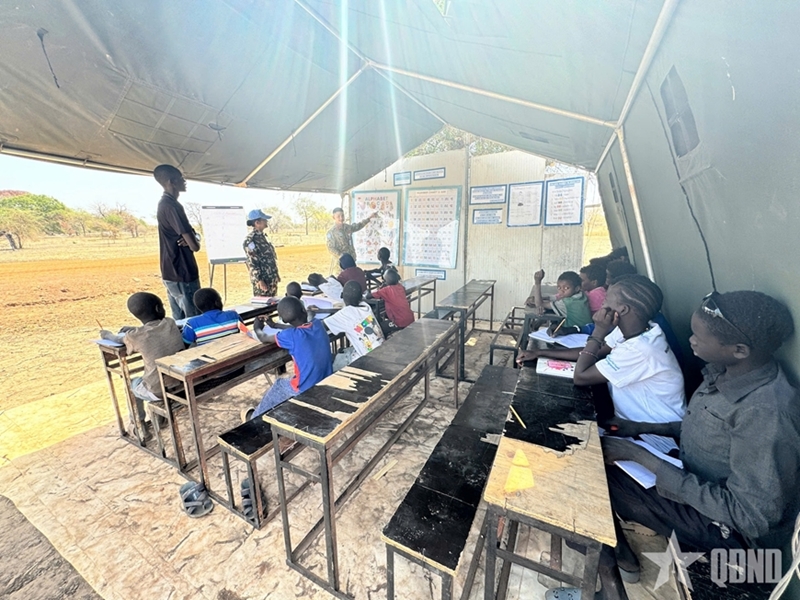
A makeshift classroom stands beneath a tarpaulin roof in Tajalei village. |
According to Senior Captain Pham Duc Tho, most children in the three villages are illiterate and have no access to school. With no schools nearby, they would otherwise have to walk for hours along muddy trails during the rainy season to reach the center of Abyei.
Surrounded by sparse woodland, the villages are almost completely isolated. During the dry season, residents are reluctant to travel because of the risk of looting amid an unstable security situation. In the rainy season, damaged roads prevent even UNMO personnel from conducting patrols, leaving helicopters as the only practical means of transportation.
|
|
 |
|
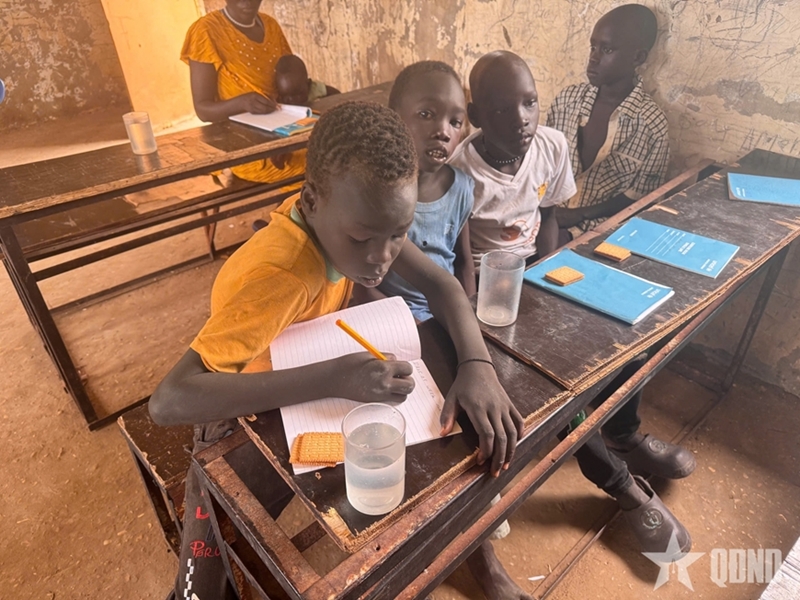
Children learn to write for the first time. The class has temporarily moved into an abandoned house because of unfavorable weather conditions. |
Tajalei village lies about one kilometer from the U.N. peacekeeping base. To make it easier for children to attend, the classroom was established in a nearby clearing. Even so, keeping the class running and ensuring regular attendance has not been easy.
At first, the peacekeepers had to visit local villages to persuade parents to allow their children to join the class. Teaching also posed challenges because the students were of different ages and educational levels.
|
|
 |
|
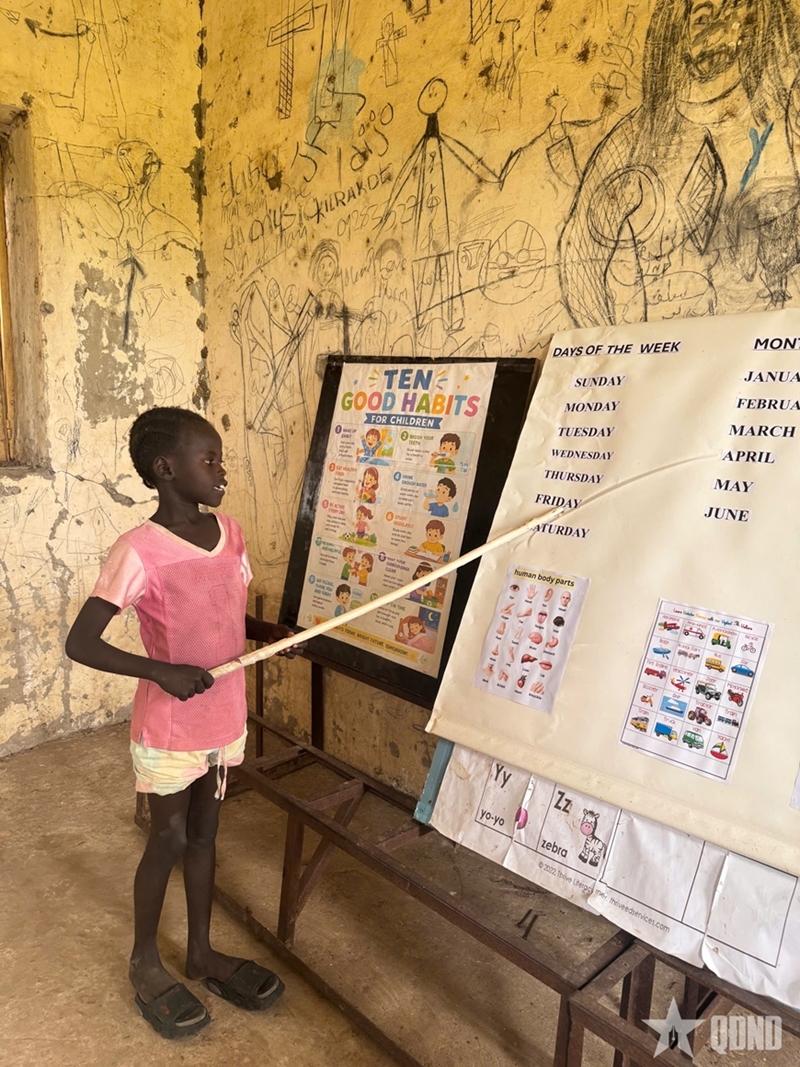
Student Atouch Maichel is able to read after attending the class. |
The classroom initially consisted of little more than a large tarpaulin stretched over a steel frame salvaged from abandoned houses, meaning lessons could only be held in favorable weather. With the rainy season now underway, the class has temporarily moved into an abandoned house closer to the village.
With resources extremely limited, desks and chairs have been made from discarded materials. The simple classroom is decorated only with alphabet charts and pictures of animals attached to makeshift corrugated-iron walls.
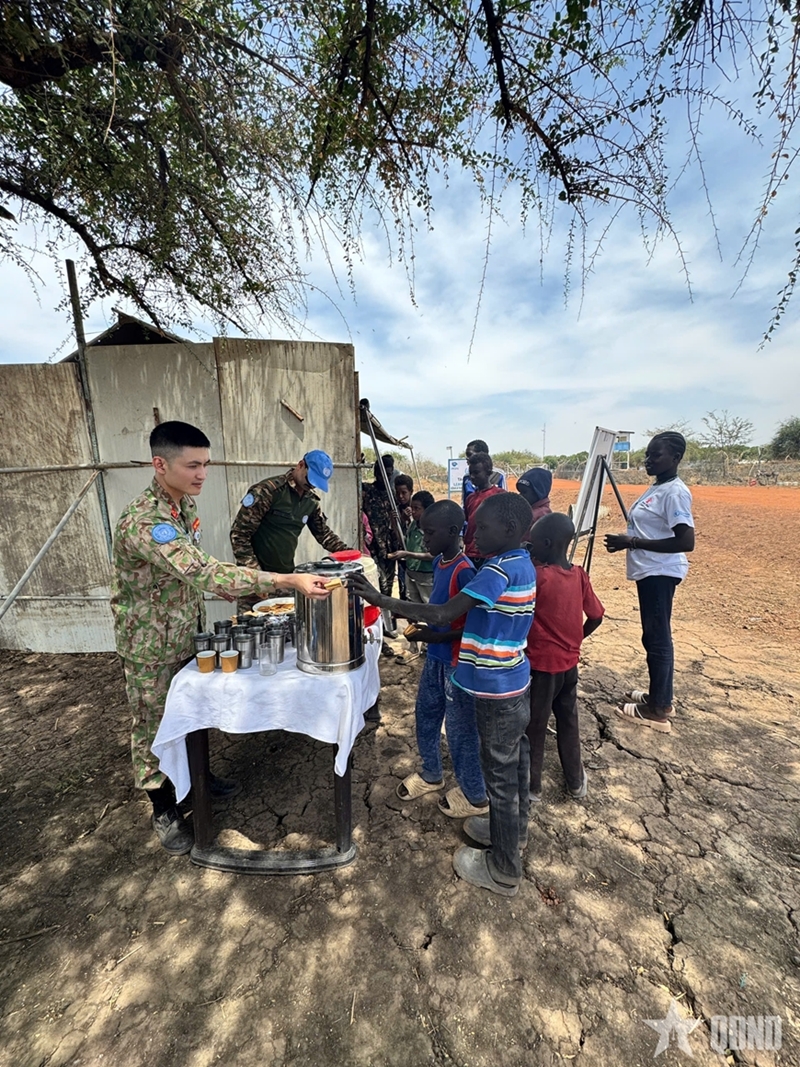
The blue berets regularly repair the facility. They also prepare snacks and drinks to encourage the children to attend class regularly.
In addition to teaching, Senior Captain Pham Duc Tho and his international colleagues in the UNMO Group have raised funds to buy notebooks, pencils and erasers for the students.
|
|
 |
|
Peacekeepers prepare snacks for the children at each class session. |
Classes are held twice a week, on Wednesdays and Thursdays, depending on weather and security conditions. During each session, personnel from the Indian protection unit are deployed to ensure safety for all students.
Despite its modest facilities, the classroom has become deeply meaningful to children in villages where electricity, medical services and schools are unavailable. Through the initiative, many have learned to read, write and count for the first time.
Children who were initially reluctant to study have gradually become more enthusiastic and now attend classes more regularly.
Eight-year-old Atouch Maichel is one of them. Maichel said he enjoys coming to class, where he learns new things in English and receives snacks and soft drinks afterward.
According to Senior Captain Pham Duc Tho, Maichel dreams of gaining enough knowledge to become a pilot so that he can one day fly wherever he wants.
Captain Francisco Guerrero of Ecuador, a colleague of Senior Captain Pham Duc Tho in the UNMO Group, said the initiative was intended to give local children better access to education. He added that the officers hoped the effort would provide practical support to disadvantaged communities, especially children living in their area of deployment.
|
|
 |
|
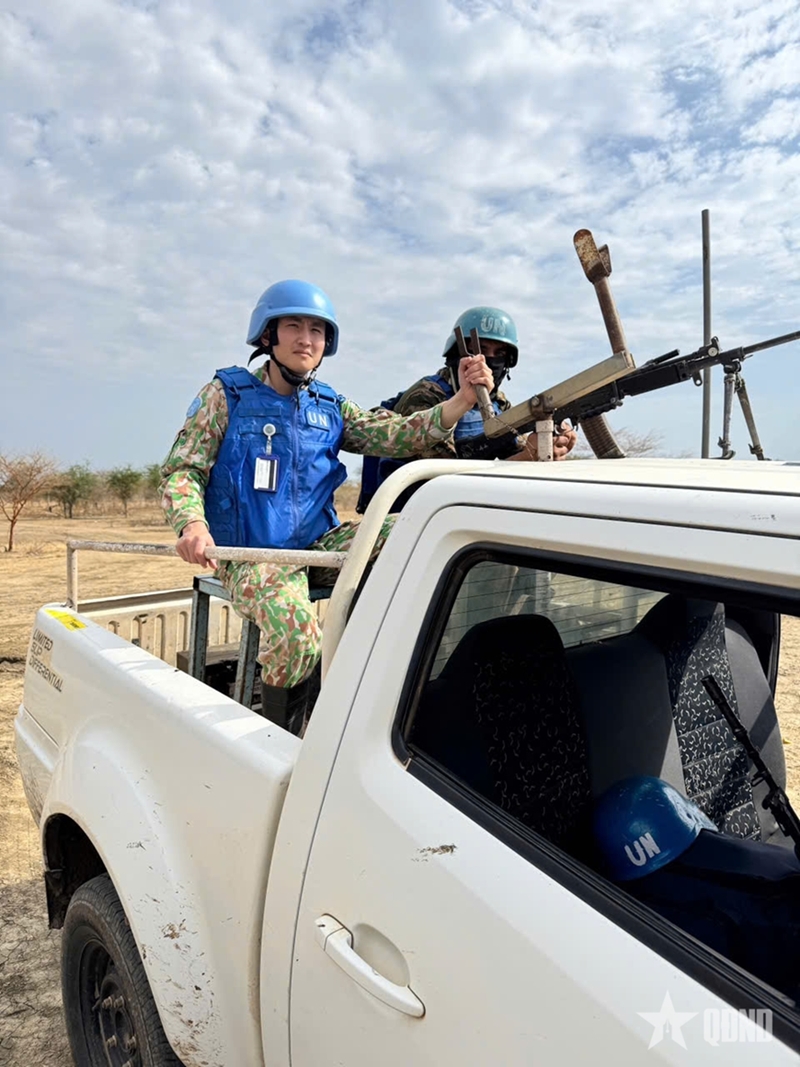
Senior Captain Pham Duc Tho carries out a patrol with his colleagues. |
Firm fulcrum for community
Senior Captain Pham Duc Tho said that in addition to coordinating with the Indian protection unit and U.N. police to maintain the classroom, the UNMO Group also provides clean water and medical assistance to residents of Tajalei.
Because the center of Abyei is about 40 kilometers away, local residents often turn to the UNMO Group’s base when they need medical assistance. Traveling such a distance carries significant risks because of tensions and disputes.
Equipped with a medical room and medicines, the UNMO Group stands ready to assist residents in need of treatment. In Tajalei, the blue berets have provided reliable support for disadvantaged people whose lives have been affected by prolonged conflict.
As the group’s chief, Senior Captain Pham Duc Tho works closely with colleagues from different countries. He said he was encouraged that despite harsh living and working conditions, all team members shared the same determination to help improve the lives of local residents.
Captain Francisco Guerrero also affirmed that the peacekeepers in Tajalei would continue working to maintain the classroom and community-support activities, helping bring a brighter future to local children and residents.
Their quiet dedication and practical support have helped strengthen local people’s trust in the U.N. peacekeeping force while spreading a strong humanitarian message.
Translated by Minh Anh