Vietnam - Europe cooperation in 2025: Rising to a new height
Hang wrote that Vietnam hosted 12 high-level European delegations last year, including visits by the King of Belgium; the Presidents of France, Hungary and Lithuania; the Prime Ministers of Russia, Spain and Kyrgyzstan; and parliamentary speakers from five partner nations. Vietnamese leaders also paid seven visits to Europe, several of them carried historic significance: the first official visit by a Vietnamese leader to Estonia since diplomatic ties began, Party General Secretary To Lam’s official visit to Russia for the 80th anniversary of the victory over fascism, stops in traditional friends Belarus and Bulgaria, followed by Northwestern Europe, including the U.K. and Finland. These engagements conveyed Vietnam’s consistent foreign policy of independence, self-reliance, multilateralization and diversification; being a friend, a trustworthy partner and a responsible member of the international community. The exchanges resulted in upgraded relations with nine countries, reflecting the elevated strategic level of Vietnam - Europe cooperation.
    |
 |
|
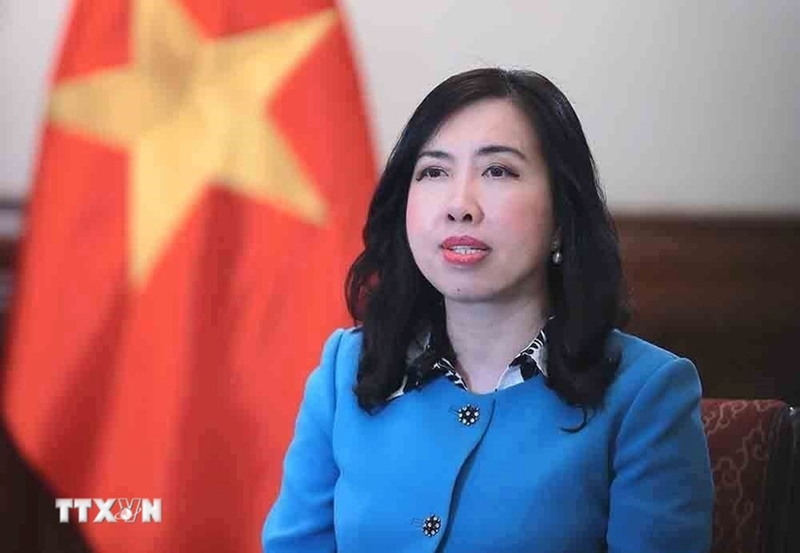
Deputy Minister of Foreign Affairs Le Thi Thu Hang |
Substantive advances also emerged in ties with European political parties and influential forces. Five European parties attended Vietnam’s major national commemorations. High-level theoretical dialogues with Germany’s Left Party and Social Democratic Party deepened political engagement and bolstered strategic trust. The diplomatic momentum elevated Vietnam - Europe relations overall, broadening strategic cooperation across political, economic, trade, investment, science-technology and other domains, and generating key resources for Vietnam’s new development era.
Trade, investment remain core driver
Five years after its launch, the E.U. - Vietnam Free Trade Agreement (EVFTA) continued yielding concrete gains, cementing Vietnam as the E.U.’s top trade partner in ASEAN and the E.U. as Vietnam’s fourth largest overall. Two-way trade approached 61 billion USD in the first 10 months of 2025, up 8.4% year-on-year. Momentum also built on the E.U. - Vietnam Investment Protection Agreement (EVIPA), with expected ratifications by Cyprus, Poland and Germany this year.
According to her, investment remained a bright spot in Vietnam - Europe economic ties. E.U. firms ranked among Vietnam’s premier sources of quality foreign direct investment, focusing on processing and manufacturing, infrastructure, logistics, finance-banking, high technology, and sustainable agriculture. They repeatedly praised Vietnam’s improving business climate, particularly institutional and administrative reforms, digital transformation, infrastructure, and workforce quality, and expanded commitments, as seen in Denmark’s LEGO Group investments. Joint projects in energy transition, green finance, green infrastructure, and climate change adaptation progressed, contributing to Vietnam’s commitment to net-zero emissions target by 2050. European capital is poised to deliver not only funding but also advanced technologies and sustainable development models, enhancing growth quality and reshaping Vietnam’s development structure.
Sci-tech and innovation: A new direction
Sci-tech and innovation have truly emerged as a new pillar of Vietnam - Europe cooperation. Cooperation deals signed in 2025 with Russia, France, Sweden, Estonia and Central Asian countries demonstrated the European partners’ timely responsiveness and strong commitment to accompany Vietnam amid its renewed development thinking in the new era, which places sci-tech and innovation as a key driver.
Practical cooperation in this field advanced with the direct involvement of local authorities, enterprises, experts, research institutes and universities from both sides. Priority areas include digital transformation, artificial intelligence, semiconductors, biotechnology and quantum technologies, which Europe holds strengths and Vietnam has pressing needs for its economic modernization, competitiveness and sustainable development.
Cultural exchange, tourism, people-to-people diplomacy nurture lasting friendship
The year 2025 featured numerous major cultural exchange and people-to-people diplomacy events, marking the 75th anniversary of diplomatic ties between Vietnam and Russia and between Vietnam and Central/Eastern European countries, the 50th anniversary of Vietnam - Germany ties, and the 35th anniversary of Vietnam - E.U. relations. Events throughout the year demonstrated the depth and vitality of Vietnam’s friendship with the region, such as a June seminar on 75 years of Vietnam - Central/ Eastern Europe relations, a July cultural and arts festival in Russia, a November event “Vietnam - E.U. Day: A cultural bridge for a sustainable future”, and a December workshop on 50 years of Vietnam - Germany relations: milestones and prospects. Notably, Vietnam Day debuted at Russia’s Red Square, drawing millions in attendance. These activities continued to serve as bridges of trust, enhancing mutual understanding and further tightening Vietnam–Europe ties.
Vietnamese audiences also enjoyed a series of distinctive cultural and art events held by European countries, including Germany’s Hessen Chamber Orchestra concert in October, Austria’s Vienna series in November, Russia’s Swan Lake ballet, Poland’s OSP Nadarzyn Orchestra exhibition and gala in November, and a Bulgarian music night in December.
In particular, new direct air routes to Milan (July), Munich (October) and Copenhagen (December) elevated Vietnam’s appeal in Europe, fueling a record tourism influx exceeding 20 million visitors.
2026 outlook: Elevating Vietnam - Europe partnership
As 2026 begins amid global uncertainties and European challenges, the continent retains its status as a vital geopolitical and economic hub. Vietnam views Europe as a priority partner and aims to deepen traditional cooperation while expanding into green transition, digital transformation, renewable energy, green finance, quality workforce training and aerospace.
To propel relations to a higher level, both sides require strong resolve and tight coordination at bilateral and multilateral levels. Sustained high-level exchanges across channels, full utilization of existing frameworks, and consolidation of political foundation will generate momentum for comprehensive ties, she wrote.
Effective implementation of FTAs, including E.U. - Vietnam FTA, U.K. - Vietnam FTA and Eurasian Economic Union - Vietnam FTA, should continue, alongside efforts to secure remaining EVIPA ratifications and better market access for Vietnamese agro-forestry-fisheries exports.
Priority should also be given to concrete projects and tangible outcomes in sci-tech, innovation, and education - training, contributing to the effective implementation of Vietnam’s strategic resolutions, she said, adding that external information, cultural and people-to-people diplomacy should be upheld, in tandem with tourism and local-level cooperation, along with stronger connections between Vietnamese communities in Europe and their homeland, thereby projecting Vietnam’s image and creating strong momentum and foundation for sustainable cooperation.
In her view, mutual liaison at multilateral forums should continue to push multilateralism, respect for international law, free trade and freedom of navigation, for the common interests of peace, stability and sustainable development in the region and worldwide.
With these orientations, she wrote that Vietnam sees its European partners as companions in the new development era and will collaborate to elevate bilateral ties to a new stature in the very first year of the 14th National Party Congress term, toward the centennial goals and the successful fulfillment of the Congress’s mandates.
Source: VNA