From the era of the Hung Kings to modern society, Tet remains a "red thread" connecting eras, preserving the cultural soul and spiritual vitality of the Vietnamese people.
    |
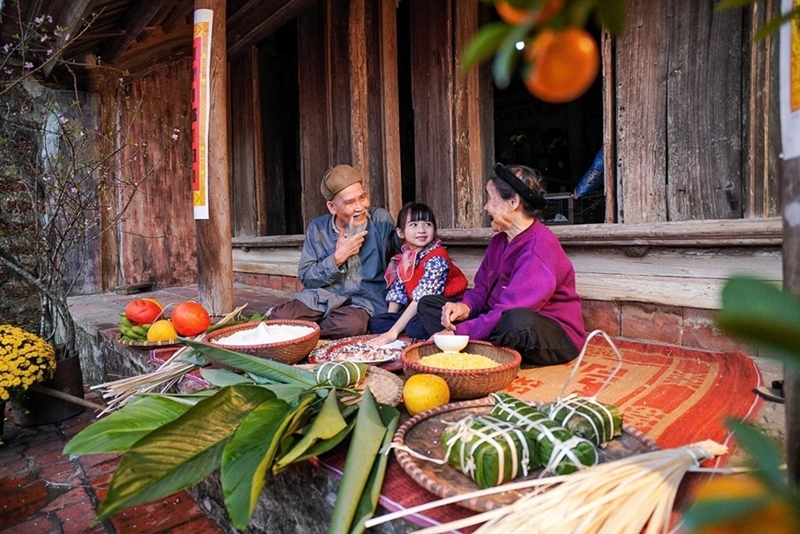 |
|
As long as Tet is welcomed with respect and sincerity, that historical red thread will remain intact, guiding the nation through new springs of the era. |
Tet in Historical Records: The Origins of Vietnamese Identity
In the collective memory of the nation, Tet came into being very early, intertwined with the legends of the country’s founding. The legend of Lang Lieu offering Banh chung and Banh giay is not only an origin story of festive cuisine, but also the first cultural manifesto of the ancient Vietnamese people, placing Heaven-Earth, agriculture, and family at the center of their worldview. Since the Hung King era, Tet has carried a sacred meaning of gratitude: to the heavens for the harvest, and to ancestors for reclaiming and protecting the land.
Ancient annals, from the Complete Annals of Dai Viet to feudal court records, show that Tet was a paramount national event. Kings issued amnesties, held spring festivals, and performed rituals for Heaven, Earth, and ancestors; the common folk gathered for family reunions. Tet, therefore, was not only a private family affair, but a collective rhythm of society, where the past and present converged.
Cultural order of Vietnamese villages
In traditional social structures, the village was the fundamental cell of the nation. Within this space, Tet evolved into a rigorous system of customs reflecting the cultural and ethical order of the Vietnamese people.
Tet is a time for returning to one's roots: cleaning homes, refurbishing altars, and visiting ancestral graves. These rituals are not mere formalities, but a way for the Vietnamese people to situate themselves within the flow of family and national history. Each incense stick serves as a reminder of the responsibility to carry on the legacy, and every New Year wish is a commitment to a better life. Traditional customs also embody the community spirit: village festivals, mutual visits, and the resolution of old grievances. Tet acts as a social self-regulatory mechanism, maintaining stability and cohesion over centuries.
Wartime Tet: Blazing flame amidst hostility
Vietnamese history is marked by long-standing resistance. Yet, even in the harshest years, Tet never vanished. On the contrary, it revealed an extraordinary spiritual strength. Celebrations in trenches and deep forests lacked perfect Banh chung or vibrant blossoms, but there were shared pots of rice cakes, letters from home, and New Year wishes scribbled before battle. In times of scarcity, Tet became a spiritual anchor, reminding soldiers of the families and nation awaiting their return. Keeping Tet amidst bombardment was an assertion of cultural bravery, a belief that this nation could not be conquered, and that life and Spring would ultimately prevail.
Peacetime Tet: Reconstruction and healing
As the country emerged from war, Tet took on a new meaning: healing and reconstruction. The first peacetime New Years were celebrations of reunions, where tears and smiles intertwined. In peace, Tet continues to serve as a social glue. Simple gestures, visiting elders, giving lucky money nourish kindness and tolerance. Tet is not just the end of a working year, but an occasion for self-reflection and personal growth.
Tet in era of integration: Evolution without disruption
Entering the era of globalization, the Vietnamese Tet faces challenges. The industrial pace and the influence of digital technology have made Tet shorter and, at times, commercialized. However, history shows that Tet is never a static entity. Through every era, it has adjusted its form to suit the circumstances while retaining its core: family, ancestors, and community. This adaptability is the defining quality of Vietnamese cultural longevity. For the diaspora, Tet is a lifeline to their identity, preventing them from dissolving into the global flux.
Red thread connecting eras
Throughout history, Tet has never stood outside the national flow. It connects the past to present, memory to actions, and tradition to innovation. Thanks to Tet, the Vietnamese remain connected to their own history, no matter how fast society changes. Preserving Tet is not about clinging to the past, but about keeping the historical flow continuous.
A nation may lose many things, but if it loses its foundational memories and rituals, it loses its way. The endurance of the Vietnamese Tet over millennia is a testament to the historical mettle and cultural depth of Vietnam. It does not flaunt power; its quiet persistence allows it to traverse all upheavals, remaining a witness to history and a steadfast companion to every Vietnamese soul.
As we look back upon today, it is clear that the Vietnamese Tet exists in the way we face time and history. Each returning Spring is a reminder of the roots and values that create the vitality of Vietnam. As long as Tet is welcomed with respect and sincerity, that historical red thread will remain intact, guiding the nation through new springs of the era.
Translated by Huu Duong