Dung said Viet Nam highly values Germany's strengths in science and technology, technical standards, safety management, the railway industry, export finance and human resources training.
    |
 |
|
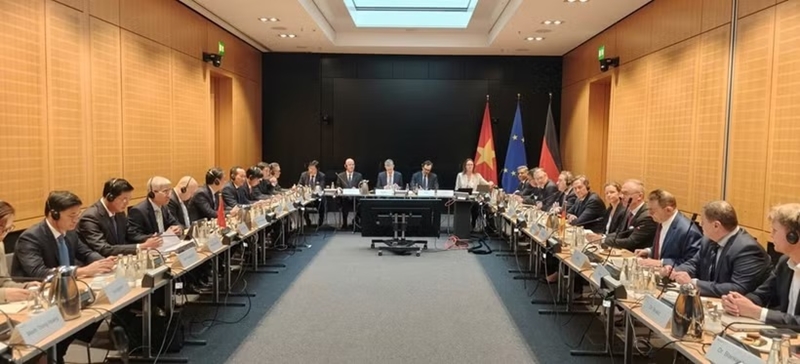
An overview of the working session |
He expressed Viet Nam's wish to establish a substantive and long-term channel for exchanges between the two countries' state management agencies and business communities in the railway sector.
Alongside quality, safety, investment efficiency and the ability to meet the technical requirements of the North-South high-speed railway project, technology transfer is important, as Viet Nam considers cooperation with foreign enterprises and partners in the high-speed railway sector, Dung stressed.
The official emphasized that Viet Nam is at a particularly important stage in preparing the project's feasibility study report. Therefore, studying and selecting modern, integrated, safe and efficient technologies suited to Viet Nam's conditions, controlling lifecycle costs, organizing project management, training human resources and building independent operation and maintenance capacity will be decisive to the project's long-term effectiveness.
Dung called on German businesses, including Siemens Mobility, Deutsche Bahn (DB) and members of the German Railway Industry Association, to study substantive cooperation models with Viet Nam that go beyond the supply of products, equipment and services to include technology transfer, human resources training, development of domestic enterprises and supply chains, and the gradual development of Viet Nam's capacity to manufacture, operate, maintain and master railway technologies.
He noted that the scope of technology transfer, human resources training, supplier development, and the establishment of manufacturing and maintenance facilities in Viet Nam are also areas that Viet Nam has identified for further in-depth study during the current project preparation phase.
Regarding the German Federal Ministry for Transport, the Vietnamese side proposed sharing experience in high-speed railway network planning, investment models and project implementation, the division of responsibilities among state management agencies, safety authorities, owners and infrastructure managers, and the control of total investment, schedules, quality and risks in major projects.
The two sides discussed systems of standards and technical regulations, independent safety assessment and certification, as well as safety management during railway operations.
With the German Ministry for Economic Affairs and Energy, the Vietnamese side expressed interest in models for mobilizing finance, export credit, risk guarantees, and green finance, as well as the potential to combine technological solutions, financing and services for large-scale railway projects.
Regarding Deutsche Bahn (DB), the Vietnamese side proposed exchanges of experience in the management, operation and maintenance of high-speed railway systems, lifecycle infrastructure asset management, transport organization and station management.
As for Siemens Mobility, Viet Nam is interested in comprehensive solutions covering rolling stock, electrification, signaling and information systems, train control, telecommunications, depots, maintenance, and indicators related to reliability, safety and lifecycle costs.
Building on sound relations between Viet Nam and Germany, as well as Germany's strengths in the railway sector, Dung said the two sides still have considerable room to develop practical cooperation programs, contributing to the development of a modern, integrated and sustainable railway system in Viet Nam.
The Vietnamese side also proposed the two sides maintain coordination contacts and organize further in-depth exchanges on technology, technical standards, management and operation models, human resources training and technology transfer.
On the occasion, the Ministry of Construction's delegation conducted a field survey at Berlin Central Station (Berlin Hauptbahnhof), learning about the organization and operation of the station and its connectivity between high-speed, intercity and urban railways and other forms of public transport.
The Vietnamese side focused on studying passenger flow management, the arrangement of multi-level transport spaces and convenient connectivity among different modes of transport. It also examined the model of integrating transport functions with commercial services, public amenities and urban development around the transport hub.
These experiences provide useful references for planning the station network of the North-South high-speed railway project, as well as for promoting transit-oriented development (TOD) in Viet Nam.
Source: VNA