The meeting was part of General Secretary of the CPV Central Committee and State President To Lam’s trip to China for the 33rd APEC Economic Leaders’ Week and bilateral engagements.
Ngoc pointed to the major orientations agreed by Party General Secretary and President To Lam and General Secretary of the Communist Party of China Central Committee and President of China Xi Jinping during their November 17 talks in Shenzhen, including cooperation in education, culture and people-to-people exchanges.
    |
 |
|
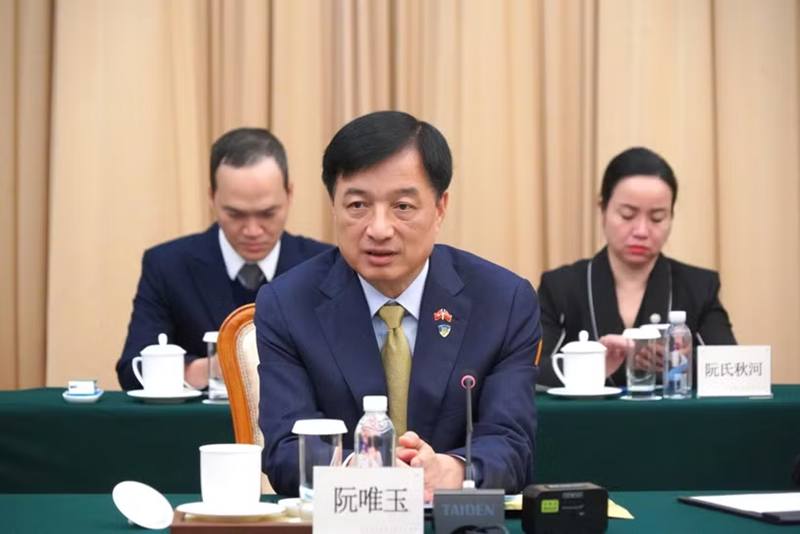
Head of the CPV Central Committee’s Organization Commission Nguyen Duy Ngoc speaks at the meeting. |
Viet Nam treats human capital, science and technology, innovation and digital transformation as drivers of national development, prompting new demands for personnel affairs, including the need for officials with technical expertise and stronger leadership capabilities across Party committees, he said, adding that Viet Nam wants to draw on Yunnan’s experience in this regard.
According to him, the CPV always considers personnel affairs “the key of all keys.” A resolution adopted at the 14th CPV Central Committee’s fourth plenum calls for a comprehensive overhaul of personnel affairs, covering recruitment, performance assessment, training, professional development, succession planning, rotation and promotion.
On digital platforms, Viet Nam is seeking to reinforce Party members’ accountability and exemplary conduct, while intensifying efforts to combat harmful and misleading content, he said.
Zhao, in reply, outlined Yunnan’s approach to Party building, which centers on raising the quality of officials, consolidating Party organizations at all levels and attracting talent to support socio-economic development. Cooperation with Vietnamese localities has expanded in recent years, particularly in personnel training, talent exchanges, science and technology, and youth engagement.
For grassroots, ethnic minority and border officials, Yunnan combines centralized courses with continuous professional development, tailoring training to operational needs and using practical assignments to test their capabilities. The province also uses grassroots postings, remote areas and border communities as testing grounds for younger officials, allowing their performance to be assessed under demanding conditions, she said.
According to Zhao, Yunnan’s talent strategy is built around five-year plans linked to its broader socio-economic development agenda. The province has decentralized decisions on recruitment, deployment, evaluation and compensation, while using local industrial strengths and workforce demand to attract and retain highly skilled professionals. It also facilitates personnel movement between the public and private sectors, subject to tighter oversight regulations.
Cooperation with Viet Nam since 2023 has included a series of training courses on Party building, industrial development, trade and economic cooperation, rural development, poverty reduction and border management. Yunnan’s Party School and other provincial training establishments have maintained exchanges with the Ho Chi Minh National Academy of Politics and political schools in Viet Nam’s border provinces.
The province will continue offering advanced training courses based on Viet Nam’s requirements, she said.
In sci-tech governance, Zhao said Yunnan established the provincial Party Committee’s Science and Technology Commission, jointly chaired by the provincial Party Secretary and Governor.
Ngoc outlined Viet Nam’s approach to placing Party committee leaders directly in charge of guiding and overseeing the sector. He also cited the “Digital Literacy for All” campaign as part of efforts to raise awareness of science, technology and digital transformation among officials at every level.
Minister of Education and Training Hoang Minh Son cited around 1,000 Vietnamese students currently enrolled at educational establishments in Yunnan and welcomed the progress made in training collaboration.
He urged Yunnan to share its experience in how universities identify and develop talent, as well as in the governance of higher education establishments. Viet Nam wants to expand training partnerships in fields requiring advanced skills, particularly science and technology, innovation and digital transformation, while stepping up joint research and technology transfer.
In closing, Ngoc thanked Yunnan for supporting training courses for officials from Viet Nam’s border localities and called for broader cooperation grounded in friendship and mutual trust, saying this would contribute to stronger ties between the two Parties and countries.
Zhao welcomed the Vietnamese delegation’s proposals and said Yunnan is ready to deepen cooperation with Vietnamese localities in personnel training.
Source: VNA