The top leader of Viet Nam underscored that the development of science, technology, innovation and high-quality human resources is no longer simply an option but an imperative for Viet Nam to achieve the aspiration of becoming a developed, high-income country by 2045.
He noted that the Party and State have established a new development model in which knowledge, science and technology, innovation, digital transformation and international integration are identified as major growth drivers of the economy.
    |
 |
|
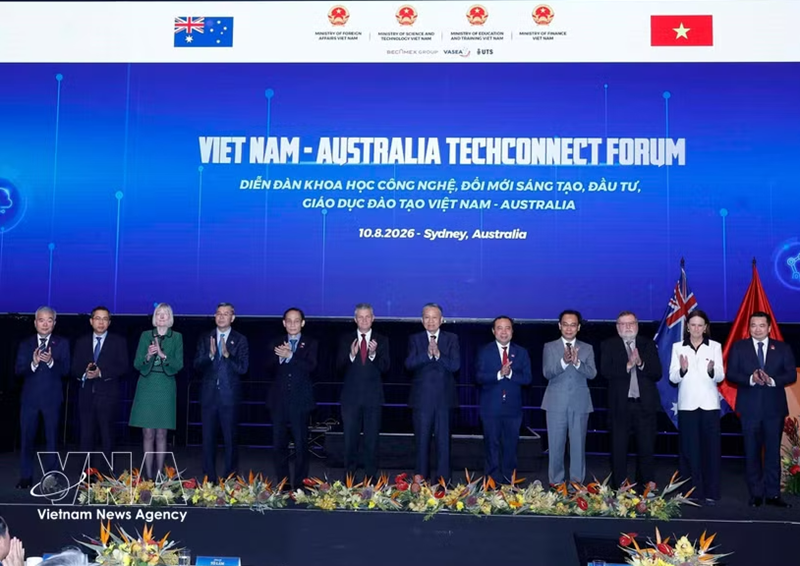
General Secretary of the Communist Party of Vietnam Central Committee and State President To Lam (sixth from right) and delegates at the Vietnam-Australia Techconnect Forum in Sydney on August 10 |
Recent important decisions adopted by the Communist Party of Viet Nam Central Committee further affirm the determination to renew development thinking, improve institutions, build an independent and self-reliant economy in combination with deep international integration, promote the private economic sector, and effectively attract international resources, particularly high-quality investment, advanced technologies, modern management expertise and high-quality human resources, he said.
Viet Nam is shifting from attracting investment to pursuing joint development, from receiving technology to co-creating technologies, and from participating in value chains to gradually securing higher value-added positions in global value chains, General Secretary and State President To Lam underlined.
He highlighted Australia as one of the partners with strengths that Viet Nam particularly values and wishes to work with in this development process. The two countries possess strategic advantages and complementary strengths that naturally reinforce each other.
He suggested that the two sides should shift from cooperation to co-creation, from technology transfer to joint research and development, and from links among individual organizations to connecting their innovation ecosystems, he said.
He called for the building of a regional innovation ecosystem in which businesses, universities, research institutes and investment funds can connect, innovate and develop together.
The General Secretary and State President proposed that the two countries develop and implement a long-term strategy for connectivity in science, technology and innovation, making it a new pillar of the Viet Nam-Australia Comprehensive Strategic Partnership.
The two sides should expand joint research programs and strengthen links among research centers, universities, businesses and innovation investment funds, while establishing joint research networks in priority fields such as AI, semiconductors, digital technology, biotechnology, quantum technology, clean energy, strategic minerals and the marine economy.
They should also promote two-way investment in high-tech industries, establish research and development (R&D) centers, joint laboratories, business incubation programs and commercially viable innovation projects, while developing financial mechanisms to support joint research and share research risks towards co-development and co-investment.
"Viet Nam encourages high-quality Australian investment in its market, including in green financial products, digital infrastructure, data and innovation centers, while seeking stronger technical support and experience sharing in developing an international financial center," he noted.
The two countries should expand cooperation in training high-quality human resources, particularly engineers, scientists, technology experts and innovation managers; strongly encourage exchanges of students, postgraduates and experts; closely link training and research with business needs; and establish bilateral mechanisms and annual forums for policy dialogue, experience sharing and cooperation among the “three parties” – the State, universities and businesses.
|
|
 |
|
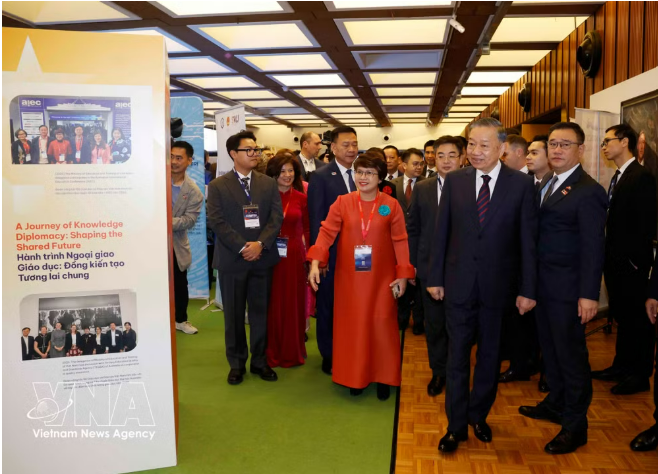
General Secretary of the Communist Party of Vietnam Central Committee and State President To Lam and delegates visit an exhibition showcasing achievements in cooperation between Vietnam and Australia across the fields of science and technology, innovation, investment, and education. |
General Secretary and State President To Lam expressed his belief that with the determination of the two governments and the engagement of businesses, universities, research institutes and scientists, the two sides would achieve new breakthroughs and help make Viet Nam-Australia relations a model for cooperation in science, technology, innovation and human resource development in the region and the world.
At the forum, Viet Nam’s Minister of Science and Technology Vu Hai Quan proposed that the two sides focus resources on areas of strength and strategic technologies, including artificial intelligence (AI), semiconductors, cybersecurity, quantum technology, biotechnology, clean energy and, particularly, marine technology.
He stressed the importance of developing a seamless cooperation chain for each research project, from market needs and testing to commercialization. The two sides should continue developing the Centre for Strategic Technology into a shared platform while connecting venture capital funds and technology financing sources so that promising inventions can move directly from laboratories to the market.
Viet Nam and Australia should also step up cooperation in the digital economy and digital transformation linked with commercialization and market access for businesses. The two sides should select specific sectors and businesses to implement digital transformation and AI application projects, particularly for small and medium-sized enterprises (SMEs). Each project will both address practical business challenges and provide evidence and data to help the governments formulate better policies, he said.
He also proposed developing joint research teams and laboratories and programs enabling scientists to work directly with businesses.
Speaking at the event, Australian Assistant Minister for Foreign Affairs and Trade and Assistant Minister for Immigration Matt Thistlethwaite said scientific and technological advances are at the heart of human progress, economic growth and improvements in quality of life.
For Viet Nam, science and technology will drive continuous economic development, while innovation is central to the country’s national growth plans, he noted.
Thistlethwaite spoke highly of Politburo Resolution No. 57-NQ/TW on breakthroughs in science, technology, innovation and national digital transformation, saying scientific and technological progress would help countries move forward and overcome challenges.
Within the framework of the Viet Nam-Australia Comprehensive Strategic Partnership and Australia’s Southeast Asia Economic Strategy to 2040, the two sides are exploring more ways to cooperate and invest in science, research and innovation, prioritizing bilateral initiatives that promote economic outcomes, social inclusion, sustainability and environmental protection, he said.
At the forum, businesses from the two countries exchanged cooperation documents and announced new initiatives.
On the occasion, Vietjet Air officially signed a cooperation agreement with Western Sydney International Airport and announced the launch of a direct route from Ho Chi Minh City to Western Sydney International Airport from January 2027. The new route is expected to boost economic, investment, trade and tourism ties, people-to-people exchanges and further concretize the Viet Nam-Australia Comprehensive Strategic Partnership.
Source: VNA