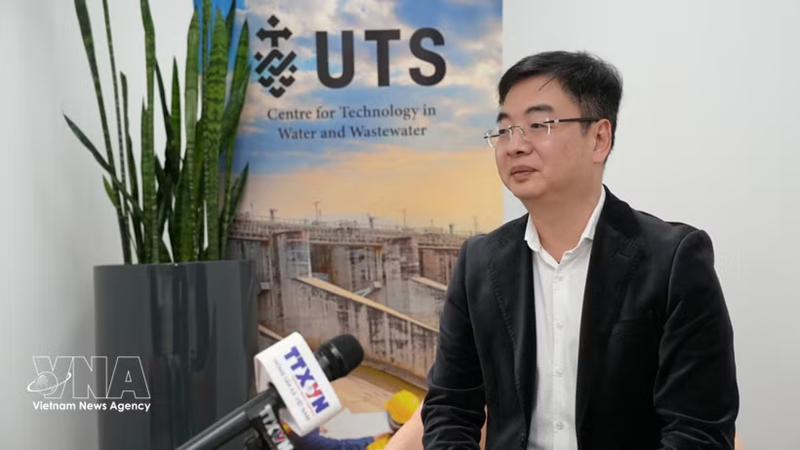
Speaking to Viet Nam News Agency correspondents in Sydney, Long, who is also Chairman of the Viet Nam-Australia Scholars & Experts Association (VASEA), said the visit comes at a time when Viet Nam's development position and aspirations have undergone major changes.
Viet Nam previously relied largely on its labor advantage and traditional growth drivers, but science, technology, innovation and digital transformation have now been identified as key engines for a new stage of development, towards higher economic growth, he said, noting that this direction is reflected in the Politburo’s Resolution No.57-NQ/TW and the agenda of the top Vietnamese leader’s visit to Australia.
    |
 |
|
Prof. Nghiem Duc Long from University of Technology Sydney (UTS), who is also Chairman of the Viet Nam-Australia Scholars & Experts Association (VASEA) |
Long highlighted the Tech Connect Forum as one of the key activities during the visit, saying its inclusion demonstrates that science, technology and innovation are no longer a standalone area of cooperation but are gradually becoming new drivers of the bilateral ties.
Australia is a suitable partner for Viet Nam’s development orientation as it boasts advanced science and education, a strong innovation ecosystem and an open environment for international cooperation. Viet Nam, meanwhile, has a high-quality workforce, a dynamic market and strong demand for technology transfer and research commercialization. Such complementarity provides an important basis for elevating bilateral science and technology cooperation, he said.
Long expects science, technology and innovation to become an increasingly important pillar of the bilateral relations, which have traditionally been known for cooperation in trade and education.
He identified artificial intelligence (AI), semiconductors, automation and smart manufacturing, strategic minerals, high-tech agriculture, clean energy, and water and environmental technologies as areas with significant cooperation potential.
In AI, the two sides could develop solutions for manufacturing, agriculture, healthcare and urban management. Australia has strengths in semiconductor materials research, specialized chip design, testing and human-resource training, while Viet Nam is seeking deeper participation in the global semiconductor value chain, he noted.
Long stressed that the priority should not be the number of cooperation areas but the ability to establish long-term programs with clear implementation mechanisms. An effective ecosystem requires coordinated participation by the Government, universities, research institutes and businesses, with the State providing policies, research institutions generating knowledge and enterprises bringing technologies to the market.
Long said he is also scheduled to meet General Secretary and President To Lam on this occasion. Representing VASEA members, he hopes to express their desire to contribute more to the country's science, technology and innovation development.
According to the expert, VASEA plans to propose making Tech Connect Viet Nam-Australia an annual event, turning it into a strategic forum where governments, universities, research institutes and businesses from both countries can connect and develop concrete cooperation programs.
The association also proposes mechanisms to attract Vietnamese scientists and experts overseas, including those capable of serving as “chief engineers” to help address major national challenges. It also recommends developing financial tools and platforms to support innovation, enabling research outcomes and technological ideas to be commercialized and developed into valuable products and businesses.
Long said Viet Nam should continue strengthening links among the State, research institutions and businesses while expanding connections between Vietnamese experts in Australia and domestic organizations and enterprises. He described the Vietnamese community in Australia as an important source of knowledge, science, technology and innovation, noting that many Vietnamese-origin scientists, experts and entrepreneurs work at leading universities, research institutes and businesses.
As VASEA chairman, Long said the association will continue serving as a bridge between Vietnamese agencies and Australian universities, research institutions, businesses and experts. He expressed hope that the visit will open a new chapter of cooperation, enabling Vietnamese intellectuals and experts in Australia to contribute more effectively to national development and helping science, technology and innovation become an important driver of the Comprehensive Strategic Partnership.
Source: VNA